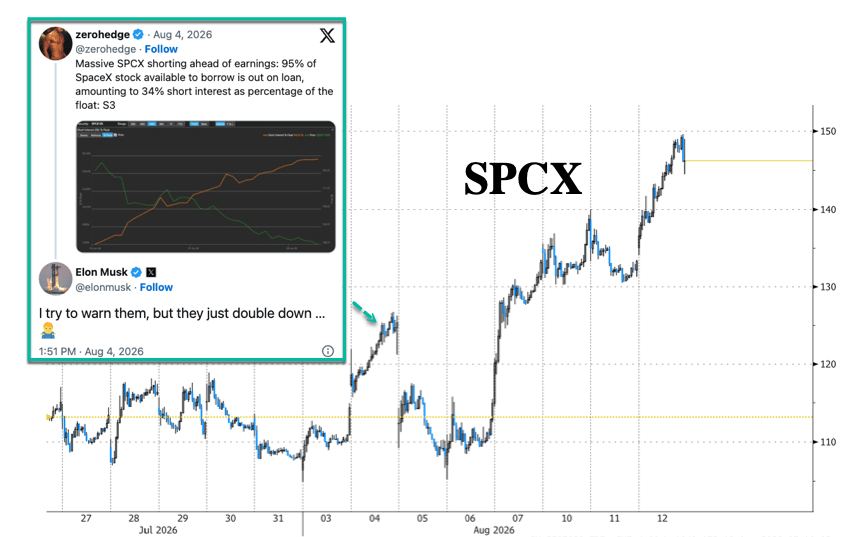
SpaceX shares have jumped 35% over five sessions and 22% since Elon Musk responded to our X post on the “massive SPCX shorting,” which cited S3 data. He said, “I try to warn them, but they just double down ...”

The post-earnings squeeze has pushed SPCX well above its $135 initial public offering price, easing concerns that future lockup expirations could overwhelm demand, which was certainly the talk of the town across institutional desks and on CNBC.
About 911.5 million shares became eligible for sale on Aug. 6, more than the number issued in SpaceX’s record $86 billion IPO in June.
Ahead of Aug. 6, Peter Singlehurst, head of Baillie Gifford’s private companies team, commented on the first round of lockup expirations, saying, “We’ve never seen anything like it. We’ve never seen anything of this scale, and we’ve never seen a lockup phased in this way,” adding, “We’re in uncharted waters.“
SpaceX staggered its lockup expirations across nine dates to mitigate potential market impact. As many as 319 million additional shares will be released Aug. 20, followed by similarly sized blocks over the coming months. Musk’s 6.4 billion shares remain restricted until June 2027.

Related:
HSBC’s Lockup Timeline

“Once investors realized after that first day that it’s not going to go into free fall, then they realized they could kind of go back and reassess what happened in the quarter and realize that things are moving along,” said Gene Munster, managing partner at Deepwater Asset Management, which holds SpaceX shares.
The stock had tumbled before last week’s first expiration, though traders attributed much of that decline to higher-than-expected artificial intelligence spending disclosed in SpaceX’s first earnings report as a publicly traded company. Better-than-expected revenue and a smaller loss helped shares recover once fears of insider selling.
Musk told investors that AI/rocket company could reach an annual revenue run rate exceeding $100 billion by year-end and generate $1 trillion in revenue by 2030, or possibly 2029.
“The earnings release was pretty surprising to the upside, and I think that’s the antidote to shares coming on the market,” said Andrew Plum, managing partner and investment committee head at Loxahatchee Capital, which holds SpaceX shares.
Plum noted, “You can have very good financial news coming from the company that’s going to attract new buyers at these levels, which will allow those shares to exit at a reasonable price and not to put too much pressure on the stock.”
Here’s how Wall Street currently views the stock:

Looking ahead, UBS analyst Gavin Parsons provided color on the next Starship launch, slated for late August:
While SpaceX has not yet officially scheduled test Flight 14, an FCC permit application sets 8/28/26 as a target launch date – aligned with earnings call commentary targeting late August for the flight. Per Elon Musk, Flight 14 will target orbit, deploy operational Starlink V3 satellites, and attempt an upper stage/Ship catch. We do not expect a booster catch attempt but see this possible with Flight 15 – a milestone critical to achieving full and rapid reusability. As SpaceX achieves Starship milestones, it enables the ramp-ups in both Connectivity and AI, the primary drivers of growth. Watch the launch via SpaceX stream, read up on our Buy thesis in our Initiation Report, read our Flight 13 recap, and see below for more Flight 14 detail.
Primary test objectives are likely to include the successful launch, achieving orbit, deploying operational Starlink V3 satellites, and catching the upper stage Ship.
- Date: The FCC permit application for Flight 13 originally targeted 5/29, and the flight occurred 7/24, so this is just one indicator that a launch could occur in August. Flights slip for many reasons, but the cadence is generally accelerating, as late August would be a five week turnaround. Elon suggested daily Starship flights is possible within 2027; this would be upside to our more conservative estimate of 32 flights in 2027.
- Curiously the FCC application states “The 1st stage booster will return to the launch site” and does not reference the 2nd stage, which the Flight 13 application did.
- The heat shield problem is solved per Elon (in regard to full and rapid reusability), which he suggested is the single biggest problem to achieving that capability. We expect iterative improvement to continue but the intact tiles on Ship 40 are clearly visible on the vehicle.
- Starlink V3 operational deployment: unclear exactly how many satellites will be deployed, but we think somewhere greater than the 20 on Flight 13 but below the 60 we estimate Starship will eventually have the capability to carry. Elon indicated 1,000 operational V3 satellites is possible within 1H27 – as with our more conservative launch assumption (which is the bottleneck) – this would be upside to our 540 estimate if achieved.
Status of the equipment
The test flight stack will likely be comprised of Booster 21 (Super Heavy booster) and Ship 41 (Starship upper stage).
- Booster 21 is awaiting engine installation in Mega Bay 1. Stacking was completed in late June and cryogenic proof testing was completed on July 20th. We do not.
Professional subscribers can read more on SPCX here at our new Marketdesk.ai portal.