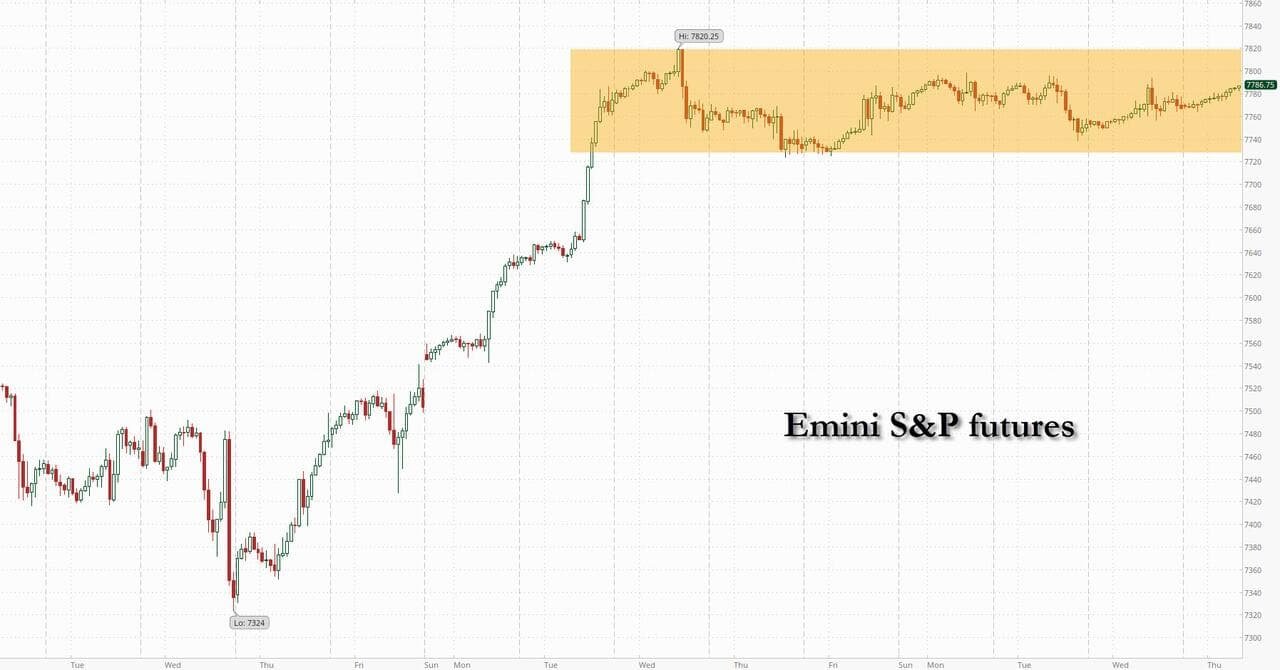
Futures are higher again, although trading in a narrow range for the past week just below all time highs, with Tech flat following disappointing earnings from CSCO. As of 8:00am ET, S&P 500 futures add 0.2% while Nasdaq futures are unchanged as Cisco shares dropped 6.4% in premarket trading after earnings failed to impress. Elsewhere, Semis are flat, Memory is lower, with Mag7 / Software trading up. Cyclicals and Defensives are trading higher with weakness in Energy / Materials; AI theme remains bid. Price action in Asia was upbeat and again characterized by bubbly tech enthusiasm just days after the last Korean bubble popped, with benchmarks in South Korea, Japan and Taiwan all advancing, and the Kospi re-entering a bull market, up 20% from its late July lows. European stocks are grinding higher with the Stoxx 600 up 0.2%. Brent crude is down 1.7%, pausing its recent rally. Newsflow remains light and the impasse over the Strait of Hormuz is dragging on. Weaker energy prices are dragging US yields lower across the curve with more price data due today via PPI metrics. The Bloomberg Dollar Spot Index is flat as the low vol environment in FX markets continues. USD/JPY is steady following a report that the government is supportive of a faster BOJ hike. Spot gold is down 0.6% and back on a $4300/oz handle. JPM says to keep an eye on the Retail investor as the bank’s flows data show an uptick from 4%-ile to 64%-ile but with a shift away from Tech to macro themes, eg, gold. Today’s US economic data calendar includes weekly jobless claims and July PPI (8:30am). Fed speakers scheduled include Cleveland Fed’s Hammack (8:15am) and Richmond Fed’s Barkin (8:40am)

In premarket trading
In other corporate news, Anthropic is in talks to buy the artificial intelligence startup Decart AI for about $6 billion, according to people familiar with the matter. Kenneth Dart’s Candle Lake launched a mandatory cash takeover offer for Evolution valuing the Swedish betting company at about 132 billion kronor ($13.8 billion).
Futures rise as a benign, inline CPI print kept the path clear for equities, while a powerful rally in Asian chip stocks – South Korea’s Kospi has now surged roughly 22% from its July low – has handed US tech a strong lead-in. The question for the session is how broadly that strength holds up once US trading gets underway: Cisco is sliding pre-market after its first full-year AI revenue forecast underwhelmed investors given the scale of its order book, while Cerebras is getting smashed despite raising its annual sales outlook, as traders questioned how quickly the AI infrastructure boom will translate into revenue.
As Bloomberg notes, investors are increasingly discerning between companies already turning the data-center boom into revenue and those where they are still being asked to look further out. The reaction to Cisco and Cerebras suggests the next batch of AI earnings may face a higher bar. Headline orders and exposure to the capex boom may no longer be enough on their own, with investors likely to focus more closely on how quickly demand converts into revenue, what it does to margins and whether earnings can keep pace.
Spending remains huge and demand remains real. But if that dispersion keeps widening, the next leg of the AI trade will be driven by companies that can actually explicitly deliver on it.

Attention later in the day will turn to producer price data, which can serve as a leading indication of consumer inflation. Traders will also be watching the results of a 30-year Treasury auction, with the $25 billion offering tipped to price at the highest interest rate in 25 years.
Headline PPI likely grew 0.2% in July, but Bloomberg Economics expects details in the report to show pockets of easing inflationary pressure.
“Things are going to get much more expensive, and that’s going to be a challenge for central banks going forward,” said Michael Hewson, a senior market analyst at iForex.
In politics, Iran reorganized its military to be more aggressive abroad as talks on ending the war with the US remain mired in stalemate, a sign that Tehran is preparing for a protracted era of regional conflict. Brent crude slipped to about $87 a barrel on Thursday. It’s still far from erasing a 12% surge in the previous six days as a deal between the US and Iran to reopen the Strait of Hormuz remains out of reach.
Citigroup strategists raised their full-year earnings forecast for S&P 500 firms, and said revenue trends at the AI capex spenders “should help provide a floor for the AI-influenced portion of the index.” The team led by Scott Chronert boosts EPS target by ~4% to $365. Yet while strong second-quarter earnings were supercharged by “paper gains” in AI investments, this poses risk that losses in those same investments may weigh on quarters ahead, especially for mega-cap tech stocks, according to Ned Davis Research.
European stocks are grinding higher with the Stoxx 600 up 0.2%, boosted by strong corporate earnings and as an easing of Federal Reserve rate hike bets added to positive sentiment. Here are the biggest movers Thursday:
- Adyen shares rose as much as 14%, the most since April 2025 and after the stock lost more than a third of its value from the end of last year to Wednesday’s close
- Mandatum climbed as much as 11%, the most since Feb. 2025, following the investment management firm’s second-quarter results
- Autostore shares rose as much as 27% after the maker of automated storage and retrieval systems delivered a strong beat across the board in the second quarter and outlined revenue guidance for the year that surpassed estimates
- Maersk shares rose as much as 8.7%, hitting their highest level since August 2022, after the shipping giant significantly beat estimates in the second quarter and hiked its earnings guidance for the year
- TKMS gained as much as 12% to a new record high, adding to the stock’s strength after Wednesday’s results, as Bernstein raises its rating on the naval shipbuilder to outperform from market-perform
- Intrum shares rose as much as 15% after analysts at DNB Carnegie reinstated coverage of the Swedish credit management service provider with a buy rating following its recent rights issue
- Pandora rose as much as 6%, the most since early May, as the Danish jewelry maker exceeds expectations in the second quarter
- Swissquote dropped as much as 12%, the most since May 2022, after the Swiss online broker lowers its full-year outlook due to weak crypto income
- Antofagasta shares fell as much as 6.2%, the most in nearly a month, after the copper miner reduced its production guidance citing weather disruption at its Los Pelambres mine in Chile
- Orsted shares fell as much as 3.5% after the Danish offshore wind developer’s second-quarter results
- HelloFresh shares fell as much as 3.4% after the meal kit provider reported another decline in orders in the second quarter and said full-year revenue growth was likely to come in at the lower end of the guided range
Price action in Asia was upbeat and again characterized by tech enthusiasm, with benchmarks in South Korea, Japan and Taiwan all advancing. Asian stocks advanced, led by chipmakers, after US inflation came in line with expectations and eased concerns of an imminent Federal Reserve interest rate hike. The MSCI Asia Pacific Index climbed as much as 1.1% to the highest since July 6, led by South Korea’s SK Hynix Inc. and Samsung Electronics Co. Ltd. The nation’s Kospi Index rose as much as 4.8%, pushing the gauge into a technical bull market. Major indexes in Japan, Taiwan and China also advanced. South Korean and Japanese technology stocks “are benefiting in part from this positive movement” after the tech-heavy Nasdaq 100 gained, said Hiroshi Namioka, chief strategist at T&D Asset Management, adding sentiment is improving after the US CPI data. The renewed buying in tech and chip shares comes as US tech earnings are making investors more upbeat that the momentum in AI-rally will continue after the selloff in the past few months.
In FX, the Bloomberg Dollar Spot Index is flat as the low vol environment in FX markets continues. USD/JPY is steady following a report that Japan’s government is supportive of a near-term rate hike by the Bank of Japan, with the next move likely either in September or October, according to people familiar with the matter.
- USD/JPY steadied at 159.42; Japan’s government is said to support faster BOJ rate hikes
- EUR/NOK rose as much as 0.4% to 10.9856; Norway’s central bank kept borrowing costs steady for a second meeting
- NZD/USD falls as much as 0.6% to 0.5821, leading G-10 losses against the dollar, after a drop in New Zealand’s two-year inflation expectations
- GBP/USD dropped as much as 0.2% to 1.3474; The UK economy unexpectedly expanded in June
In rates, treasuries are near session highs in early US trading with oil prices down about 2%. This week’s curve-steepening move extends as long-end tenors lag ahead of $25 billion 30-year new-issue bond auction at 1pm New York time. Treasury yields richer by up to 3.5bp across belly of the curve, which outperforms, steepening 5s30s by around 1bp vs. Wednesday’s close; spread is widest since May 20 ahead of the 30-year bond auction, providing additional concession that may help the sale. US 10-year yield near 4.67% is about 3bp lower on the day, outperforming bunds and gilts in the sector by 0.5bp and 2.5bp. This week’s Treasury auctions conclude with $25 billion 30-year new issue set to draw the highest yield for the tenor since 2001; Wednesday’s solid 10-year note sale tailed by just 0.1bp. IG credit new-issue slate is empty so far; Wells Fargo led a five-item, $6.1 billion docket on Wednesday following the busiest two-day stretch since January. Wednesday’s issuers paid about 5bp on offerings that were 3.9 times covered. Thursday’s economic data slate includes weekly jobless claims and July PPI, and scheduled Fed speakers include Hammack and Barkin.
In commodities, Brent crude is down 1.7%, pausing its recent rally. News flow remains light and the impasse over the Strait of Hormuz is dragging on. WTI crude oil futures are approaching $81/bbl vs session high near $83, supporting Treasuries. Weaker energy prices are dragging US yields lower across the curve with more price data due today via PPI metrics. Spot gold is down 0.6% and back on a $4300/oz handle.
Today’s US economic data calendar includes weekly jobless claims and July PPI (8:30am). Fed speakers scheduled include Cleveland Fed’s Hammack (8:15am) and Richmond Fed’s Barkin (8:40am)
Market Snapshot

Top Overnight News
- SpaceX has surged 35% after its first lockup expired, adding about $500 billion in market value. BBG
- Prices for Japan’s corporate goods continued to rise at an elevated pace in July, keeping high cost pressure on companies, as central bank officials continue to consider whether to proceed with additional interest rate hikes to contain inflation. BBG
- Anthropic investors expect the AI start-up to float at a valuation of $2tn or more in October, a figure that would eclipse SpaceX and make the AI lab’s debut the largest ever initial public offering. FT
- Japan’s government supports a near-term BOJ rate hike, probably in September or October, people familiar said. Traders took note, raising the odds of a 25-basis-point move next month to about 75% and briefly lifting the yen. BBG
- The US is set to sell $25 billion of 30-year bonds at the highest borrowing cost since 2001. Lofty financing costs are feeding through to the broader economy, adding to pressure on Donald Trump ahead of the midterms.
- South Korean retail investors must now complete a week-long course before they can start trading in single-stock funds, as regulators tighten restrictions on products blamed for exacerbating wild swings in one of the world’s most volatile stock markets. FT
- Global food supplies come under threat as Russia ramps attacks on Ukraine ports and ships in the Black Sea. RTRS
- The UK economy unexpectedly expanded 0.3% in June boosted by sunny weather and World Cup football. Over the whole of the second quarter, it grew 0.4%. BBG
- Colombia’s government asked the US to join its fight against drug gangs, authorizing joint military operations against so-called “narco-terrorism,” Pete Hegseth said. BBG
- The Mexican government is pushing the U.S. to lower tariffs on North American automobiles as part of conversations over reworking the U.S.-Mexico-Canada Agreement, according to people familiar with the matter. The move is a counterproposal to the Trump administration after its push to require more American-made parts in vehicles. WSJ
- US President Trump signed a memorandum authorizing US law enforcement to use cyber tools to target criminal organizations operating in foreign jurisdictions, according to The White House.
- The US race to compete with China on lithium runs into water battles, with Trump-backed plans to build production of critical elements undercut by community resistance: FT.
- BofA Total Card Spending (w/e Aug 8th) +6.2% Y/Y (prev. 4.7%); the rebound in spending over the past 3 weeks is consistent that the mid-July slump was a blip
A more detailed look at global markets courtesy of Newqsuawk
APAC stocks were predominantly in the green as the region took its cue from the mild positive handover from Wall Street, where equities were underpinned by earnings, and September rate hike bets were unwound after in-line CPI data. ASX 200 bucked the trend amid various earnings releases, while RBA Assistant Governor Kent stuck to the hawkish-leaning script in which he noted the possibility of rates increasing further if risks materialise, but acknowledged evidence suggests that monetary policy in Australia is somewhat restrictive, and that the tightening earlier this year is working. Nikkei 225 rallied amid the tech momentum and following softer-than-expected PPI data for Japan. KOSPI outperformed as renewed semiconductor strength lifted the index into a technical bull market. Hang Seng and Shanghai Comp diverged, with sentiment initially dampened in Hong Kong as participants reflected on earnings, including mixed results from Tencent, while gains in the mainland were contained after the PBoC reiterated its support pledges in its quarterly implementation report, but refrained from 7-day reverse repo operations for the third consecutive day.
Top Asian News
- RBNZ plans a paper on modernising New Zealand’s payment system, including potential changes to the current framework
European bourses are firmer across the board, outside of the FTSE 100 given that 19% of the index is trading ex-divs. The positiveness follows on from the constructive tone overnight in Asia. Despite choppiness in China, Lenovo surged some 22% after the Co. reported a 43% increase in revenue to USD 26.94bln, beating expectations of USD 22.33bln. Post-earnings, the CEO said they are to achieve the USD 100bln annual revenue goal ahead of schedule and announced that they are working with Nvidia (NVDA) to launch an AI PC powered by the RTX chip later this year. Sectors point to a more mixed picture. Banks top the sector pile, followed by Consumer Products & Services and Food, Beverages & Tobacco. Basic Resources is the clear sector laggard, with Chemicals and Energy printing modest losses.
Top European News
- UK GDP Growth Rate Prel (Q2 QQ) 0.4% vs. Exp. 0.4% (Prev. 0.6%).
- UK GDP Growth Rate Prel (Q2 YY) 1.2% vs. Exp. 1.1% (Prev. 0.9%).
- UK GDP (Jun MM) 0.3% vs. Exp. 0% (Prev. 0.0%).
- UK GDP (Jun YY) 1.1% vs. Exp. 0.8% (Prev. 1.2%).
FX
- USD stabilises just below 100.00 after gains on Wednesday despite US CPI triggering a small dovish repricing. ING opines the USD strength seen after the data is likely a function of traders rebuilding longs as the set of July data comes to a close ahead of PPI today. Another potential factor could be this week’s quiet markets, which could have triggered some carry demand, especially as the recent data do not imply a clear Fed policy direction. Today, DXY is flat within a narrow 99.91-100.08 range after facing resistance at 100.05.
- JPY saw some strength after Bloomberg sources indicated the Takaichi government is said to support a faster BoJ rate hike. A report which has convinced markets, with interest rate futures now implying a 75% probability of BoJ tightening in September. This could be added to should these remarks come from Takaichi herself. USD/JPY fell c. 30 pips to a 159.18 base, before paring some of the move, now sitting around 159.40.
- NOK saw some weakness as while the Norges Bank left rates unchanged and keeping the door open to further tightening, it signalled inflation progress in the statement. If this progress is reflected in September’s statement, it could imply a removal of the tightening bias and as such has led to the trimming of NOK longs. Despite this, the bank remains slated to hike in September, a view held by Nordea and SEB. EUR/NOK was choppy on the announcement, initially falling 0.2% to a 10.90 base, before reversing the move to a peak just above 10.97.
- NZD is the G10 laggard after soft one year and two year inflation expectations. Kiwi saw pressure throughout the APAC session, rebounding slightly now after surpassing the 100 and 200 DMAs in NZD/USD, reaching a 0.5820 trough.
Fixed Income
- Once again, a contained start for fixed income. Major macro updates relatively light, and nothing that changes the narrative for the complex. Today, the focus is on US PPI for July, which will inform/update the calls ahead of PCE after Wednesday’s CPI; as a reminder, the series sparked a modest dovish reaction in near-term Fed pricing.
- USTs flat in 108-15 to 108-23 parameters, looking to PPI as mentioned before Fed’s Barkin (2027) and Hammack (2026), and while both have spoken recently and updated view post-CPI will be pertinent.
- Bunds in-fitting with the above, newsflow for the bloc has been and is scheduled to remain light. Currently a few ticks firmer in 124.65-83 parameters.
- A similar picture for Gilts, with no lasting reaction at the open to the morning’s GDP series which, in short, was stronger-than-expected for the GDP components aside from an in-line Q2 Q/Q print. However, the series is caveated by a weaker-than-expected breakdown for June and downward revisions to the May GDP series.
Commodities
- WTI Sep and Brent Oct futures are subdued amid a lack of notable US-Iran-related updates. On diplomacy, Pakistan’s key mediator has held a second meeting with Iran’s Foreign Minister Araghchi and is seeking to extend the 60-day truce, according to an informed source cited by Al Arabiya. On the flip side, the Strait of Hormuz authority rejected US claims and said the waterway remains blocked until Iran’s conditions are met, according to Press TV.
- WTI currently resides in a USD 81.64-83.30/bbl range, with prices now under yesterday’s USD 82.40-84.35/bbl. Brent resides in a USD 87.30-89.07/bbl range vs yesterday’s 88.10-90.07/bbl range. Dutch TTF is similarly subdued and back under EUR 60/MWh, with focus in Europe on no storage replenishing ahead of winter, and against the backdrop of Middle Eastern issues.
- Precious metals consolidate amid a lack of macro updates ahead of US PPI. Spot gold trades on either side of its 100 DMA (USD 4,387/oz) in a current USD 4,364-4,450/oz range. Spot silver similarly gives back yesterday’s gains (and more), with the precious metal under USD 64.50/oz vs yesterday’s 66.80/oz high.
- Base metals are also lower across the board amid the summer lull. Elsewhere, Antofagasta lowered its full-year 2026 copper production guidance to 625–655kmetric tons (vs prior from 650–700ktons) following a precautionary weather-related shutdown at its Los Pelambres mine in Chile. 3M LME copper hovers around the USD 14k/t mark in a current USD 13,949.58-14,133.43/t range at the time of writing.
- Romania’s Nuclearelectrica has begun to to disconnect the final nuclear reactor, due to the continued low Danube level.
Trade/Tariffs
- Mexico is pressing the US to reduce tariffs on North American autos as part of discussions over reworking the USMCA, according to people familiar with the matter cited by WSJ.
- Indian Trade Ministry said they are actively in talks with the US on pending trade issues.
Central Banks
- Japanese PM Takaichi’s government is said to support a faster BoJ rate hike, while market sources say the BoJ could raise rates in September or October, according to Bloomberg.
- Norges Bank maintained its rate at 4.25%, as expected; may still become necessary to raise the policy rate. On inflation, the statement said that slower inflation is welcome news, but inflation is still too high, and it is too early to conclude that the inflation outlook has changed materially. The Committee judges that a restrictive monetary policy stance is still needed to bring inflation down to target within a reasonable time horizon.
- RBA’s Kent said the Board sets the level of the Cash Rate it judges will achieve low and stable inflation and full employment, while he added that borrowing costs have increased, mortgage payments have risen and conditions in the established housing market have turned down. Kent stated evidence suggests that monetary policy in Australia is somewhat restrictive, and that the tightening earlier this year is working, but also noted the possibility of rates increasing further if risks materialise.
Geopolitics: Middle East
- A White House official said US sanctions and a naval blockade have left Iran completely bankrupt, and that President Trump has many tools to pressure Tehran in the coming months, according to Al Jazeera citing media reports.
- The Strait of Hormuz authority rejected the US’ claims and said the waterway remains blocked until Iran’s conditions are met, according to Press TV.
- Iran’s Paramilitary Head Basij said the Strait of Hormuz is “under Iran’s control and management”, Fars News reported.
- Pakistan’s Defence Minister met with Iran’s ambassador to Islamabad and called for strengthening bilateral cooperation with Iran, according to IRNA.
- Yemeni Armed Forces announced strikes on Saudi ships and military sites, according to Press TV.
- US President Trump’s administration criticised Israeli Defence Minister Katz’s remarks about maintaining Israel’s occupation of southern Lebanon, stressing the comments contradict commitments Israel made under framework agreement with the US and Lebanon, according to Axios.
Geopolitics: Ukraine
- Russia hit Ukraine’s Izmail port, with port infrastructure is on fire following the Russian attack, according to local authorities.
- Ukraine’s military said they hit Russia’s oil refinery in Bashkortostan, some 1,300km from the border.
US Event Calendar
- 8:30 am: United States Aug 8 Initial Jobless Claims, est. 202k, prior 199k
- 8:30 am: United States Aug 1 Continuing Claims, est. 1794k, prior 1801k
- 8:30 am: United States Jul PPI Final Demand MoM, est. 0.2%, prior -0.3%
- 8:30 am: United States Jul PPI Ex Food and Energy MoM, est. 0.3%, prior 0.2%
- 8:30 am: United States Jul PPI Final Demand YoY, est. 4.9%, prior 5.5%
- 8:30 am: United States Jul PPI Ex Food and Energy YoY, est. 4.1%, prior 4.7%
Central Bank Speakers
- 8:15 am: United States Fed’s Hammack Speaks in Moderated Discussion
- 8:40 am: United States Barkin Speaks on Economic Outlook
DB’s Jim Reid concludes the overnight wrap
For Sale: One pair of eclipse glasses. One careful owner. Used exactly once. Given yesterday’s scramble to get hold of a pair, these could prove to be a superb long-term investment for the next equivalent event to yesterday. The date? Well, the next solar eclipse visible from the UK that’s bigger than yesterday’s arrives on 3 September 2081. If you’re prepared to hold for even longer, the next total solar eclipse over the UK is on 23 September 2090.
Rewinding 64 years, for the last 24 hours, the broad market story has been a modest eclipse of Fed-hike fears, even as the Middle East backdrop has darkened again. US inflation came in broadly as expected in July, which was enough after Friday’s weak employment report to reduce the urgency for another rate increase. The result was a modest rally in front end Treasuries, while another strong performance from semiconductor stocks left the broader S&P 500 (+0.26%) within touching distance of a record high. In fact, in Asia this morning, chip stocks have also continued to boost the KOSPI’s (+4.46%) performance, with the index now up around +22% in the last 10 days. However, long-dated yields barely moved, oil remained close to $90/bbl, European gas jumped and gold climbed as hopes for a rapid US-Iran agreement continued to fade.
The main event was the US CPI report, where headline prices rose by +0.1% month-on-month in July and +3.4% year-on-year. Core CPI increased by +0.2% on the month and +2.5% on the year, with the latter matching its slowest pace since March 2021. It was all in-line with consensus but that still makes it two consecutive relatively encouraging core inflation reports and, when combined with last week’s weaker employment data, leaves less pressure on the Fed to act immediately in September.
There were some reassuring details beneath the headline. Energy and gasoline prices fell for a second consecutive month, grocery prices (-0.1%) declined for the first time since March and supercore inflation rose by a modest +0.2% mom. However, it wasn’t an entirely clean disinflationary report. Core goods prices (+0.2%) saw their largest monthly increase since last September as computer software and accessories prices rose +21.2% year-on-year, their largest increase on record. With memory chips increasingly being diverted towards data-centre demand, it is an interesting reminder that the AI investment boom is not only supporting growth and equities but may also be creating inflation in parts of the consumer technology supply chain.
For the most part, markets focused on the benign headline of the CPI print. Pricing of a September Fed hike fell from 48% to 40%, the lowest it has been since the June Fed meeting shifted the market perspective on hikes. But the overall repricing was modest, with the amount of hikes priced by year-end falling by -1.9bps to 27bps. So less a decisive all-clear on inflation than potential permission for the Fed to remain patient. Our US economists maintain their call for a Fed rate hike in September, though the CPI print together with last Friday’s mixed jobs report reduce the urgency for imminent action.
That distinction showed up clearly in the Treasury curve. The 2yr yield fell -1.4bps to 4.20%, but the 10yr yield inched up +0.5bps to 4.69%, closing about +3bps above its pre-CPI levels. And at the very long end, the 30yr yield rose +1.7bps to 5.26%, closing less than 2bps from the post -2007 high it reached on July 31.
So the CPI report eased concerns about the next Fed move without doing much to resolve the longer-term concerns around deficits, supply, and term premium. That will remain relevant as the Treasury sells $25bn of new 30yr bonds today, with the auction expected to produce the highest yield for a new 30yr issue since August 2001. Yesterday’s 10yr sale had seen $42bn of bonds issued at the highest yield since 2007 at 4.68%. Ahead of that 30yr auction, Treasury yields are a little lower overnight, with the 10yr down -2.4bps.
One reason for continued caution in rates markets is the situation in the Middle East as Iran and the US appear to harden their positions. A Revolutionary Guard general said yesterday that Iran has reorganised parts of its military as part of an “offensive doctrine”. By contrast, US President Trump posted on social media around the European close that the US has “total control” over the Strait of Hormuz as he also talked up the US naval blockade and called Iran “all talk and no action”. In another sign that talks between the US as currently deadlocked, Pakistan’s foreign ministry suggested that the larger peace process has stalled.
While there is little sign of agreement over control of the Strait of Hormuz, sanctions relief or the terms under which maritime traffic might normalize, oil flows through Hormuz have improved a bit from the worst point of the disruption, in part as shuttle transfers have played an increasing role. So that’s helped limit the extent of the upward pressure on oil prices, with both Brent crude (+0.08% to $88.98/bbl) and WTI (+0.08% to $83.27/bbl) little changed yesterday. And they are trading slightly lower this morning, though that still leaves them +6% higher so far this week.
European natural gas was the larger energy mover yesterday, surging +3.89% to €61.02/MWh and taking its gain for the week to +9.86%. In other inflationary news, wheat prices rose +3.57% after a key Russian grain export port on the Black Sea was damaged by Ukrainian drone strikes. With this backdrop, the 1yr euro inflation swap (+1.5bps) rose to a two-week high of 2.43%, even as its US counterpart fell -7.3bps to 1.90% following the CPI print. That said, European sovereign bonds saw muted moves, with yields on 10yr bunds (+0.2bps), OATs (+0.1bps) and gilts (+0.7bps) inching higher, while BTPs (-0.8bps) edged lower.
Meanwhile, US equities were the clearer beneficiaries as concerns over imminent Fed hikes eased. The S&P 500 (+0.26%) closed just -0.12% below its record high from August 7, while its equal-weighted equivalent (+0.16%) reached a new high of its own. Both the Nasdaq (+0.54%) and the Russell 2000 (+0.61%) saw larger gains, while the Mag-7 (-1.05%) lost ground. With a CPI risk event being avoided, there was also a sense of an August lull taking hold, as the VIX volatility index fell to its lowest level since January (-0.73pts to 14.55pts).
The main equity excitement remained in semiconductors, with the Philadelphia Semiconductor Index up +2.49%. That leaves the index up +75.1% year-to-date and +18.7% from its low on July 29 though still -15.3% beneath its June record. The latest gains have been led by stocks benefitting directly from AI spending, underpinned by another strong set of AI-infrastructure results. CoreWeave (+19.28%) and Super Micro (+19.02%) both soared yesterday following their upbeat outlooks on Tuesday evening. Nebius (+34.14%) then added to the positive mood before yesterday’s US open, reporting a +454% year-on-year rise in revenue to $582m, alongside stronger-than-expected margins. Demand for AI computing remains exceptionally strong, even if the escalating cost of supplying it continues to grow just as quickly.
Tencent’s results after the Hong Kong close also offered a positive revenue message out of China, with +11% sales growth, though its shares are down -3.81% this morning as profits were weaker-than-expected as the company stepped up AI capex spending. As a result, the Hang Seng (+0.05%) is broadly flat.
Looking at the broader market moves in Asia this morning, the subdued US CPI release and continued tech-rally are also propelling indices forward. South Korea’s KOSPI (+4.46%) has now recovered from its late July lows, putting the index into a technical bull market. Elsewhere, the Nikkei 225 (+1.75%) CSI 300 (+0.49%) and Shanghai Composite (+0.42%) are also advancing. Only the S&P/ASX 200 (-0.39%) has pulled back this morning.
European stock markets were softer yesterday. The Stoxx 600 fell -0.16%, ending a run of 7 consecutive gains. The CAC 40 lost -0.46%, with the DAX (-0.23%) and FTSE 100 (-0.10%) also slipping. Nevertheless, the major European indices remain very close to recent records, with all four indices within 1% of their highs.
In other asset classes, gold continued its recent rebound, rising +0.87% to $4,408/oz. Gold is now up +8.95% since the end of July, though remarkably it is still up only +2.06% year-to-date.
Turning ahead to today, the main attention will be on the US PPI release for July after yesterday’s CPI print. As a reminder, our US economists expect headline (+0.2% vs. -0.3%) and core (+0.3% vs. +0.2%) to come in close to their CPI counterparts. But as ever, the focus will be on categories like health care services, airfares, and portfolio management which feed into core PCE, because the Fed officially target the PCE measure of inflation. So with pricing for the next Fed meeting still in the balance, all these prints are likely to get a lot of attention.
In terms of the rest of the day ahead, outside of US July PPI, we’ll see initial jobless claims, UK Q2 GDP, EU industrial production. Central bank events include the Norges Bank decision, while the Fed’s Hammack and Barkin will speak. Applied Materials will be reporting its earnings today.