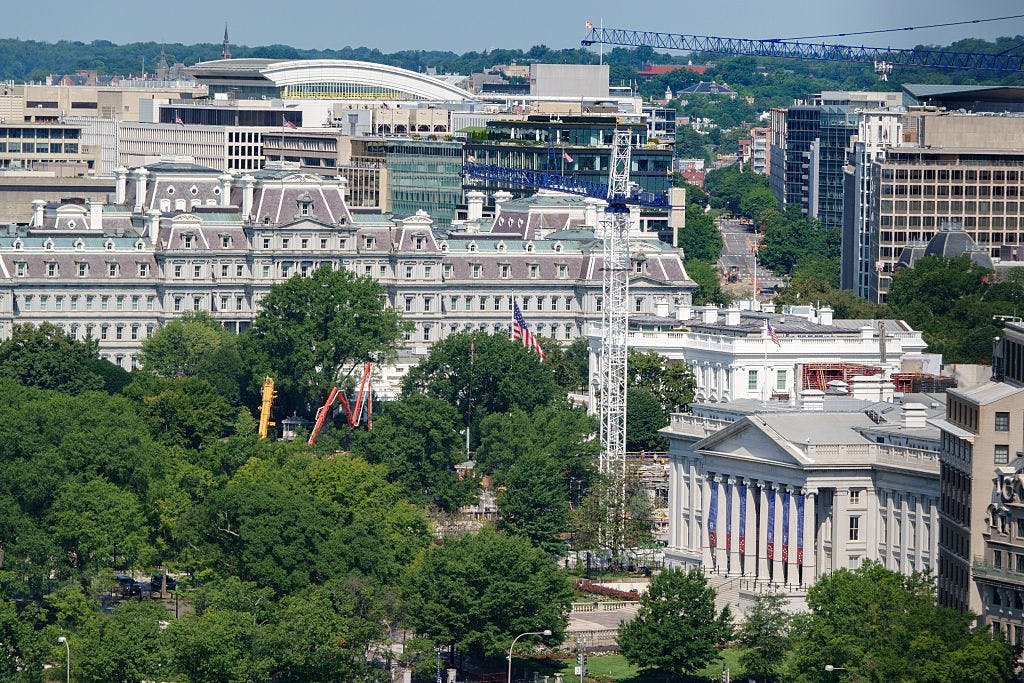
The Supreme Court on Friday temporarily cleared the way for President Donald Trump’s administration to continue construction of the White House ballroom, pausing a lower court order that would have halted above-ground work on the controversial project.
Chief Justice John Roberts issued an administrative stay Friday, preventing a federal district court’s injunction from taking effect while the Supreme Court considers the Trump administration’s emergency request. The order does not resolve the underlying legal dispute or determine whether Trump had the authority to construct the ballroom without congressional approval.
The move is nevertheless a significant victory for the administration, which has argued that construction should be allowed to continue as the case makes its way through the courts. The dispute is likely to head to the full Supreme Court after the U.S. Court of Appeals for the D.C. Circuit ruled earlier this month that Trump could not proceed with the project without authorization from Congress.
That 2-1 ruling by the appeals court held that the decision to construct the massive addition to the White House was ultimately Congress’ to make. “Whether or not a massive ballroom should be constructed is for Congress to decide and is not a matter for Executive self-help,” the appeals court majority wrote.
The court, however, paused its ruling for two weeks to give the administration time to seek relief from the Supreme Court. The Trump administration subsequently asked the justices to intervene. Roberts’ Friday order keeps construction moving while the justices consider that request. The order is an administrative stay, meaning it is temporary and procedural rather than a ruling on the merits of the case. The full Supreme Court could ultimately lift the stay, leave it in place while the case proceeds, or take up the underlying dispute.
The administration has urged the Supreme Court to allow construction to continue, arguing that the project is already substantially underway and that stopping it would interfere with national security.
Solicitor General D. John Sauer described the project in a filing as an “integrated military complex” that includes a secure ballroom space that is “vitally required by national security.” The administration has also argued that the White House requires additional security infrastructure, including facilities designed to protect the president and other officials from potential attacks.
The National Trust for Historic Preservation, which brought the lawsuit against the administration, has taken the opposite position. The group argues that Trump cannot unilaterally demolish portions of the White House and construct a 90,000-square-foot addition without congressional authorization and other required reviews. The trust has accused the administration of attempting to “outrun judicial review” by moving construction forward as quickly as possible.
The administration said in court filings that the project is already roughly 65% complete, with crews working 20 hours a day, seven days a week. About $200 million in private donations has reportedly already been spent or committed to the project. Trump first announced the ballroom project after returning to the White House, describing it as a roughly $400 million project that would be financed primarily through private donations. The administration subsequently demolished the White House’s East Wing last year to clear the site.
The legal battle escalated after U.S. District Judge Richard Leon issued an injunction blocking most above-ground construction. Leon permitted underground work related to security facilities, including bunkers and other national security infrastructure, to continue.
The D.C. Circuit subsequently upheld Leon’s ruling, with Democratic-appointed judges Patricia Millett and Bradley Garcia forming the majority. Trump-appointed Judge Neomi Rao dissented, arguing that the lower court had improperly intervened in the president’s management of the White House.
“Each president is a temporary tenant, not the owner, of the White House and its executive residence,” the majority wrote. Rao countered that the lower court had exceeded its authority. “The district court seized supervision of construction at the White House, and my colleagues affirm this judicial overreach,” Rao wrote.
The Supreme Court’s Friday order does not indicate when the justices will decide whether to take further action. But with the Trump administration appealing the D.C. Circuit ruling, the legal dispute is now positioned to potentially become a full-fledged Supreme Court case.
For now, however, construction continues. The Trump administration has argued that halting the project would jeopardize both the construction schedule and national security, while preservationists maintain that allowing construction to proceed could effectively make the courts’ eventual ruling meaningless if the ballroom is completed before the legal dispute is resolved.
Friday’s order leaves that larger question unresolved: whether Trump has the unilateral authority to transform the White House’s East Wing into a 90,000-square-foot ballroom without first obtaining Congress’ approval.