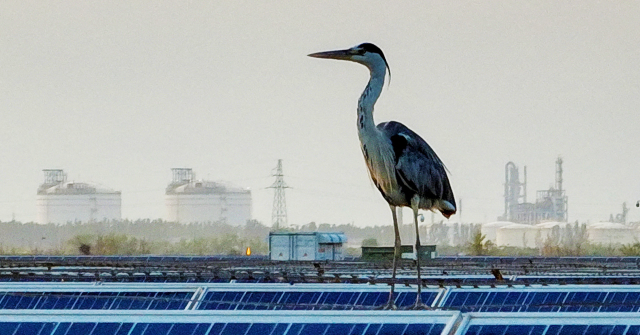
A paper published in Science on Friday found that China’s rapid construction of solar panels has damaged the environment and reduced biodiversity, especially among birds, who have lost habitat space plus foraging and breeding grounds to the vast fields of photovoltaic cells.
The Science paper — produced by researchers from China, Vietnam, and the United States — began with the required genuflections towards the renewable energy industry but admitted that “clean energy also will have a large footprint on nature.”
Researchers studied over 2,000 counties in China and found those with the most solar panels experienced “reductions in bird diversity, primarily due to land conversion.”
“Land conversion” is the preferred euphemism for gigantic fields of solar panels gobbling up land that was formerly used for agriculture or environmental preserves. The U.S. Department of Energy (DOE) has lately been promoting “agrivoltaics,” which means figuring out ways to continue growing crops, herding livestock, and building insect pollinator colonies in the shadow of massive solar panels.
The Science paper, on the other hand, rather bluntly concluded that solar farms ought to be built in deserts and other sparse terrain because they indisputably have a negative effect on vegetation, which in turn harms birds that rely on the vegetation for food and shelter.
China is building solar panels at a more rapid pace than other nations, so the negative effects on biodiversity became apparent quickly in the shadow of vast Chinese solar farms. China’s “solar footprint” now covers acreage “equivalent in size to the U.S. state of Rhode Island.”
One of the unexpected consequences of this development was a “paradox” called “inferior greening,” which means that solar panels tend to reduce diversity in the vegetation around them, producing “dense but ecologically homogenous vegetation.” This phenomenon is disastrous for birds, insects, and animals that cannot make good use of the newly homogenous plant life.
Researchers found solar panels also “fragment landscapes,” “create visual and thermal disturbances,” and wipe out bird habitats.
“Conversely, a growing body of work suggests potential co-benefits. The shaded, cooler, and more humid microclimates under photovoltaic panels can foster vegetation growth, potentially enriching food sources, and the physical structures can act as ‘habitat islands’ in degraded areas,” the paper added before admitting that none of these theoretical “benefits” seemed to have helped the birds getting shoved aside by China’s solar panel explosion.
The paper hinted that one problem is China’s predilection for laying out “five-year plans” designed by the central Communist government which tend to be inflexible and do not account for unpleasant discoveries along the way such as the inferior greening problem.
On the other hand, China’s central planning created a “distinctive, quasi-experimental landscape” that made it easier for researchers to compare the environmental impact of different solar energy strategies.
Researchers found that Chinese counties with “stringent” solar panel expansion plans almost invariably suffered a significant loss of biodiversity and none of the techniques employed to mitigate the effect seem to have helped much at the time of the study.
Bird species that nest in specific vegetation, and have carnivorous or omnivorous diets, suffered the most from solar panel land conversion. Flocking birds were often confused by the light reflected from solar fields, mistaking the glare for sunlight reflected off water, which led to fatal midair collisions and birds searching haplessly for lakes and ponds that did not exist.
Also, contrary to the “agrivoltaic” aspirations of the U.S. DOE, the Science paper found that China’s solar expansion led to major reductions in farming crop yields.
“Our findings highlight a critical green dilemma: Without meticulous spatial planning, policy-driven solar expansion can inadvertently compromise local biodiversity,” the researchers concluded.
The authors did not address the possibility that huge solar farms might unavoidably damage the environment, or suggest that pumping the brakes on China’s solar transition might be the only way to save the birds. Instead, they proposed a “data-driven, scientific basis for refining photovoltaic deployment.” The only concrete strategy produced by this data-driven science was moving large-scale photovoltaic projects to “arid and semiarid regions, particularly the desert and Gobi areas of northern China.”
The other two proposals were purely administrative and speculative: advising the Chinese to “transition from abrupt policy shocks to phased, well-integrated rollouts” and monitoring solar facilities to figure out some method of avoiding the inferior greening problem. Assuming a solution to reduced plant diversity can be devised, the authors advised China to provide “financial incentives for biodiversity-positive solar farm management.”
Liang Yuanning, an assistant professor at Peking University, added some commentary to the Science paper that criticized the Chinese government for putting political needs, “engineering feasibility,” and “issues like poverty alleviation and economic development” ahead of ecological concerns when choosing where to build its solar farms.
Liang noted that a great deal of China’s large-scale solar development was originally concentrated in the deserts and tundra of northern and western China, but as those areas reached the limit of construction feasibility and energy demand, construction has spread across the country.
Huiming Zhang of the Nanjing University of Information Science and Technology, lead author of the research paper, told Agence France-Presse (AFP) that his “main message” was “not to slow the renewable energy transition, but to make solar development more ecologically informed.”
“Clean energy development and biodiversity conservation do not have to come at each other’s expense, but careful siting and biodiversity safeguards are essential,” Zhang said.