Communist regime officials documented twice as many deaths as births in Cuba in 2025, outlets reported on Friday.
The shocking statistics mark a new milestone in the ongoing demographic collapse of the nation ruined by communism, which has lost over 15 percent of its entire population in recent years.
For the past nine consecutive years, Cuba has experienced a continued decline of its population, marked by record-low birth rates, a growing elderly population, and a steady amount of hundreds of thousands of Cubans who flee from communism every year. This week, Cuba’s National Office of Statistics and Information (ONEI) reportedly acknowledged that the nation lost three percent of its population between 2024 and 2025. Per the Associated Press, ONEI also confirmed a drop of more than 300,000 in the Cuban population the nation disclosed in July.
On Thursday, the Cuban state media outlet Cubadebate published statistical information from ONEI and “keys” to understanding the demographic collapse documented therein. Per the statistics, Cuban officials registered 136,214 deaths in 2025 but only 68,064 births. The disparity is further pronounced in the capital city of Havana, where the deaths nearly tripled the number of births. Per the statistics disclosed by Cubadebate, Cuban authorities documented 29,646 deaths and 10,323 births in Havana last year. Santiago de Cuba, Holguín, Camagüey, and Villa Clara were the provinces with the highest registered number of deaths.
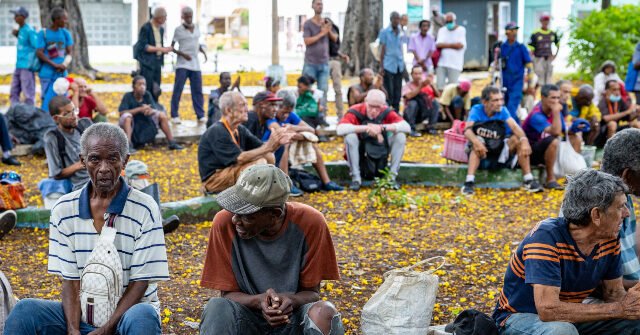
The Cuban state media outlet acknowledged that Cuba’s population is aging at an “unstoppable pace,” with a median age of 45. Over 2.5 million Cubans, 26.7 percent of the population, are now over the age of 60. Per Cubadebate, the Havana municipality of Plaza de la Revolución houses the largest number of elderly, with 38.2 percent of its inhabitants now 60 years old or older. The ongoing demographic collapse in Cuba has inexorably led to a significant — over 1.25 million — decline in the number of working-age population in the country over the past years, from 6.86 million in 2021 to 5.6 million in 2025.
Cuba’s Gross Reproduction Rate — the average number of daughters a woman would have in her childbearing years — reportedly stands at only 0.62 daughters per woman. Total Fertility Rate was once again measured at 1.29 children per woman, the worst results documented in Cuba since 1958, the last year the country was free. Per ONEI, the remaining population in Cuba has a ratio of 972 males for every 1,000 females. The ratio further drops down to 921 males for every 1,000 women in rural areas.
The results, Cubadebate affirmed, denote an “overrepresentation of women that reflects their greater access to higher education and employment in the service sector, as well as the feminization of internal migration to cities.”
According to Cubadebate, specialists from the communist regime’s Center for Population and Development Studies and the United Nations Population Fund (UNFPA) recommended what was called “demographic resilience,” which, according to the outlet, is a policy such that “the population is neither too large nor too small.”
Last week, Cuban demographer Juan Carlos Albizu-Campos spoke with Martí Noticias and warned that the precarious situation of Cuba has plunged the nation into a complete “demographic disaster” scenario.
Regarding the significant drop in Cuba’s demographic statistics, Albizu-Campos stressed that it is the result of a much broader situation in which Cuba’s economic, food, health, and social crises play a key role, as well as the “loss of future expectations” in the nation’s population. The expert asserted that one such example of the widespread issue is that “many Cuban women do not want to have children in the country’s current conditions, and some even contemplate emigrating to have them outside of Cuba.”
Albizu-Campos stressed that should the current trends continue, the country will experience a “demographic emptying” that will extend through 2030. The expert emphasized that simply achieving certain birth and mortality rate goals will not solve Cuba’s demographic situation. In order to do so, he suggested, a “profound transformation” of the communist-ruled nation’s political, economic, and judicial systems must take place.
“The solution must be that the model, in some way, has to change,” Albizu-Campos told Martí Noticias.
Christian K. Caruzo is a Venezuelan writer and documents life under socialism. You can follow him on Twitter here.