

Russia is repeating in Mali the same strategic errors the Soviets made in Afghanistan. After the 2011 NATO-backed collapse of Qaddafi, armed Tuareg fighters flooded back into northern Mali. This triggered a cascade of separatist rebellion, jihadist expansion, a military coup, and near-total state collapse by 2013.
France stabilized the situation through Operation Serval and the broader Operation Barkhane. Russia, through the private military company Wagner and later through the Kremlin’s Africa Corps, systematically dismantled that security architecture through disinformation, political manipulation, and backing of the juntas in Mali, Burkina Faso, and Niger.
Having expelled France, Russia now finds itself holding a collapsing state against a resilient jihadist insurgency. The insurgents blockaded Bamako, Mali’s capital, beginning in September 2025 and struck near the presidential residence in April 2026.
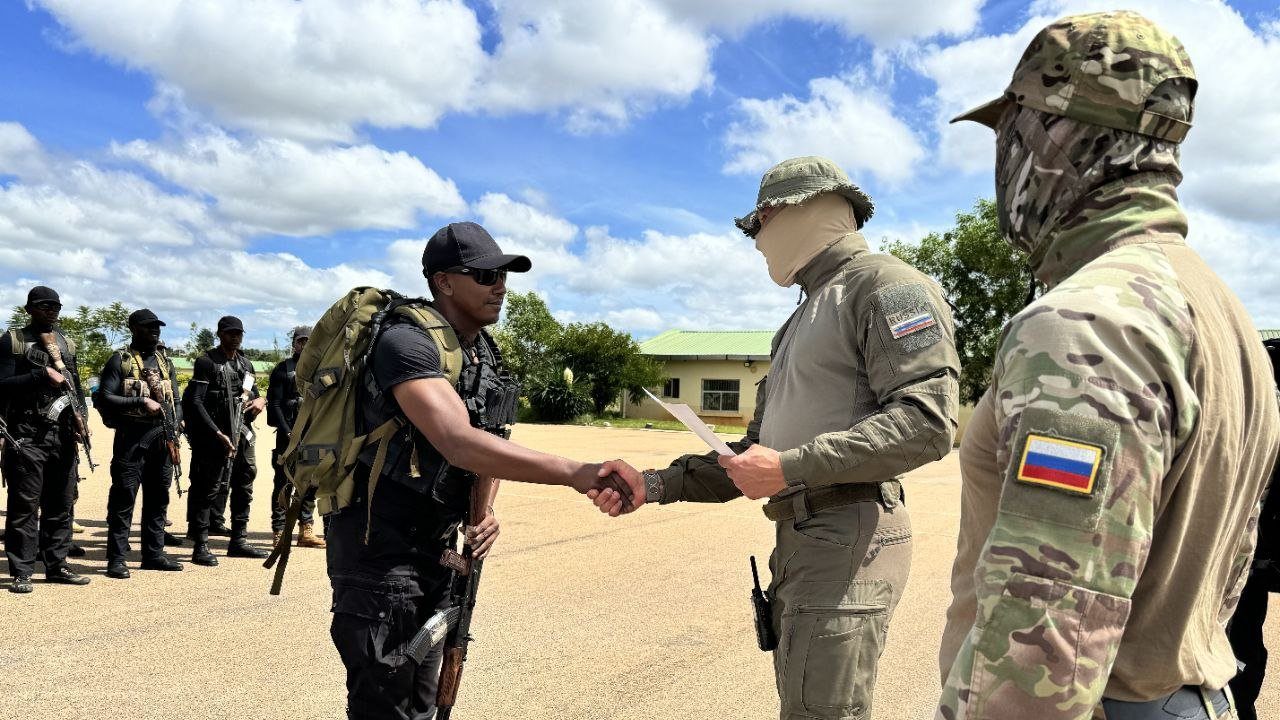
Following Prigozhin’s death in August 2023, Moscow restructured Wagner’s African operations under direct state control, creating Africa Corps, a paramilitary formation fully subordinate to the Ministry of Defense. Wagner forces officially withdrew from Mali on June 6, 2025, after more than three years in the country. Africa Corps formally assumed control the following day.
The transition was driven by Russian domestic politics. The rebrand preserved most of Wagner’s functionality. Legacy staff had a choice to quit or continue under a government agency, and Wagner personnel could still wear their old chevrons and insignia.
The key shift was accountability. Wagner’s gray status as a private military company helped the Kremlin obscure contractor deaths and use the group as a scapegoat. Debacles such as Tinzaouaten, the July 2024 ambush near the Algerian border where Tuareg rebels and JNIM killed upward of 80 Wagner mercenaries and more than 40 Malian soldiers in what stands as Wagner’s worst defeat in Africa, were often dismissed as Wagner failures rather than Russian failures. Africa Corps, operating directly under the Ministry of War, removes that buffer.
The strategic rationale was also financial. Wagner’s gold-mine model is no longer sustainable for Moscow’s broader ambitions. Under the old arrangement, Russian-linked companies received mining concessions for gold, diamonds, and other minerals in exchange for providing regime protection and counterinsurgency support. The system generated revenue independently of the Kremlin and made Wagner largely self-financing, giving Yevgeny Prigozhin an independent economic base that ultimately contributed to his June 2023 mutiny against the Russian military leadership.
Putin now seeks state-to-state agreements covering energy deals, uranium supply chains, and sanctions-evasion infrastructure. These arrangements require direct ministerial involvement rather than a privatized mercenary company operating its own resource-extraction business.
In early 2025, three major convoys of Russian-made trucks, tanks, and heavy armored vehicles were shipped into Bamako as part of the transition. As many as 2,500 Russian personnel were reported in Mali as of early 2026.
The overconfidence that followed the Kidal victory in 2023 set the conditions for Tinzaouaten. Following the withdrawal of MINUSMA, the Malian military and Wagner launched an offensive to secure former MINUSMA bases in the Tombouctou region. After a series of tactical victories, they began operating in areas that had been rebel-controlled for years, though they remained unable to hold territory for long periods.
On July 25, 2024, the Tuareg rebel coalition CSP-DPA ambushed a convoy transporting Malian and Wagner personnel near Tinzaouaten, close to the Algerian border. During the retreat, Wagner and Malian forces were hit again in a second ambush by Jama’a Nusrat ul-Islam wa al-Muslimin (JNIM). Reports indicated that more than 80 Wagner personnel and over 40 Malian soldiers were killed.
Russian state media outlet TASS reported that only three Russian fighters survived, including the unit commander, Sergey Shevchenko. Among the dead was Nikita Fedyanin, administrator of Wagner’s Grey Zone Telegram channel. Reuters verified at least 47 bodies from video footage and separately identified 23 missing Wagner operators through relatives posting in an official Wagner Telegram group. Among the dead were veterans of deployments in Ukraine, Libya, and Syria.
Following the defeat, Ukraine publicly stated that it had provided limited financial assistance, medical training, mini-drone training, and at least one trainer to northern Mali. The Tuareg had reportedly sought outside support from international actors since late 2023.
The ambush exposed the fragility of Algeria’s southern border and deepened Algiers’ dilemma over how to counter Russian-backed forces in the Sahel without jeopardizing its relationship with Moscow.
The April 25, 2026, offensive marked a further and more severe reckoning. Joint coordinated attacks by the Azawad Liberation Front and JNIM struck Bourem, Bamako, Kati, Sévaré, Senou, and Mopti simultaneously, while the FLA claimed control of Kidal and parts of Gao. The Islamic State’s Sahel Province also launched attacks under the cover of the offensive.
Malian Defense Minister Sadio Camara, a Russian-trained officer and architect of Mali’s pivot toward Moscow, was killed in a suicide vehicle bombing near Bamako. JNIM claimed responsibility for the attack.
An Africa Corps helicopter was shot down by the FLA, killing its crew. At least 400 Africa Corps paramilitaries were evacuated from Kidal under escort, while Malian soldiers were left behind as prisoners.
By April 26, the FLA declared that it had reached an agreement with Russian troops for the complete evacuation of Kidal. Africa Corps subsequently withdrew from Aguelhok and Tessalit in the Kidal Region, Tessit in the Gao Region, and Ber in the Tombouctou Region.
The Russian Ministry of Defense claimed its forces had inflicted “irreparable losses” and “prevented a coup.” However, a Russian deputy foreign minister told lawmakers on April 28 that the loss of Kidal “creates a big problem.”
Kidal had been seized by Malian forces and Russian mercenaries in 2023, a victory that symbolized Moscow’s displacement of Western influence in the Sahel. Its loss directly inverted that narrative.
This insurgency is demonstrating that the Kremlin’s security model offers only a surface-level solution. Russia can provide rapid military assistance to despotic governments, but it does little to address the weak governance, corruption, socio-economic marginalization, and ethnic tensions driving instability across the Sahel.
Africa Corps’ footprint extends across Burkina Faso, Niger, the Central African Republic, Libya, and Equatorial Guinea, with reported expansion into Chad, Madagascar, and Togo. However, the Kidal debacle materially damaged Moscow’s image as a reliable security guarantor, the core selling point that originally displaced France and other Western powers from the region.
The episode also mirrors recent Russian failures to protect allied regimes, including Bashar al-Assad in Syria, Nicolás Maduro in Venezuela, and the Iranian leadership during the conflict with the United States.
The post Russia’s New Afghanistan: How Moscow Lost Mali appeared first on The Gateway Pundit.