Chris MasonPolitical editor

 Ian Forsyth via Getty Images
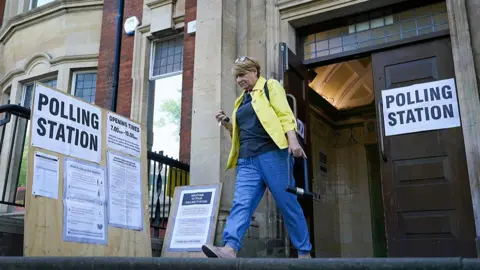
There are now just days left before a vital set of elections around Britain on Thursday, which will determine who spends billions of pounds of taxpayers’ money and will shape the mood and career prospects of political leaders in town halls, in Holyrood, in the Senedd and in Westminster.
Depending on where you are reading this, your doormat may have been carpeted with colourful leaflets for weeks and your TV and social media feeds chocca with political promises. You may already have voted – postal votes have been arriving with people and been posted back for some time now. Or perhaps you are in Northern Ireland or the parts of England without elections this year and this is all stuff happening elsewhere.
Wherever you are, these elections matter and tell us something about the British political tussle of the mid-2020s.
In recent years, the palette of popular political parties has widened.
For decades, Labour and the Conservatives were the primary colours of British politics. Not the only parties, for sure, but – most of the time at least – standing tall compared with their Westminster rivals. Now, almost wherever you look, politics feels like it is changing.
As well as Labour and the Conservatives, in the English local contests there are the Liberal Democrats, there is Reform UK, there is the Green Party of England and Wales and there are often competitive independents too. In the devolved elections, in Wales there is Plaid Cymru, which would one day like to see an independent Wales, and in Scotland, there are the Scottish Green Party and the Scottish National Party, both of whom would like to see Scotland become independent.
Most of these parties have been around for a long time, Reform UK less so. But what has changed is they all appear more competitive in more places than they used to be. And this has coincided with Labour and the Conservatives both being unpopular at the same time, which is rare.
This fracturing was clear at the last general election two years ago, even if the make-up of the House of Commons afterwards didn’t really reflect it.
Labour won a huge majority of seats, but did so with the smallest ever vote share for a government with an overall majority in the House of Commons. And it was simultaneously the first time since 1832 that the Conservatives had won less than 30% at a general election.
But the longer-term trend is clear. As this brilliant House of Commons Library briefing paper points out, “between 1945 and 1970 all but a handful of House of Commons seats were held by the Conservatives and Labour, who together took about nine in every ten votes cast in general elections over this period”.
It doesn’t feel remotely like that now and hasn’t for some time, and the fracturing appears to be accelerating.
Professor Sir John Curtice, the BBC’s lead elections analyst, told The Times: “We’re going to see records tumble. We are living in unprecedented circumstances. The opinion polls suggest that the traditional Conservative-Labour duopoly is facing its biggest challenge since its advent in the 1920s.”
He added: “The basic assumptions of British politics – there isn’t enough space for a party to the right of the Tories or the left of Labour – have gone. British politics looks more fundamentally different than it has done at any time in postwar history.”
Activists from all the parties tell me of their horror or excitement, more of the former if they are Labour or Conservative, more of the latter if they are one of the others, about the contemporary volatility.
As tribal loyalties have broken down for many, and the range of electoral options widened, those who regularly knock on doors for parties tell me of the unsentimental switching voters now consider, as if swopping from a Mazda to a Renault, rather than their party affiliation meaning any more than that.
On top of this, there is the difficult backdrop, economically and internationally. The research group More in Common wrote of a “shattered Britain” last summer.
“For many Britons, recent years have been imbued with a sense of unending crises and dissatisfaction with the status quo. A large share of the public do not feel that we have an economic or social model that works for ordinary people or a politics that delivers for them,” its authors concluded. Little wonder things feel so febrile.
And so little wonder, then, that “May” has been used as a three-letter, one-word shorthand within Labour circles for months and months on end. These elections have long represented for them a deepseated fear that deepseated unpopularity would switch from opinion poll sentiment to voting reality.
Like a tennis umpire, eyes forever dashing left and right, Labour folk do the same, politically and geographically.
Yes, incumbent governments at Westminster frequently find themselves on the receiving end of volleys of opprobrium from the electorate between general elections.
But the scale of these elections looks set to vividly expose the breadth of Labour’s vulnerabilities.
They have won every general election in Wales since 1922 and every devolved election since 1999.
In many parts of England, Reform hope to win, including in places so often associated with Labour, such as Barnsley and Sunderland.
The Liberal Democrats eye potential gains at the Conservatives’ expense in parts of rural southern England, such as Surrey and Hampshire – with expected poor results for the Tories likely to be drowned out by Labour’s bigger expected struggles.
Then there are independents, standing on multiple platforms. Some of the most competitive are those deeply concerned about Gaza and the government’s approach to the Middle East. Observers expect them to make gains in places with a significant Muslim population, such as parts of Lancashire, Birmingham and east London.
And if Labour do get a multi-coloured shellacking, at the hands of rivals to both its left and right, it will intensify conversations within the party and beyond about the Westminster government’s direction and, yes, its leadership.
That does not necessarily mean the ousting of Sir Keir Starmer in the short term, but it might.
We are in for a lively 10 days or so.