Jaroslav Lukivand
Bernd Debusmann Jr,White House reporter, Florida

 Getty Images
Iran has received a US response to its latest peace proposal, Iranian state-linked media have said.
Iran’s foreign ministry spokesperson said the response – which was delivered via Pakistan – was now being reviewed, according to Tasnim news agency.
The US is yet to formally confirm it has replied to Tehran. However, President Donald Trump reportedly told Israel’s Kan News on Sunday that it was unacceptable to him.
Iranian state media said Tehran’s 14-point plan asked Washington to withdraw its forces from near Iran’s borders, end its naval blockade of Iranian ports, and for all hostilities to cease – including Israel’s offensive in Lebanon.
It also called for an agreement between the two countries to be reached within 30 days.
Iranian state media added that the proposal urged the two warring sides to focus on “ending the war” rather than extending a current ceasefire.
Referring to the proposal, Trump wrote in a post on Truth Social late on Saturday: “They have not yet paid a big enough price for what they have done to Humanity, and the World, over the last 47 years.”
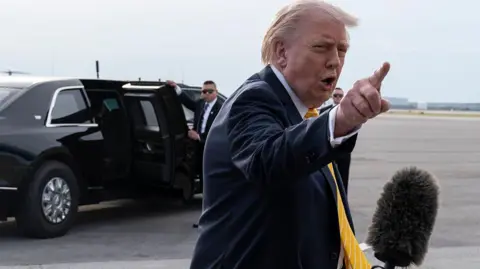
Speaking to reporters on the same day in Palm Beach, Florida, he said he had yet to look over the plan in detail.
“They told me about the concept of the deal,” he said. “They’re going to give me the exact wording now.”
Asked by the BBC about the possibility of renewing military strikes against targets inside Iran, Trump said that it was “a possibility”.
“If they misbehave. If they do something bad,” he said. “But right now we’ll see.”
Trump appeared disinclined to withdraw from the conflict entirely, saying that “we’re not leaving” and that “we’re going to do it, so nobody has to go back in two years or five years.”
The Iranian state-linked agencies said Tehran’s latest proposal was in response to a nine-point US plan, which envisaged a two-month ceasefire.
 Reuters
On Friday, Trump addressed a letter to members of the US Congress, saying the conflict had been “terminated” since a ceasefire took effect on 8 April – even though Iran still posed a “significant” threat to the US and its military forces deployed in the region.
The ongoing blockade of Iranian ports, he claimed, did not represent the continuation of the conflict.
“It’s a very friendly blockade,” he said. “Nobody is even challenging it.”
Trump also argued he did not need to meet a deadline for legislative approval of the war as the truce had paused the clock on any such obligation.
By law, a US president must receive Congress’ approval within 60 days of notifying lawmakers of military action, or else cease hostilities.
Friday was the 60th day since Trump formally notified Congress of US strikes against Iran on 2 March. The US and Israel launched their attacks two days earlier – on 28 February.
At various points during a series of public remarks on the same day, Trump also repeated his refrain that “Iran can never have a nuclear weapon”.
Iran has repeatedly denied it is seeking a bomb and says its programme is only for peaceful purposes, though the country is the only non-nuclear-armed state to have enriched uranium at near weapons-grade level.
Trump’s latest remarks come as US lawmakers – including many from his Republican party – are growing publicly frustrated with what many view as a costly, complex war with murky objectives.
Missouri Republican Senator Josh Hawley called on the Trump administration to begin redeploying forces away from the conflict and argued that Congressional approval would be necessary for the war to continue.
“I don’t really want to do that,” Hawley said. “I want to wind it down.”
Another Republican Senator, Alaska’s Lisa Murkowski – a prominent Trump critic – cast doubt on the success of the operation and any potential talks.
“While the administration may point to ongoing negotiations, events on the ground and the rhetoric coming out of Tehran tell a different story,” she said.
“But if the US steps back abruptly and prematurely, we almost certainly leave their critical capabilities intact.
“And those are not risks that I’m willing to take. But the answer is not a blank check for another endless war,” Murkowski added.