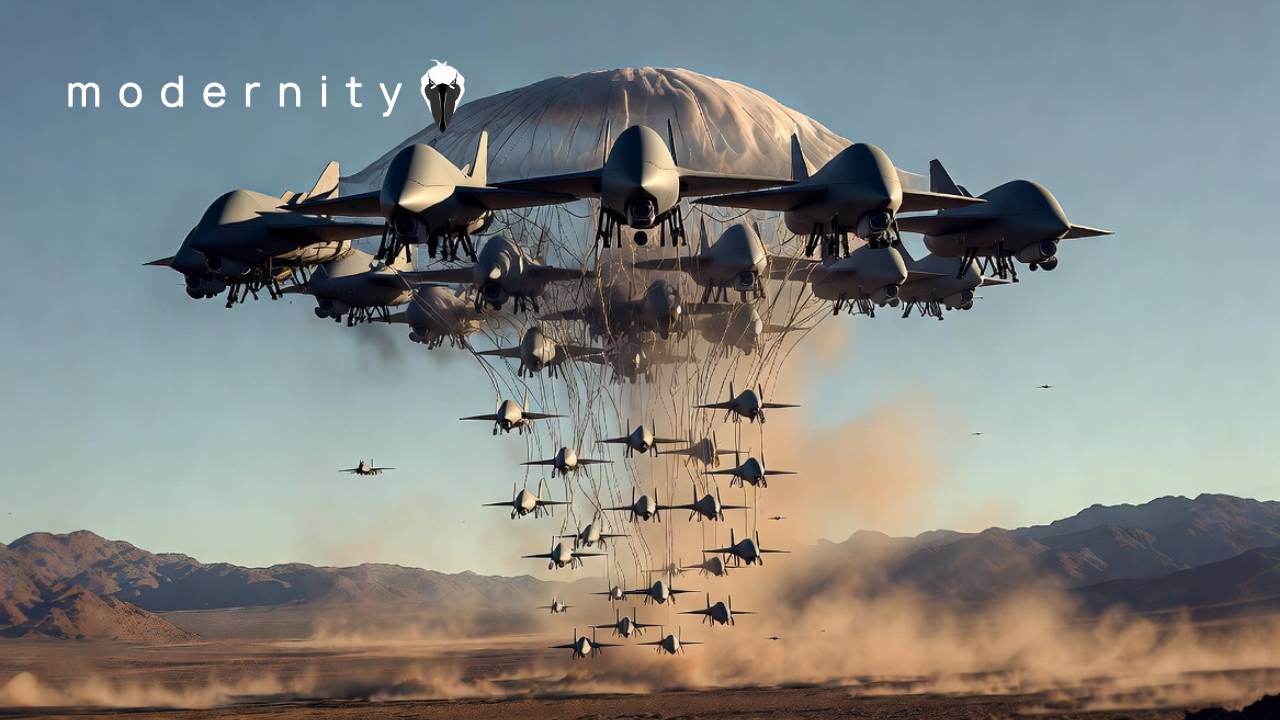
A US F-15E Strike Eagle pilot shot down over Iran in early April described a startling scene in the moments before ejection: multiple drones hovering and operating together in a formation that resembled a jellyfish, with larger drones docked to each other and smaller ones positioned underneath like legs.
Another source familiar with the account said the pilot portrayed the sky as a “minefield of drones.”
The pilot, who suffered a concussion during the incident, provided the details during intelligence debriefings.
A US fighter jet pilot rescued by special forces after being shot down over Iran in April described a shocking sight before ejecting from his aircraft: multiple Iranian drones hovering in the air, moving as one, in a formation that resembled a jellyfish, according to four sources… pic.twitter.com/RiAEUzEI3b
— CNN (@CNN) June 23, 2026
The account comes from four sources familiar with the pilot’s debrief and was first detailed in reporting published this week.
The pilot painted an unsettling picture of coordinated enemy technology in action. He recounted multiple Iranian drones hovering and operating in perfect sync, forming a shape that closely resembled a jellyfish drifting through the sky.
The larger drones appeared linked together while smaller ones trailed beneath them, creating a single, fluid entity rather than individual aircraft operating on their own.
One source with direct knowledge of the account summarized the pilot’s description as “Real alien sh*t.” A separate source added that the pilot characterized the scene as a swarm of drones filling the airspace ahead of him.
US officials split on how to interpret the report — some questioned whether the concussion and stress of the event clouded his recollection, while others saw potential evidence of advanced technology.
Something like this. pic.twitter.com/6eY1XvTcO6
— Monetary Metals (@monetarymetals) June 23, 2026
The downing occurred during Operation Epic Fury, the US campaign against Iranian targets that began in late February. Iranian forces shot down the F-15E near the Esfahan area.
The pilot ejected and was rescued by US special forces within hours. His weapons systems officer evaded capture in mountainous terrain for more than a day before extraction.
During the broader rescue effort, an A-10 was also downed, though its pilot ejected safely outside Iranian airspace. US forces destroyed two MC-130 aircraft and several MH-6 helicopters on the ground at a forward site to prevent them from falling into Iranian hands.
Iranian state media released photos of wreckage from multiple US aircraft at the location. The pilot had already been shot down once earlier in the conflict — in a friendly-fire incident involving Kuwaiti defenses — making this his second ejection of the war.
In a striking display of American technological edge, the CIA deployed a classified “Ghost Murmur” system to locate the weapons systems officer hiding in a mountain crevice in southern Iran’s barren desert. The tool employs long-range quantum magnetometry to detect the electromagnetic fingerprint of a human heartbeat, paired with AI software that isolates the signal from background noise. Sensors built around microscopic defects in synthetic diamonds enabled detection from roughly 40 miles away under the right conditions.
President Trump referenced the capability during a White House briefing. A source familiar with the system described its precision: “It’s like hearing a voice in a stadium, except the stadium is a thousand square miles of desert.” Another explained the name and function: “In the right conditions, if your heart is beating, we will find you.” The moniker is deliberate — “Murmur” refers to a heart rhythm, while “Ghost” captures the challenge of finding someone who has effectively disappeared.
Developed by Lockheed Martin’s Skunk Works and previously tested on Black Hawk helicopters, the system saw its first known operational use in a real-world personnel recovery mission. CIA Director John Ratcliffe alluded to the agency’s advanced methods, noting it possessed “unique capabilities.” Coordinated deception efforts by special operations teams helped draw Iranian attention away from the airman’s position until extraction succeeded with no American casualties.
US intelligence had not previously assessed Iran as possessing mature “one-to-many meshed networking” for drones, a capability Russia and China are believed to hold.
The reported formation suggested drones that could coordinate as a single unit, potentially complicating interception efforts.
Pentagon officials had already acknowledged to Congress in March that Iranian Shahed-type drones proved harder to counter than expected during the fighting.
Drone warfare expert Emma Bates told CNN that coordinated systems of this type would force major investment in defenses: “We will spend huge, huge dollars, like a lot of blood and treasure, protecting ourselves from something that can coordinate like that.”
She added that a formation able to maintain shape, carry explosives, and hold reserves for follow-on attacks represented “a very capable approach.”
The pilot’s name has not been released publicly. Some online discussion questioned aspects of the rescue narrative and the timing of the disclosure amid ongoing ceasefire talks, while others focused on the technical implications of networked drone swarms for future conflicts.
Operation Epic Fury produced heavy attrition on both sides. Congressional tallies later showed dozens of US aircraft lost or damaged by May. Iranian forces relied heavily on drones in asymmetric attacks against US, Israeli, and regional targets throughout the campaign.
The US and Iran reached a ceasefire framework in mid-June, opening a 60-day negotiation window covering Iran’s nuclear program, the Strait of Hormuz, sanctions relief, and related issues. Technical talks continued into late June with reports of progress on a roadmap for a final agreement.
This latest detail from the April fighting offers a rare window into the kinds of tactical surprises US aircrews encountered. It also highlights how quickly drone technology — potentially accelerated through external assistance — can alter the battlefield calculus even against a technologically superior force.
Special forces’ ability to recover both crew members under contested conditions demonstrated the continued edge in human skill and rapid response that no amount of adversary innovation has yet erased.
The episode reinforces a core reality: peer and near-peer adversaries continue to field new tools designed to exploit gaps in existing defenses.
America’s response will depend on honest assessment of those tools rather than assumptions carried over from earlier eras.
Strong investment in counter-drone systems, resilient networks, and the industrial capacity to sustain high-intensity operations remains essential if the United States intends to maintain deterrence without repeating the costly learning curves of recent months.
Your support is crucial in helping us defeat mass censorship. Please consider donating via Locals or check out our unique merch. Follow us on X @ModernityNews.