Alex Kleiderman,
Ella Kiplingand
Hugh Pym,health editor

 Facebook
Two British people are self-isolating at home in the UK after potential exposure to hantavirus on a cruise ship struck by the outbreak, the UK Health Security Agency (UKHSA) has said.
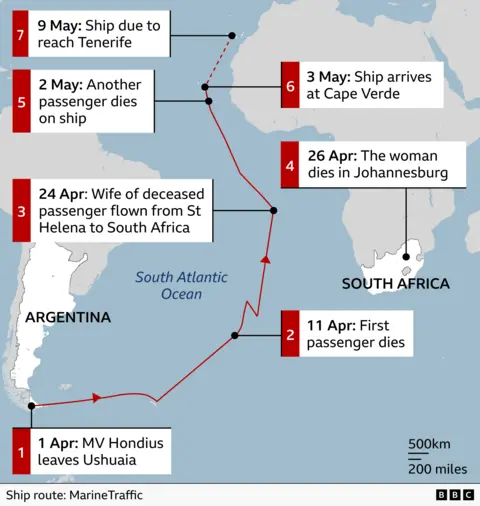
They left MV Hondius at St Helena in late April, flying back to the UK via Johannesburg. Neither had symptoms but contacted health officials when they heard of the ship’s cases.
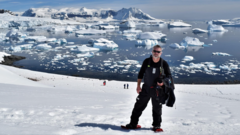
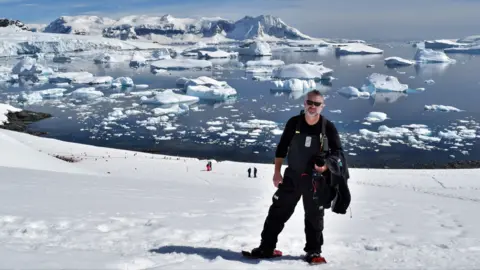
A 56-year-old British man is in a stable condition after being evacuated from the ship on Wednesday. He has been named as former police officer Martin Anstee by media outlets.
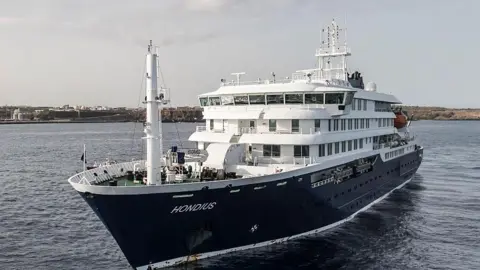
Three people have died on the ship, which set sail from Argentina a month ago, following the hantavirus outbreak.
The British man was among three people evacuated from the ship on Wednesday to the Netherlands for treatment, operator Oceanwide Expeditions said.
Prof Robin May, the chief scientific officer at the UKHSA, told BBC Breakfast that is was his understanding that “is he is doing well”.
“He is going to be under investigation for some time. I’m very pleased he’s now in hospital and receiving the treatment he needs,” May said.
“He’s relieved to be off the ship. He had it quite mild then it got a bit more serious and now he’s stable again.
“The fear with this virus is it can deteriorate very quickly so it’s been a bit up and down for him. I don’t believe he’s in imminent danger now but it was horrible.”
The other evacuees were Dutch and German. Oceanwide Expeditions said the German evacuee was “closely associated” with a German woman who died on board the ship on 2 May.
 Getty Images
They include 19 passengers and four crew members listed as British, according to figures released by the operator on Tuesday.
Spanish authorities have given permission for the ship to dock in the Canary Islands, despite concerns from local officials.
The US Department of State said it is in “direct contact” with affected passengers and the risk to the American public is “extremely low” at this time, according to the Centers for Disease Control and Prevention (CDC).
Eight people, including a Swiss citizen, are suspected to have contracted the virus, said the World Health Organization (WHO).
The UKHSA said the Britons on the ship would be flown home on a charter flight, probably from the Canary Islands as long as they did not have symptoms.
They would then have to self-isolate or be put into quarantine potentially for up to six weeks, depending on the timing of their last potential exposure to the virus.
May told the BBC they would be contacting contacts of anyone who may have been exposed to the virus including family members, anyone who shared rooms on the ship with them or anyone who sat next to them on a long haul flight.
The World Health Organization (WHO) said the risk to the wider public was low and the virus rarely spreads through human to human transmission and only after close contact.
It is still unknown where the outbreak originated from and if people other than cruise ship passengers have been infected with the disease.
The three people with symptoms – who also include a 41-year-old Dutch crew member and 65-year-old German – were evacuated from the vessel to receive medical help in the Netherlands, the WHO said.
The Foreign Office has said it was “working urgently” to get British nationals stuck on board the MV Hondius home safely.
Foreign Secretary Yvette Cooper said the situation was “very serious and deeply stressful for those affected and their families”.
The Foreign Office said the UK response to the outbreak was being led by the UKHSA working with the WHO.
Consular staff are in contact with British nationals onboard the ship and the Foreign Office has been “working with other countries to facilitate the medical evacuations, to support our Overseas Territories and to get British nationals home safely as quickly as possible”, Cooper added.
The UKHSA is also working with governments in St Helena, Tristan de Cunha and Ascension Island on isolation, contact-tracing efforts and response protocols.
The vessel will sail to the Canary Islands where all passengers will be evacuated at the Granadilla port in Tenerife, Spain’s health minister Monica Garcia said on Wednesday.
Spanish passengers will be quarantined in Madrid, while those from other countries will be repatriated if they have no symptoms, Garcia said.
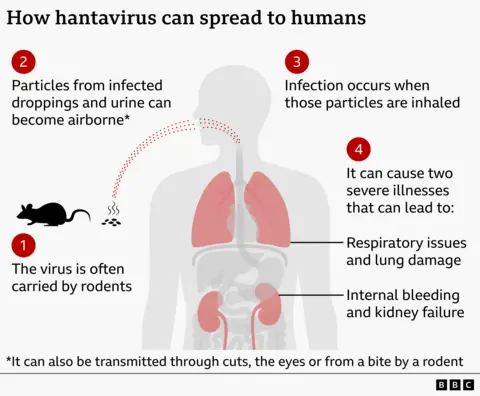
Hantavirus is a group of viruses carried by rodents such as mice and rats, and symptoms can include fever, extreme fatigue, muscle aches, stomach pain, nausea and vomiting.
Following the outbreak on the cruise, the UKHSA said the risk to the UK population was “very low” and there was “no need for concern among the general public”.