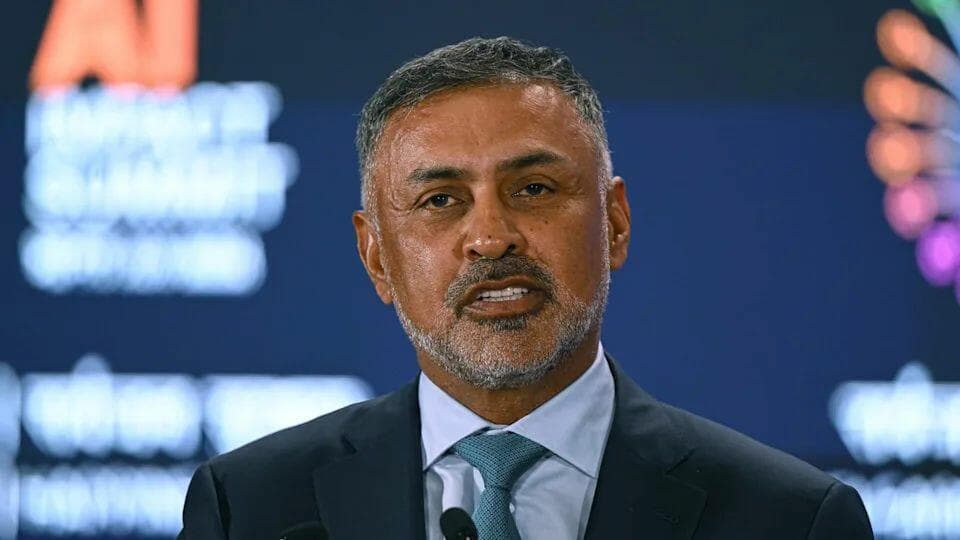
Eight days ago it was Palantir’s Alex Karp going ballistic on live television about the “effing insane” economics of renting intelligence by the token. On Thursday it was Palo Alto Networks CEO Nikesh Arora’s turn, and while his delivery was calmer, his number was not: Arora told CNBC that AI token prices need to fall as much as 90% before enterprise adoption can actually scale.

So the chief executive of one of the largest cybersecurity companies in the world – that buys this stuff at industrial scale – telling the frontier labs, on their favorite network, that their pricing model is broken by roughly an order of magnitude.
90% Or Bust
Arora wants token costs at roughly one-fifth of current levels within the next 12 months, and down 90% by the year after that. Arora joins a growing list of executives – Karp most loudly among them – calling out runaway token costs, and that the bill shock is already pushing corporate buyers toward cheaper open-weight alternatives, including Chinese models that are rapidly closing the capability gap with the American labs. Regular readers will recognize that migration: we have documented Coinbase cutting its internal AI spend nearly in half by defaulting engineers to Chinese open-weight models, Microsoft weighing a hosted DeepSeek variant for its own agentic tools, and OpenRouter data showing Chinese models capturing – in some periods – north of 60% of global token consumption among top models.
Palo Alto CEO Arora says AI pricing needs to fall 90% as token costs skyrocket | Samantha Subin, CNBC
Palo Alto Networks CEO Nikesh Arora warned that token costs need to drop as much as 90% to promote large-scale artificial intelligence adoption.
“I think 54% is a good start,”… pic.twitter.com/tMVMd9Eeuf
— Owen Gregorian (@OwenGregorian) July 10, 2026
Altman Blinks First
The timing was not accidental. Arora’s comments landed the same day OpenAI shipped its new GPT-5.6 family, with Sam Altman telling CNBC the latest model is 54% more token-efficient on agentic coding – a spec sheet line that doubles as a confession about what customers have been screaming at him for months. Asked about it, Arora offered the faintest of praise, calling the efficiency gain a good start before adding: “I think we probably need another turn at it.“
Translation: nice 54%, now do it again. Twice.
None of this should surprise regular readers, who know OpenAI has been weighing drastic price cuts to claw enterprise customers back from Anthropic – the start of a classical deflationary race to the bottom – the opposite of what an industry burning tens of billions a year, and hoping to grow into trillion-dollar public valuations, actually needs. Altman himself conceded in June that cost had gone from a non-issue to a major one for customers. A month later, the “drastic cuts” are arriving dressed up as efficiency gains.
Meta Rising?
Also on Thursday, Meta launched Muse Spark 1.1, its first serious run at the agentic coding market that made Claude Code a phenomenon. Per Reuters figures cited by TechCrunch, Meta is charging $1.25 per million input tokens and $4.25 per million output tokens – parked right alongside the budget tiers of its rivals, Anthropic’s Claude Haiku 4.5 and OpenAI’s GPT-5.6 Luna. Meta AI chief Alexandr Wang described the pricing as “very aggressive and attractive,” and every new API account starts with $20 in free credits.
The launch was apparently important enough that Mark Zuckerberg posted on X for the first time in three years – his last post came in July 2023 – to pitch Spark as “a strong agentic and coding model at a very low price.” Read that again: the CEO of a company spending well north of $100 billion a year on AI infrastructure, a company Wall Street is openly pressing for evidence of AI returns, broke a three-year social media silence to advertise that his product is cheap.
Meta also shipped its Muse Image generation model Tuesday, SpaceXAI dropped a new Grok, and OpenAI’s GPT-5.6 family all landed inside the same 48 hours.
The Math Has Not Changed
Arora’s admission is the latest wake-up call – from the tokenmaxxing fiasco and the $500 million mystery Claude bill, to Uber capping AI coding spend after torching its 2026 agentic budget in four months, to UBS checks finding token costs are now a live issue for roughly 60% of enterprise customers – including one that got its first AI invoice and heard leadership respond, flatly, “we don’t have the money for this.”
And we aren’t the only ones concerned about how this will go… As JPMorgan noted one month ago: falling prices do not automatically fix the customer’s problem, but they absolutely wreck the seller’s. Gartner’s own work suggests that even a 90% collapse in inference costs may not shrink enterprise AI bills, because agentic consumption grows faster than prices fall and providers do not pass the savings through. Meanwhile Apollo’s chief economist Torsten Slok has laid out the mirror-image problem: if token prices converge toward zero, there is not enough revenue to support the hyperscaler buildout even in a world where compute demand keeps surging. Arora’s 90% is the customer’s survival number. It may also be the vendor’s extinction number.
Meanwhile, the buildout is not slowing down to wait for the answer. Amazon raised $25 billion in debt this week to fund AI infrastructure, a month after SpaceX’s $25 billion bond sale – while this very morning, SK Hynix pulled off the largest US listing ever by a foreign company, a $26.5 billion raise that saw its ADRs open 14% above the offer price. The pattern could not be cleaner: the companies selling the shovels are booking record raises at record valuations, on the same tape where the companies selling the tokens are being told to cut prices 90%.
All of which lands at a delicate moment for the two firms the price war is actually about. OpenAI has already pushed its IPO into 2027, and Anthropic’s headline $47 billion ARR – a figure we treated with some skepticism when it was paraded ahead of the IPO filing – now faces its first print in a world where the customers have read their invoices and the competition includes Meta at $1.25 per million tokens.