The director of the National Museum of American History (NMAH), Dr. Anthea Hartig, was in the hot seat on July 21, defending the framing of US history and promotion of sexually explicit exhibits at the Smithsonian, visited by hundreds of thousands of children every year. She appeared before a House Oversight subcommittee on “Rewriting American History: Examining the Smithsonian’s Efforts to Reshape the Past.”
The hearing was prompted by the White House’s Domestic Policy Council’s July 4 report, “Saving America’s Story,” which concluded:
“By the intention and at the direction of current Museum and Smithsonian leadership, NMAH has become subject to institutional capture by a radical, activist ideology that is fundamentally opposed to telling the noble, honest story of the great country we know and love.”
Saving America’s Story
US Rep. Tim Burchett (R-TN), who chairs the subcommittee, opened the hearing with a video montage of Hartig’s lectures and meetings on behalf of the NMAH. During each, Hartig encouraged attendees and viewers to “give thanks to the first peoples on whose land we’re honored to live, love, struggle, and work.”
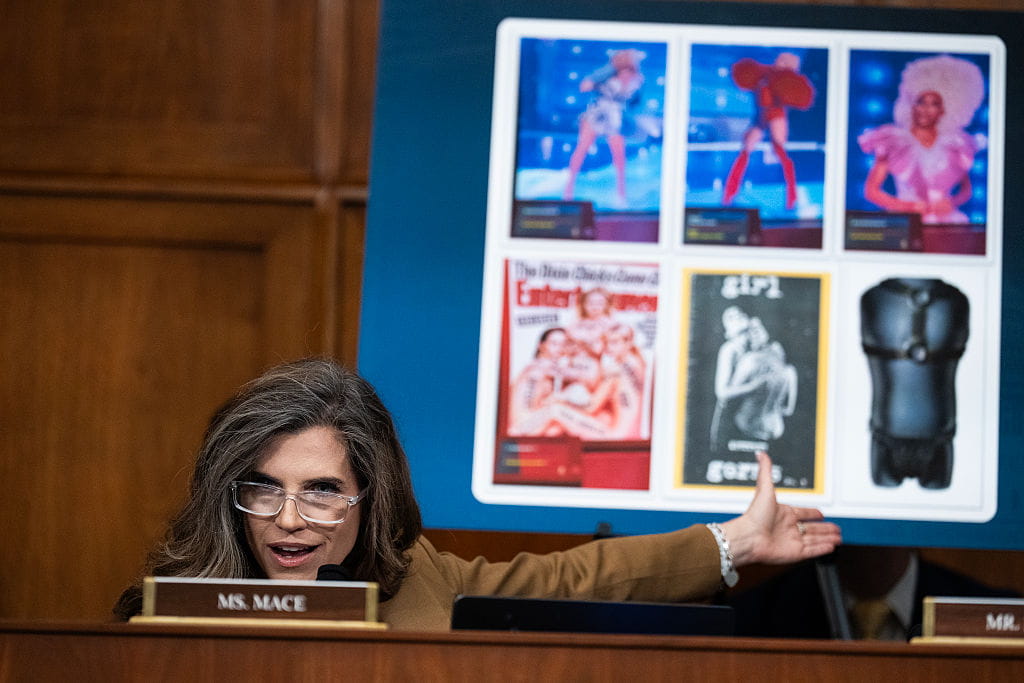
Burchett asked Hartig if she “ever planned on deeding her personal property” or that of the Smithsonian to any of the tribes she referred to in her messages. He pointed to a poster showing an exhibit from Entertainment Nation at the museum, which depicted sexual images of drag queens, bondage, and a lesbian couple.
“But in another exhibit, a six-year-old girl asks why she doesn’t have male genitalia,” he asked. “Do you really think that content is appropriate for children?” Hartig would not directly answer, although he asked three more times. “You’re funded by taxpayers. And the taxpayers would like to know, is that appropriate?”
Sexualizing the Smithsonian
Rep. Michael Cloud (R-TX) grilled Hartig on the most influential book on American history. When she couldn’t name one, he said, “The Founders quoted one book more than any other book. And that book would have been the Bible. Secondly would have been Common Sense by Thomas Paine.”
The congressman followed up by reading a sexually explicit line from George Takei’s book It Rhymes With Takei and questioned why it was displayed in the children’s section of the museum bookstore. “Who made the decision to put that in [the bookstore] and not Common Sense?” Cloud wanted to know.
The Federalist Papers
Unravel the Constitution
Hamilton, Madison & Jay’s complete case for America, free and searchable in the Publius Reader.
- All 85 essays, full original text
- Search and jump to any paper
- Read on your phone or desktop
Join the free Daily Briefing and your reading link arrives in your inbox.
Free with the Daily Briefing. Unsubscribe anytime.
Hartig would not answer that question or many others from Republicans on the subcommittee. Rep. Nancy Mace (R-SC) asked her if provocative sexual imagery displayed at the NMAH was appropriate for children at an American history museum. “What kind of message are you trying to send to kids with BDSM imagery?” Hartig responded with a smile.
Mace pressed her: “I don’t know how much money you spent on getting prepped for this hearing. They did a good job because you’re filibustering and not answering a single question from a single Republican today.”
“You sexualize the American History museum, so this is a fair question. What is a woman?”
With another smile, Hartig replied, “So, at the museum, we strive to represent and not categorize all Americans.”
Mace continued about the NMAH’s exhibit that stated, “Gender is not always revealed at birth,” asking how many genders there are and when gender is revealed. Hartig didn’t answer those queries, either.
Lawmakers fell along party lines, with Democrats shifting the attention to President Donald Trump, the cost of producing the Domestic Policy Council’s report, downplaying its findings, and ignoring the sexually explicit exhibit in the room.
Museum as a Site for Social Action
Rep. Brandon Gill (R-TX) asked Hartig: “Are you promoting a white supremacy culture at the Smithsonian?” Hartig repeated his query.

Gill pressed her. “Is this a difficult question?”
Hartig responded, “No, sir. I’m just thinking about the mass action toolkit. We didn’t develop it. But back to your question. No, we’re not promoting any ideology.”
According to the American Alliance of Museums:
“MASS Action — Museum as Site for Social Action — is a collaborative project that launched in 2016, centering on the question: How do you transform museums from the inside out? Through a series of public convenings and the creation of a toolkit of resources, the project’s intention is to share strategies and frameworks needed to align museums with more equitable and inclusive practices.”
Gill asked the director about NMAH’s promotion of the toolkit.
“One of your goals is objectivity and your mass action toolkit references ‘objectivity’ as a defining characteristic of white supremacy culture’
“Hartig responded: ‘It’s not our toolkit.’
“Gill said: ‘It is your toolkit. You’ve been promoting it for quite some time.’”
Killing America’s Story
Dr. Matthew Spalding, constitutional government professor and dean of the Van Andel Graduate School of Government at Hillsdale College, Washington, DC Campus, testified that America’s story has been replaced by a new and controversial approach:
“… one defined by abstract post-modern theories that see history as nothing more than an oppressive power struggle and so uses history as a tool in that struggle to encourage social change … it shouldn’t be the rubric for a Smithsonian Museum.”
Mike Gonzalez, senior fellow at the Heritage Foundation, called for replacing the leadership at the Smithsonian. “I don’t think trying to reform with present leadership is going to do anything … We only have to listen to what they say and look at the evidence of what they produced.”
The Smithsonian Institution is 62% federally funded through an annual congressional appropriation, federal grants, and contracts, according to its website. The current federal appropriation is reportedly more than $1 billion.
That’s a lot of money for little to no answers to questions about how sexually explicit exhibits and a social action toolkit are safeguarding American history at the Smithsonian.