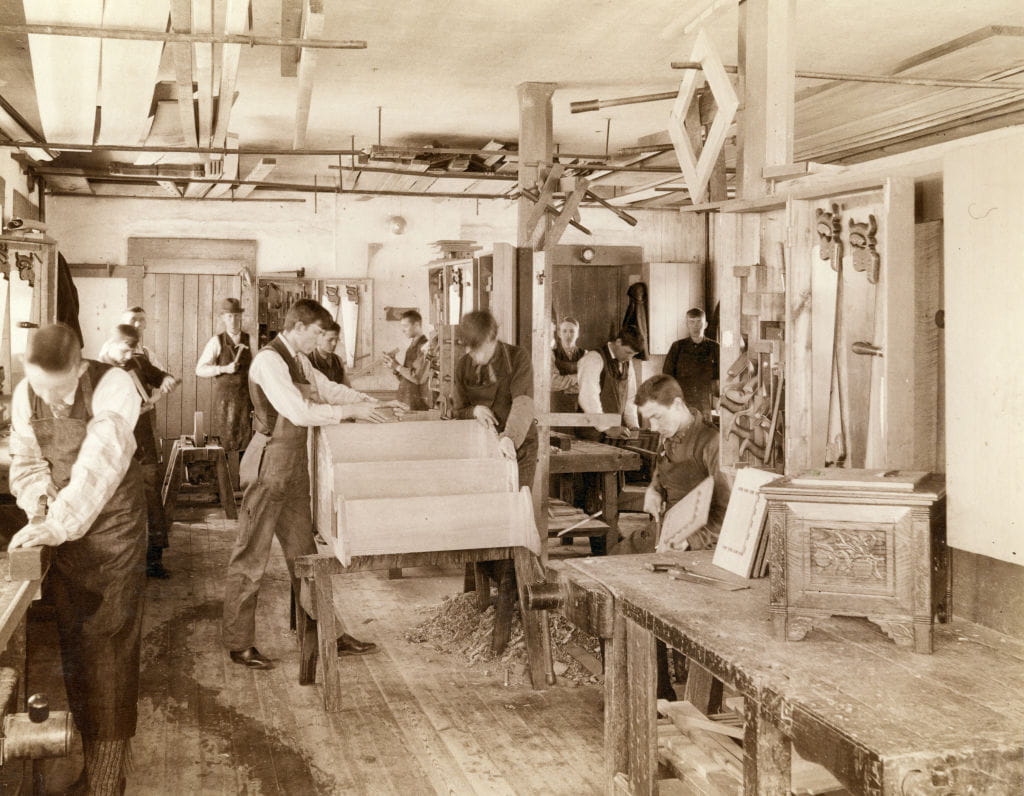
Next year, US Registered Apprenticeship System will celebrate its 90th anniversary. Of course, the general practice goes much farther back in history – this system, established by the National Apprenticeship Act in 1937, formally established the federal standards for it. Back in the day, there were a lot of apprentices who learned their trades from family, friends, and other business owners. That traditional way of learning has helped shaped America. So where does it stand today?
A Historical View
The apprenticeship system came to America from England during the colonial period. Rather than attending college, young people typically learned directly from experienced craftsmen. They lived or worked alongside a master, learning everything from blacksmithing and carpentry to printing, masonry, shoemaking, tailoring, and shipbuilding.
Many of America’s Founding Fathers learned through apprenticeships rather than college. Benjamin Franklin didn’t receive formal higher education. At the young age of 12, he became an apprentice to his brother James to learn the printing trade. It taught him the profession, but his experience also launched one of the greatest publishing and political careers in American history. Likewise, George Washington got his experience by training as a surveyor before entering the military and political life.
The Federalist Papers
Unravel the Constitution
Hamilton, Madison & Jay’s complete case for America, free and searchable in the Publius Reader.
- All 85 essays, full original text
- Search and jump to any paper
- Read on your phone or desktop
Join the free Daily Briefing and your reading link arrives in your inbox.
Free with the Daily Briefing. Unsubscribe anytime.
Throughout most of American history, relatively few people attended college. Historically, apprenticeships were the primary path into the middle class for millions of Americans long before college became the default expectation. Up until the 20th century, universities mostly taught ministers, physicians, lawyers, and political leaders.
In 1911, Wisconsin created the first state registered apprenticeship system, and in 1937 Congress enacted the National Apprenticeship Act (also known as the Fitzgerald Act), establishing the program as it is today. By the mid-1940s, there were approximately 6,233 Registered Apprenticeship programs nationwide, educating and training 4,000 apprentices.
Registered apprenticeship programs were found mainly in the manufacturing, construction, and utilities industries. After World War II, however, the program began to grow to include the training of firefighters, police, emergency medical technicians, and other health and safety workers.
What Happened to America’s Apprentices?
One of the biggest contributors to the decline of apprentices was higher education. For generations, people entered trades and were guided under an experienced craftsman. But by the 20th century, that path veered off as more emphasis on getting a college degree became popular. The education system started treating a four-year degree as the standard route to financial and professional success. Career and technical education were seen as a lesser option and apprenticeships started becoming associated with construction and union trades.
The public’s view and even understanding of apprenticeship declined. Instead of being seen as a respectable way of obtaining training and jobs, it was seen as a specialized program for specific trades such as plumbers, electricians, and carpenters – to many, a “lower” path compared to higher education in the classroom.

Many high schools offered woodworking, metalworking, home economics, agriculture, and auto repair classes, giving graduates a basic understanding and hands-on experience with occupational skills that could help them find a job. But, as time went on and budget cuts hit the education system, schools dropped these options. Instead, they focused on preparing students for college with standardized tests and practical training was pushed aside. The result was a cultural divide where college was looked at as the ambitious and successful choice while vocational training was seen as the place for students who supposedly couldn’t handle academic work.
Today, a lot of young students are not even aware that apprenticeships exist.
The decline of manufacturing also hurt apprentices and programs. Apprenticeship requires that an employer make a long-term investment, but when companies became more focused on cutting short-term labor costs, many preferred to hire those who were already trained instead of teaching someone new.
Degree Inflation
In 2017, Harvard Business School released a report titled “Dismissed by Degrees.” Researchers analyzed 26 million job postings and surveyed 600 business and human resource leaders to understand “degree inflation,” which is where employers prefer or require bachelor’s degrees for jobs that didn’t use to need them. These jobs included supervisors, sales representatives, clerks, and administrative assistances.
One example involved a job posting for supervisors in 2015. Of those examined, 67% required a college degree even though only 16% of workers were already employed in that line of work. Harvard described this 51-point difference as a “degree gap.”
“Degree inflation is corrosive to U.S. competitiveness in two ways,” said Harvard Business School Professor of Management Practice Joseph B. Fuller. “It slams the door of opportunity in the face of Americans with the experience to do a job or the aptitude to grow into it. It simultaneously makes it harder for American companies to find and retain affordable talent. The purpose of our research is not to undervalue college degree attainment, but to point out the consequences of employers relying on degrees as a proxy for the competencies to succeed in today’s workplace.”
That helped create a difficult cycle. Employers asked for degrees because apprenticeships were scarce, and students pursued degrees because employers asked for them, thereby further reducing the number of apprentices.
America Falls Behind
While other countries such as Germany, Switzerland, and Austria expanded their apprenticeships, the US fell behind. American apprenticeships remained limited and heavily concentrated in a smaller number of occupations compared to other nations, and employers required college degrees even for jobs that wouldn’t necessarily require them.
In the US, people go into debt to get degrees to hopefully find decent employment. In Switzerland, Germany, and Austria, apprentices are respected just as much as higher education as a path into middle class, which allows young adults to earn wages, gain experience, and build their careers without getting swallowed up by student debt.
Unlike the United States, apprenticeships never became viewed as a secondary option in much of Central Europe. Instead of separating vocational education from academic education, these countries built apprenticeship into their national education systems. Students often choose between academic and vocational pathways during secondary school, with apprentices dividing their time between classroom instruction and paid work.
In many ways, apprenticeship is a disappearing tradition. Not because there is no longer a need for skilled workers, but because fewer people have the opportunity to learn directly from those who have spent decades mastering their craft. Every retiring carpenter, machinist, mechanic, electrician, chef, or printer takes a lifetime of knowledge with them unless someone is there to learn it. Colleges will always have an important place, but they can’t preserve every trade, technique, or hands-on lesson that has been passed from one generation to the next. If apprentices continue to fade away, America won’t just lose another career path – it risks losing the knowledge, craftsmanship, and mentorship that helped build the nation in the first place.