President Trump’s trade agenda just produced a billion-dollar enforcement receipt.
The Justice Department announced Tuesday that its Trade Fraud Task Force has surpassed $1 BILLION in less than one year.
That total includes criminal and civil recoveries, penalties, forfeitures and publicly charged losses.
The figure should be read precisely: some of it has been recovered, while another portion represents losses alleged in public charges. Even with that distinction, it is a massive measure of the cases the task force has resolved or brought into the open since its launch last August.
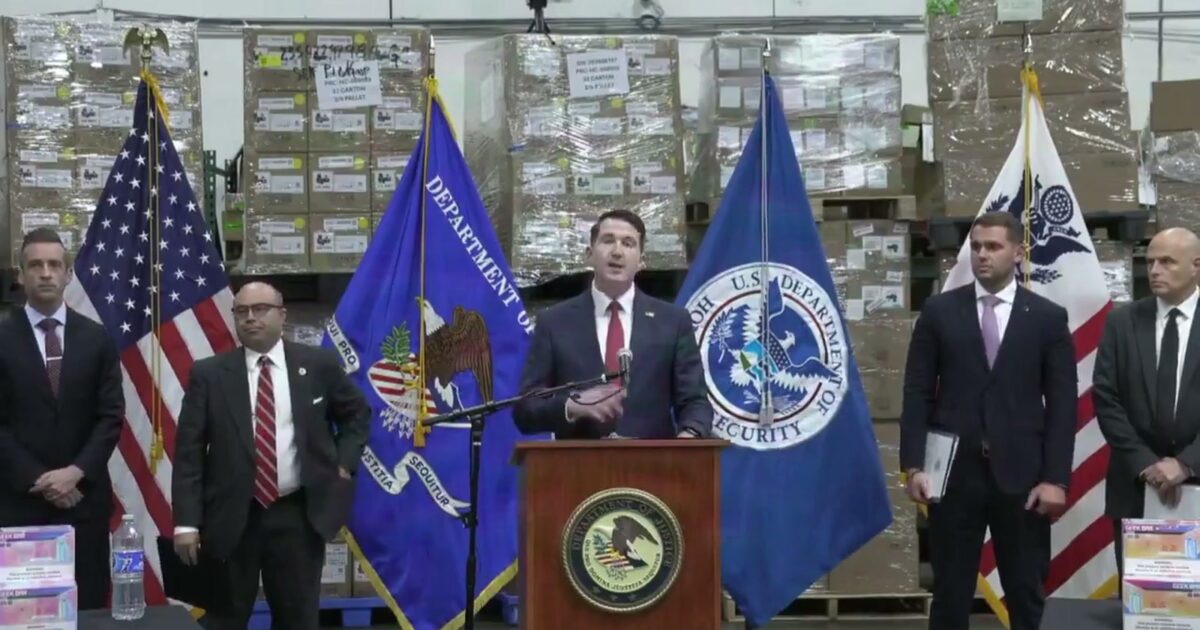
Assistant Attorney General Colin McDonald delivered the news alongside officials from DHS, Customs and Border Protection and the U.S. Attorney’s Office in Chicago:
🚨Assistant Attorney General Colin McDonald announces the Justice Department’s Trade Fraud Task Force SURPASSES $1 BILLION in recoveries and charged losses in less than one year alongside @DHSgov @CBP @NDILnews and other federal partners: pic.twitter.com/aS9yjTCicb
— National Fraud Enforcement Division (@DOJFraudDiv) July 14, 2026
This is what tariffs look like when they have teeth.
A tariff on paper means very little if an importer can relabel where a product came from, use the wrong customs code or disguise the merchandise and walk away with a cheaper price than every honest American competitor.
The latest report from the Justice Department says the task force is deliberately moving beyond administrative fines and into criminal prosecutions, civil actions, forfeitures and supply-chain cases.
Its reach does not stop with the company whose name appears on a customs form. Prosecutors say importers, brokers, distributors, end users and other participants can all face scrutiny when they knowingly handle merchandise entered into the country illegally.
The targets include schemes to evade ordinary tariffs, antidumping duties and countervailing duties. The task force is also pursuing prohibited goods, products tied to forced labor and unsafe imports that can put American consumers at risk.
That combination matters. Trade fraud can drain federal revenue, undercut domestic manufacturers and allow dangerous products into the market at the same time.
Acting Deputy CBP Commissioner Ron Vitiello put the goal plainly:
Acting Deputy @CBP Commissioner Ron Vitiello: Cracking down on trade fraud “helps American businesses compete on a level playing field. It protects American consumers.” https://t.co/hlANXfEfPF pic.twitter.com/2a7WtqoMR8
— Rapid Response 47 (@RapidResponse47) July 14, 2026
The Justice Department launched the task force jointly with DHS on August 29, 2025, to pursue tariff evasion and the smuggling of prohibited goods.
From the beginning, the administration invited American industries to refer suspicious trade patterns to federal investigators. Companies operating in a market every day are often the first to notice when a competitor’s price suddenly stops making economic sense.
The task force joined DOJ’s Civil and Criminal Divisions with Homeland Security Investigations and Customs and Border Protection. That structure allows the government to pursue duty collection, False Claims Act cases, seizures and criminal charges from the same underlying conduct.
It also opened direct paths for whistleblowers and domestic manufacturers to report suspected schemes. The aim was clear from day one: make evading a tariff far more expensive than paying it.
The newest cases show how large those alleged schemes can become.
Federal prosecutors in Chicago charged Raj Kohli and Veena Kohli, operators of Surya International, with allegedly declaring that imported gold jewelry came from Singapore rather than India and the United Arab Emirates.
According to DOJ, the case involves approximately 563 entries of jewelry valued at more than $693 million. Prosecutors allege that the false declarations avoided more than $38 million in customs duties.
A separate case charges Narain Gulabani, owner of Barkha Wholesale, with allegedly misdeclaring the origin of roughly 242 gold-jewelry entries valued at more than $240 million.
That alleged scheme avoided approximately $13.6 million in duties, the government says.
The charges are allegations, and every defendant is presumed innocent unless proven guilty.
DOJ announced both cases Tuesday:
.@NDILnews today announced charges against multiple defendants in significant customs duty evasion schemes involving the false declaration of countries of origin for gold jewelry.
The Trade Fraud Task Force (TFTF) has selected NDIL as its lead prosecutorial partner. These… pic.twitter.com/V5LzYZyIm1
— National Fraud Enforcement Division (@DOJFraudDiv) July 14, 2026
The billion-dollar total did not come from the Chicago cases alone.
One of the biggest pieces was a $549.5 million settlement involving Perfectus Aluminum and related companies. The Justice Department alleged that millions of Chinese aluminum extrusions were made to look like finished pallets so the importers could evade antidumping and countervailing duties.
Another case produced a $54.4 million settlement over tungsten carbide products imported from China. A separate prosecution resulted in $8 million in criminal fines and restitution involving defective imported air conditioners allegedly linked to more than 40 fires and one death.
CBP says it has assessed more than $2.1 billion in commercial trade penalties during the current fiscal year and debarred 35 parties from doing business with the federal government.
DOJ and DHS also released their first joint trade-fraud enforcement guide and announced a new Global Trade & Commerce Enforcement Section inside the National Fraud Enforcement Division.

The new section will focus on import and trade offenses that undermine American industries, threaten consumers, finance foreign adversaries or promote forced labor.
That is the machinery required to make an America First trade policy real.
Tariffs set the rule. Investigators, prosecutors and customs officers determine whether the rule means anything once the cargo reaches the border.
Less than one year in, the Trump DOJ says that enforcement tab has already crossed $1 billion.
And for companies that built their margins around cheating the system, the warning could not be much louder.
This is a Guest Post from our friends over at WLTReport. View the original article here.
What are your thoughts?