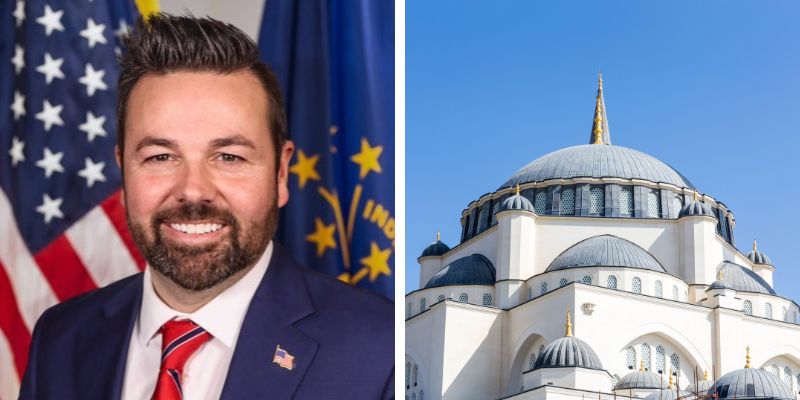
“Yes, I 100% want to ban mosques in America from blaring the Muslim call to prayer through loudspeakers 5 times a day.”
The lieutenant governor of Indiana has called for the banning of public calls to prayer that originate from Muslim mosques five times a day. In some instances, mosques will use loudspeakers to publicly announce the call to prayer for participants.
Indiana Lt. Governor Micah Beckwith said that Muslims should be banned from having the public calls to prayer while he was speaking to Daniel Horowitz on the commentator’s podcast, Conservative Review.
He said, “We should ban the call to prayer, public calls to prayer.” The term for the call to prayer is “Adhan” which is the public announcement for Muslims to pray five times during the day.
“If you’re a mosque and you want to have a loudspeaker and you want to start pumping these out five times a day locally, the state can say, ‘You’re not going to do that,'” he added. “We’re not allowing that. We’re not going to let you put these words of death and destruction throughout the city streets in any of our cities.”
After making the comments, he doubled down on X, saying that he was getting a lot of media requests to clarify his comments. “I’ve received multiple media requests today asking for comment on my recent call to ban mosques in America from blaring the Muslim call to prayer through loudspeakers 5 times a day across our cities.”
“Just to save time, here’s my official response: Yes, I 100% want to ban mosques in America from blaring the Muslim call to prayer through loudspeakers 5 times a day across our cities. Hope this clarifies everything and have a great weekend!” he added.
Legal action to support the move would likely deal with First Amendment challenges. Although the First Amendment guarantees the right to free speech, religion, and expression, there are time, place, and manner restrictions on expression in the public setting. Nuisance laws are an example of the use of time, place, and manner restrictions to curb free speech. However, the government cannot stop or block the content of free speech or the exercise of religion.
An outright ban on the call to prayer would likely face an uphill legal battle.