

John Wilkes Booth, who assassinated President Abraham Lincoln in 1865, was a Democrat and an ardent defender of slavery and the Southern cause. The Confederacy’s political leadership was also overwhelmingly Democratic. Confederate President Jefferson Davis and most Confederate officials came from the Democratic Party, which before the Civil War was the party most closely associated with defending slavery and states’ rights. By contrast, the Republican Party, founded in 1854, emerged largely in opposition to the expansion of slavery.
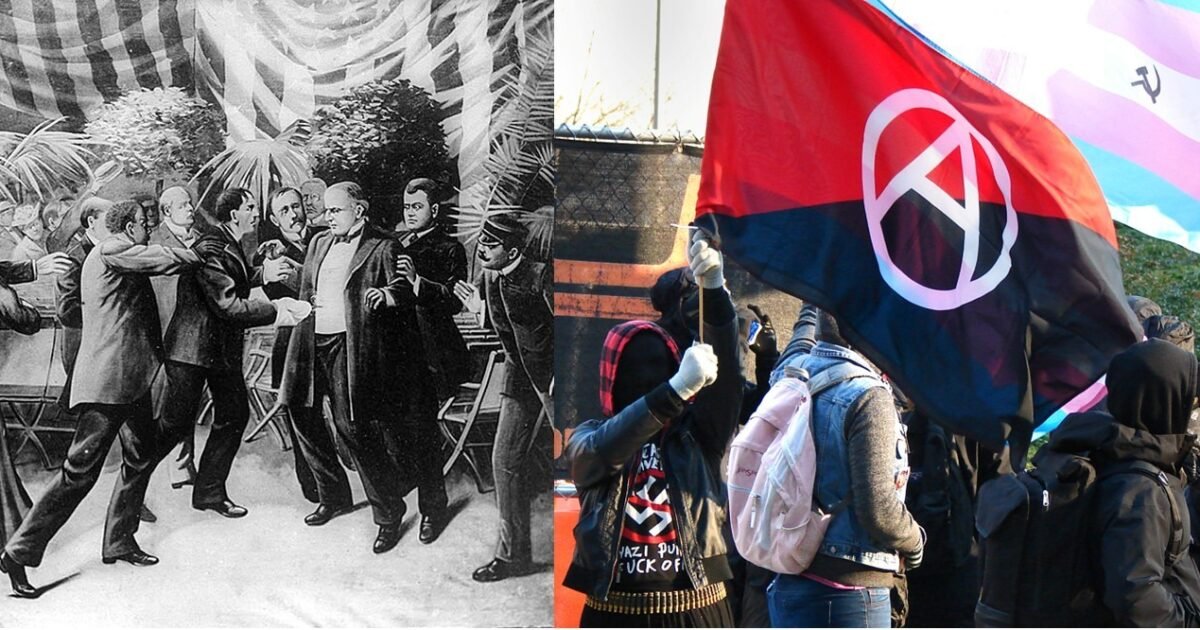
The Lincoln assassination was just the beginning of Democrat and left-wing violence in America. On September 6, 1901, Leon Czolgosz, a self-described anarchist inspired by Emma Goldman’s speeches, fatally shot President William McKinley, who died eight days later. The assassination marked an early major act of anarchist political violence in the U.S. and foreshadowed the terrorist campaigns of the 1910s and 1920s, rooted in anti-capitalist and anti-statist ideology and the doctrine of “propaganda of the deed.”
The Galleanisti operated amid high labor unrest, resistance to the World War I draft, and government suppression of radical organizations. In April and June 1919, they mailed or detonated dynamite bombs targeting politicians, judges, and business leaders in eight cities, including a blast at the home of Attorney General A. Mitchell Palmer. Leaflets signed “American Anarchist Fighters” demanded the release of political prisoners.
On September 16, 1920, a horse-drawn wagon loaded with roughly 100 pounds of dynamite and cast-iron weights exploded outside J.P. Morgan’s offices on Wall Street, killing 38 to 40 people and injuring more than 140, the deadliest act of domestic terrorism in the U.S. until the 1995 Oklahoma City bombing.
The attacks triggered the First Red Scare and the Palmer Raids of 1919–1920, which brought mass arrests and the deportation of hundreds of radical non-citizens. Anarchist violence largely faded by the mid-1920s amid the government crackdown and the rise of Bolshevism and communism, which drew radical support away from pure anarchism.
Left-wing terrorism receded through the Depression and World War II as federal law enforcement pressure mounted, labor unions integrated into institutional politics, and the Communist Party USA shifted toward lawful political activity. By the 1950s, violent activity had moved toward anti-colonial nationalism tied to Marxist-Leninist causes, led by the Puerto Rican Nationalist Party under Pedro Albizu Campos.
Its adherents attempted to assassinate President Harry Truman at Blair House in 1950, and on March 1, 1954, four nationalists opened fire from the House gallery, wounding five members of Congress.
The late 1960s brought a new peak of American left-wing terrorism, driven by opposition to the Vietnam War, the draft, government surveillance under COINTELPRO, capitalism, racism, and support for Black liberation and Third World revolutionary movements. Many participants emerged from Students for a Democratic Society, the Black Panther Party, and the broader antiwar and civil rights movements, adopting Marxist-Leninist, Maoist, or Black nationalist ideologies and going underground.
According to FBI historical accounts and Bryan Burrough’s 2015 book “Days of Rage,” the 1970s saw more than 2,500 domestic bombings in the U.S. in 1971 and 1972 alone, averaging several per day at their peak and hitting government buildings, corporations, police, and military-related sites.
The Weatherman faction of SDS broke into rioting during Chicago’s Days of Rage in October 1969 and went underground as the Weather Underground Organization, adopting anti-imperialist Marxism. A 1970 Greenwich Village townhouse explosion killed three of its own members while they assembled bombs. The group’s subsequent intentional bombings, including strikes on the Capitol in 1971, the Pentagon in 1972, and the State Department, generally targeted property and were preceded by warning calls. The group remained a high-profile underground presence into the mid-1970s.
The Black Liberation Army, an underground Marxist-Leninist offshoot of the Black Panther Party, carried out armed robberies described internally as “expropriations,” assassinations of police officers in 1971 and 1972, and other attacks framed around Black self-determination and war against the state. It remained active roughly from 1970 to 1981. The Symbionese Liberation Army, a small and cultish Marxist group based in California, assassinated Oakland schools superintendent Marcus Foster in 1973, kidnapped Patricia Hearst in 1974 and involved her in a subsequent bank robbery, and committed other crimes.
FALN, a Marxist-influenced Puerto Rican separatist group seeking independence, with Cuban ties claimed by authorities, waged a bombing campaign of more than 130 incidents across the 1970s and into the mid-1980s, targeting banks, corporations, and government sites, mainly in New York. Its January 24, 1975, bombing of Fraunces Tavern in New York killed four people and injured more than fifty. The group’s campaign killed six people in total.
The United Freedom Front, also known as the Sam Melville-Jonathan Jackson Unit, bombed courthouses and military contractors and robbed banks along the East Coast from the mid-1970s into the 1980s, targeting companies doing business with South Africa. One member killed a New Jersey state trooper in 1981.
Amid US military interventions in Central America and the Caribbean and opposition to South African apartheid, the late 1970s and early 1980s saw the movement fragment into isolated, tightly knit cells as broad public support collapsed. The May 19th Communist Organization, also called the Revolutionary Armed Task Force or “the Family,” was a female-led alliance of former Weather Underground and Black Liberation Army members supporting revolutionary struggles in southern Africa, Central America, and Puerto Rico.
It helped Black Liberation Army member Assata Shakur escape to Cuba, and on October 20, 1981, joined with BLA veterans in the Brink’s armored-truck robbery in Nyack, New York, killing a security guard and two police officers. On November 7, 1983, the group bombed the Senate wing of the US Capitol in response to US military action in Grenada and Lebanon, causing more than $1 million in damage.
The New World Liberation Front carried out numerous additional bombings targeting capitalism during this period. Intensive FBI investigations, including Operation Resistance, along with forensic advances and a wave of arrests, dismantled these underground networks by the mid-1980s, compounded by internal factionalism and the end of the Vietnam War.
By the late 1980s, the dominant strain of left-wing violence had shifted to single-issue environmental and animal-rights sabotage, often labeled eco-terrorism and traceable less to the 1970s Marxist groups than to the animal-rights movement’s UK predecessor, the Band of Mercy, formed in 1972. The Earth Liberation Front formed in Brighton, England, in 1992 and began US operations with an arson in Oregon in October 1996. Between 1996 and 2001, self-proclaimed members of ELF and the Animal Liberation Front committed 20 acts arson across five western states, tied to a 65-count 2006 federal indictment in the District of Oregon.
Rebecca Jeanette Rubin, a Canadian citizen, was among those charged for an October 2001 arson at a Bureau of Land Management wild-horse facility in Litchfield, California, that caused more than $207,000 in damage, built from five-gallon buckets of gasoline and heavy petroleum distillate fitted with delayed dual-timer igniters, and separately faced an eight-count indictment for the 1998 destruction of lodges and buildings at the Vail, Colorado, ski resort.
Rubin surrendered to the FBI in November 2012 after roughly a decade of evading capture and pleaded guilty in 2013 to conspiracy and arson. In January 2014, U.S. District Judge Ann Aiken sentenced her to five years in prison and ordered $13.9 million in restitution. At sentencing, as reported by Maclean’s, Rubin said impatience, anger, and self-righteousness had driven her actions alongside her environmental beliefs, while prosecutors described her ideology as “hard-core” activism.
In February 2002 testimony archived by the FBI, Domestic Terrorism Section Chief James Jarboe told Congress that ALF and ELF had committed more than 600 criminal acts in the US since 1996, causing over $43 million in damage. FBI Deputy Assistant Director John Lewis told a Senate committee that ALF/ELF activity was “way out in front” of any other category of domestic terrorism in the number of violent crimes and incidents recorded.
No fatalities have been attributed to ELF or ALF actions in the US; a 2005 Senate hearing noted that ELF and ALF had “not killed anyone to date.” The FBI’s designation of ELF/ALF as the top domestic terrorism threat followed a decade in which most groups on the Bureau’s domestic terrorism list were left-wing; the Ku Klux Klan remained an exception, active through the 1970s, and in November 1979, Klan Nazi members killed five demonstrators in what became known as the Greensboro massacre.
The Klan’s last documented killing came roughly seventeen months later, on March 21, 1981, when two Klansmen abducted, beat, and lynched 19-year-old Michael Donald in Mobile, Alabama, an act widely recognized as the last lynching in American history. A subsequent civil suit brought by Donald’s mother bankrupted the United Klans of America, and no KKK-attributed killing has been documented in the roughly 44 years since. ELF and ALF activity wound down by the mid-2010s following Operation Backfire, the FBI-led investigation that produced prison sentences for Rubin and her co-defendants.
The DOJ’s April 2026 indictment, expanded in a June 2026 superseding indictment, states that the SPLC funneled more than $4 million in donor funds to individuals affiliated with the KKK, the United Klans of America, and the American Nazi Party between 2014 and 2023, payments SPLC does not dispute. SPLC says the funds went to paid informants for intelligence-gathering shared with the FBI; DOJ alleges the money financed KKK cross-burnings, robes, and other operational materials. The case is pending.
The original Black Panther Party dissolved by the early 1980s, but self-described successor organizations remain active, including the Black Riders Liberation Party, a Los Angeles-based group founded in 1996 that describes itself on its own website as “the new generation of the Black Panther Party for Self Defense.” The group played a leading organizing role in the 2012 May Day demonstrations in Los Angeles.
Separately, the Party for Socialism and Liberation, a Marxist-Leninist group whose website has published articles on the Black Panther Party’s legacy, was named by Senate Judiciary Subcommittee Chairman Josh Hawley in a June 2025 letter requesting records related to its alleged support for the 2025 Los Angeles immigration-enforcement protests.
The Antifa movement draws on anti-fascist organizing traditions dating to 1920s and 1930s Europe and has been active in the US in its current form since roughly 2016, organized around opposition to a broad range of targets associated with the political right rather than a single environmental or animal-rights cause.
President Trump designated Antifa a domestic terrorist organization in a September 2025 executive order, and Michael Glasheen, operations director of the FBI’s National Security Branch, told Congress in December 2025 that Antifa is the bureau’s “primary concern” and “the most immediate violent threat” it faces.
The post From John Wilkes Booth to Antifa: The Evolution of Left-Wing Terrorism appeared first on The Gateway Pundit.