 EPA
EPA
The twenty-seven foreign ministers of the European Union approved new sanctions on Monday on Israeli settlers over rising violence against Palestinians in the occupied West Bank.
There has been a surge in attacks by settlers since the start of the Gaza war in October 2023, the UN has recorded.
Settlements – illegal under international law – are built on Israeli-occupied land in the West Bank and East Jerusalem, areas Palestinians claim for a future state.
The EU foreign policy chief, Kaja Kallas, said it was “high time we move from deadlock to delivery… extremisms and violence carry consequences.”
A change in government in Hungary ended months of delays to the EU’s plans for further sanctions, which had been blocked by the former right-wing Hungarian prime minister Viktor Orban, a close ally of Israel.
The French foreign minister Jean-Noel Barrot wrote on social media that the EU was “sanctioning today the main Israeli organisations guilty of supporting the extremist and violent colonisation of the West Bank”.
Israel’s foreign minister Gideon Sa’ar said the decision was “arbitrary and political” and that Israel would continue to “stand for the right of Jews to settle in the heart of our homeland”.
Successive Israeli governments have allowed and encouraged settlements to grow. Expansion has risen sharply since Prime Minister Benjamin Netanyahu returned to power in late 2022 at the head of a right-wing, pro-settler coalition, as well as the start of the Gaza war, triggered by the armed Palestinian group Hamas’s 7 October 2023 attack on Israel.
There is still technical and legal work that must be done in the EU before the sanctions are officially imposed.
EU officials said that seven settlers or settler organisations would be sanctioned. The EU also agreed to sanction more representatives from Hamas.
 Reuters
Israeli media have reported that the sanctioned individuals and organisations include Daniella Weiss, who is already sanctioned by the UK and is known as the “godmother” of the settler movement.
It is also reported that they include the organisations Nachala and Regavim, movements that promote settlements, as well as HaShomer Yosh and Amana, organisations that help to finance and assist unauthorised settlements known as outposts.
Meir Deutsch, the CEO of Regavim, and Avichai Suissa, the CEO of HaShomer Yosh, are also reportedly on the list. Suissa was sanctioned by the US in 2024, but removed from the sanctions list under Donald Trump.
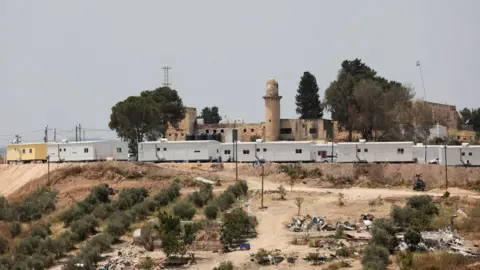
Israel has built about 160 settlements housing some 700,000 Jews since it occupied the West Bank and East Jerusalem in the 1967 Middle East war. There are periods of near-daily reports of violence by settlers towards Palestinians. The UN documented more than 1,800 settler attacks in 2025 that resulted in casualties or damage to property, in around 280 communities across the West Bank.
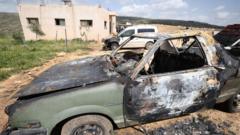
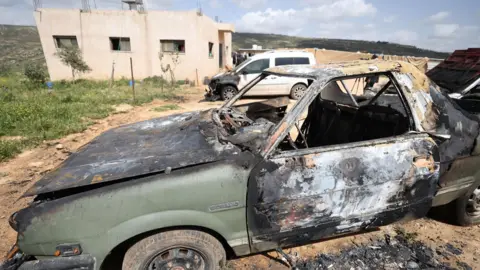
Recent examples include allegations Israeli settlers forced Palestinians to exhume a grave, which the UN human rights office condemned as “appalling”; a Palestinian man shot dead by an Israeli during a settler attack in the village of Tayasir; and a spate of attacks on villages including homes, vehicles, and agricultural fields set on fire.
A number of EU countries have also pushed to ban products from Israeli settlements in the West Bank, although the EU has not yet reached consensus on this.
Israeli foreign minister Sa’ar said Israel “firmly rejects the decision to impose sanctions on Israeli citizens and organisations”.
He added: “The European Union has chosen, in an arbitrary and political manner, to impose sanctions on Israeli citizens and entities because of their political views and without any basis.”
“Equally outrageous is the unacceptable comparison the European Union has chosen to make between Israeli citizens and Hamas terrorists. This is a completely distorted moral equivalence.”