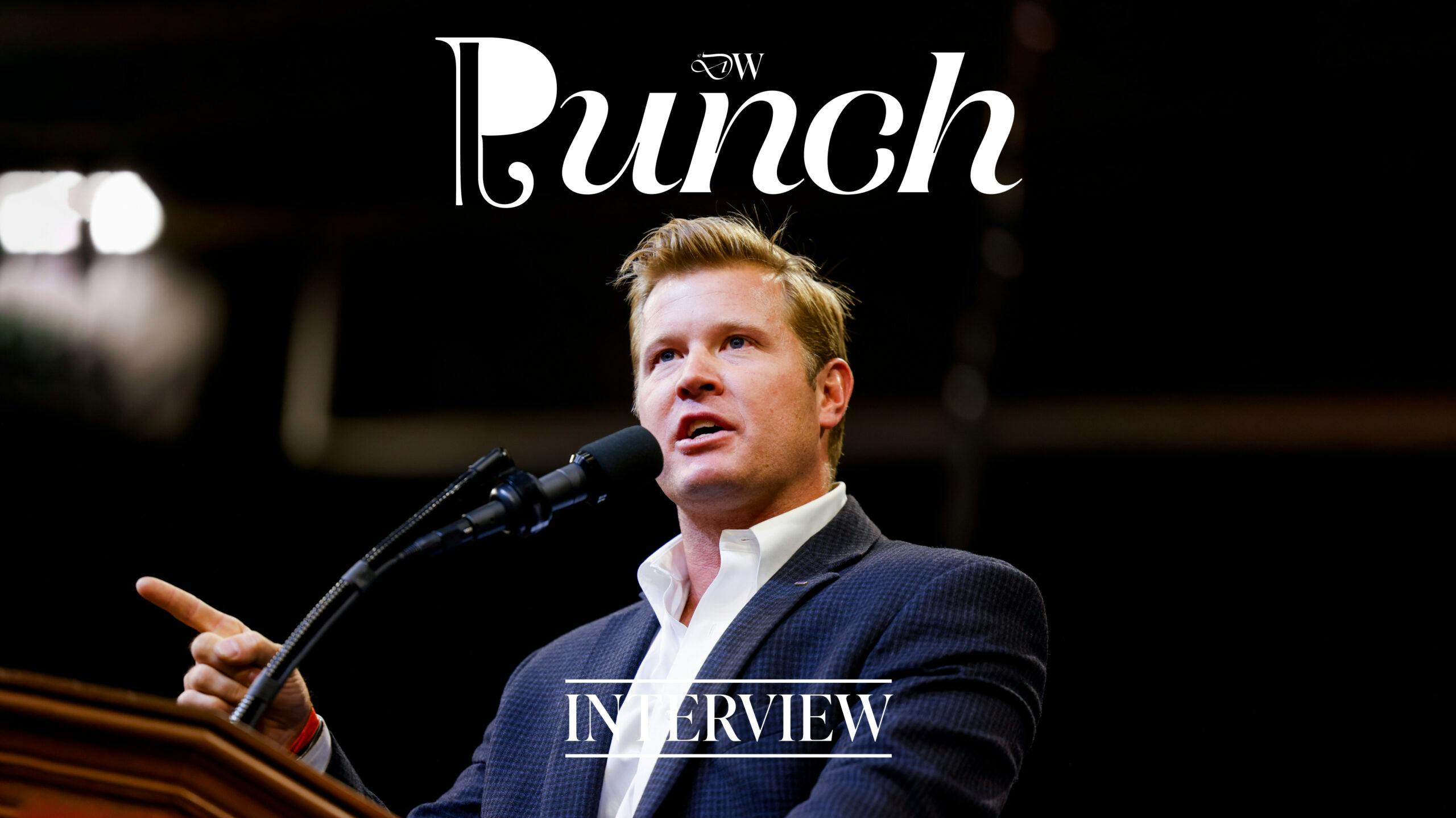
“Death to America.” These are the only words Tim Sheehy needs to hear to understand what motivates the Iranian regime. The senator from Montana and former Navy SEAL understands this threat and doesn’t hesitate to speak plainly about what is at stake for America and the broader Middle East. In this weekend’s Punch interview, DW talks with Sheehy about the importance of the fight with Iran to the future of the region and American interests, the rise of radicals within our borders, and his views on the Trump administration’s foreign policy strategy.
***
Ben Domenech: Why do you think that what you had to say about this current situation with Iran hit a nerve with a lot of people?
Tim Sheehy: I don’t have any problem with us trying to come to an agreement with Iran. That’s not the issue. My issue’s not with the administration or the negotiating teams. The issue is with Iran. And as one of the few people on the Hill who actually fought the Iranians directly, and their proxies, who spent years of my life — and my wife’s a combat veteran and all my friends — fighting against the Iranian influence. I think it gives us a very clear-eyed realization of how insidious the IRGC [Islamic Revolutionary Guard Corps] and their proxy groups really are and how brutal and barbaric they actually are.
Their designs on the world don’t end with Israel in the Persian Gulf or with Azerbaijan. They want a global caliphate, and they will literally kill everybody to get that caliphate. And they don’t want to kill them in a lethal injection snap of a finger. They want to brutally wipe us off the face of the earth, like what happened on October 7.
They want us to be in pain. They want us to be burned alive and destroyed. So I think we have to keep that in mind, and trust cannot be a component of our negotiations. We cannot have them say something, and we say something, and we trust that they’re going to carry it out. And I support President Trump and his team’s campaign. I think it was way overdue — the first president ever to do this. And I support getting a resolution to the conflict that truly has structural limits around it because we don’t want to invade Iran.
We don’t want 500,000 troops there. But I simply feel propelled as someone who fought there and who lost friends to Iran, to remind our side of this negotiation that we need to not forget who we are dealing with. We need to remember what they’re capable of and what they want because we don’t have to think or assume what they want; they tell us that every single day, and they act on it every single day. And that is death to America, death to Israel.
BD: Do you think that there is an attitude of naiveté about the Iranians that has perhaps seeped in over the last couple of years, just given the fact that people are so tired of foreign wars, but particularly of Middle East wars, that they perhaps downgrade that threat mentally?
TS: I think that is the wrong answer. I think it’s just general non-awareness of the threat. I mean, the average American, the average politician, the average person who works in government is not aware of what Iran has done, does every day, and is capable of. They’re just not. And that’s a good thing, Ben. That’s the whole point of these forever wars that everyone hates, and I get it. I fought them, too. I don’t like forever wars, but we’ve been able to keep this terrible threat at bay thousands of miles away for the last 50 years. And that’s a good thing. As a result, the average American, luckily, doesn’t have a personal experience with radical Muslim psychopaths who want to murder them and their family. And as a result, they’re like, “What’s the big deal? Why do we care about Iran? I don’t want six-dollar-a-gallon gasoline; this is unpopular. Let’s get back to bringing inflation down, housing prices down, and immigration under control.” All very valid points, and they’re not wrong, but they’re also just not aware that because we’ve kept these savages at bay, they actually still exist. And not only do they exist, but they also want to come kill us. And I don’t want it to be another 9/11. I don’t want it to be another October 7. And I certainly don’t want to funnel billions of dollars, as Obama did, into a terrorist regime that wants to kill all of us in any way possible. So I don’t think it’s naive today. It’s generally not awareness of the reality of it. And I think the vice president and his team are cheering on the president’s directive to try to bring an orderly close to this. And I think it’s very important.
I’ve expressed skepticism about our ability to get a deal. I have not expressed skepticism about the president and his team at all. I’m simply reminding everyone that our counterpart here is not trustworthy. And our counterpart will say and do anything to create time and space to rebuild themselves and come at us. They have a very long view on this; they’re not in a hurry. They say, “You know what? Fine. This guy Trump, he’s pretty tough on us. Let’s just play nice. Let’s get a few hundred billion dollars of revenue. We’ll act like nice people for a couple of years until he’s gone, and hopefully we’ll get another Biden or Kamala or Mamdani for Christ’s sake. That would be a dream come true.” And then they’re like, “Great, we’re back, baby.” And then, with all the money we give them access to, they’ve rebuilt a whole new infrastructure.
One thing we did learn from this is that a lot of people underestimated how many drones and missiles these dudes really built. They had them buried everywhere, like squirrels with acorns. And on every mountain, they had a goddamn cave full of missiles. And we’re like, “Where did those come from? Oh, they came from the American taxpayer when we gave them the money to build them.” And I’ll be goddamned if we let that happen again.
BD: You talk about radical Muslim psychopaths. I think that you could be talking about them or you could be talking about the latest round of Democrats who ran and won in New York this week. Why do you think the Democratic Party is tolerating this degree of psychopathy on its side? And do you think it’s actually a more serious problem than perhaps Republicans have been paying attention to? As much as they talk about it, I feel like they didn’t take it seriously.
TS: I don’t think they did. And once again, I try not to be a history professor, but sometimes you have to remind people where these issues come from. As you well know, the Red Green Alliance goes back a long way. Radical Islam and Marxist communist ideology have been interwoven for the last 60 years. This is nothing new. The IRGC is really the most virulent example of that. The Ayatollah Khomeini’s rise in 1979 was very much a Red-Green alliance. So this collectivist, Marxist-revolutionary mindset is interwoven with radical Islamic ideology in many ways. And it’s always been there. Hell, even the Civil Rights movement and the Black Panther Movement were very tied in with that. Muhammad Ali changed his name because of that. So there’s always been that tie. But I think what’s happened lately is there’s been a very targeted investment into our media markets by Muslim influencers who don’t like us.
They’re paying off people to say things specifically to incite opinions and events that are obviously, number one, antisemitic and number two, anti-American. It’s a very engineered attempt to undermine the fabric of our society. And the Democratic Party, of course, traditionally the home base for the American Jewish voter, shockingly became their vessel to do this. I shouldn’t say shockingly because, actually, it makes perfect logical sense, because the Democratic Party has drifted more and more into the Marxist direction of the past couple of decades, which again, is a natural home for radical Islamic ideology.
So I’m not surprised by this per se, but I am disappointed that the establishment hasn’t made a stronger effort to clarify their moral positioning. Because at this point, as you know, the Democrats for the last 30 years, anytime there’s a policy disagreement with Republicans, we’re racist, we’re Nazis, we’re homophobes, we’re transphobes, and we’re sexist. Pick your name, and they call us that. Well, now they’ve embraced an ideology that literally murders gay people, that stones women to death, that condones the rape and murder of innocent families on October 7, and then condones terrorist attacks that have killed thousands of Americans.
In a terrible way, it’s politically good for Republicans because they have removed any moral high ground, if they ever had any, to accuse us of being anti-women, anti-minority, or racist. They don’t have a soapbox anymore because their flagship candidate – the leader of the Democrat Party today – is Zohran Mamdani. That is who leads the Democrat Party. That is their mascot, and that is their messaging platform.
BD: You mentioned that this has been something that’s been fomented. There’s an interesting piece that ran in New York magazine recently called “Your Feed Is Fake,” which dug into the number of essentially AstroTurfed campaigns designed to help things go viral. They were looking at it in the context of mostly Hollywood, but also other things. Just to give one example, there were firms that were hired around the Sydney Sweeney Jeans ad that were fomenting and pushing both sides of that argument, meaning the negative and the positive at the same time, to gin up more activity. Do you think there needs to be some kind of transparency requirement, or more government attention, to the number of people out there who are paid influencers advocating for these DSA plans because they are everywhere?
TS: There absolutely should be. And to your point, I do think, though, the podcast-social media influencer world has reached its peak because I think in the 2024 election, we saw that the podcasters were a game changer, the influencers were a game changer, and that’s because it was legitimate. And I think it’s been so saturated now. There are so many podcasts, and so many fake influencers with AstroTurf content, that the average person is now starting to just not believe any of it, and they don’t have the bandwidth to absorb it all. So I think we’re going to start to see the influence wane. I think it already is waning, but I do believe, just like in TV commercials, there should be a requirement to disclose who’s paying for this. You can’t run a political ad without saying who’s paying for this and this is no different. So that would obviously fall within my purview as a member of the Commerce committee. And I think there’s already been discussions about that to say, listen, you should be forced to disclose who’s paying you for this podcast.
If a foreign government gave you $20 million to buy your podcast, well, you need to say that because if you’re going to pretend like you’re in your basement in the heartland with your Coors Lite beer and a rifle on the wall and act like you’re a red-necked hillbilly, but in fact, you’ve been bought by the Chinese Communist Party, well, we should know that.
BD: The issues related to Iran obviously flow into other foreign conflicts. And one of the big open questions is what does this mean for China – particularly their interest in Taiwan? Do you think that, given the way this played out, it makes China’s attempt to take Taiwan and absorb it more or less likely?
TS: I think on the whole, this whole campaign makes it less likely. Number one, we had a tremendously successful military campaign, and despite the media just looking for any reason to bash the president, despite the Democrats being abjectly un-American during this process by going after our troops. It was disgusting how the internal backstabbing was happening here against our campaign, against the country that’s been working after 47 years. So I think we displayed a level of precision and ferocity in those strikes all the way from Midnight Hammer through the latest campaign that China said, “That’s oppressive. They can’t do that.” But let’s not forget that China has not fought a war since the Korean War, from 1950 to 1953. So they have a big paper-tiger military that should not be underestimated but is not combat-tested, unlike ours. So we showed extreme capability and ferocity in our targeting. That’s going to give them a good bit of pause.
At the same time, look at Ukraine and say wow, Russia – big, giant, big bear Russia – they’ve been beaten back and essentially knocked into a stairway now by little old Ukraine with a bunch of off-the-shelf drones and scrappy fighters and trenches.
So China will realize it’s a lot harder to project military power, especially across a body of water, than you think. It has really only been one time in history where military power has been successfully projected amphibiously over a body of water. That’s America during World War II with our island-hopping campaign and the Normandy invasion. It’s really hard to quickly and effectively move thousands of people across a body of water without getting your ass kicked. So I think that will be a tale of caution.
At the same time, though, if China is able to hack this deal in some way on the backend and recognize revenue from a very dependent Iran.
China is always dependent on cheap, sanctioned Iranian oil. That’s been a superpower for their economies. They get oil for cents on the dollar. With Iran being weaker than ever, they’re going to be more and more desperate to make a deal with China, and they may even give them cheaper oil, and China can take more of it for cheaper. Additionally, sanctions-dodging will continue. No matter what we do, they aren’t going to follow any sort of sanctions regime. So they’re going to want to try to find a way to continue to use the Chinese yuan as their exchange currency for oil, and that’s, of course, good for China and bad for us. So on the whole, this is going to be worse for China and the designs on Taiwan, but in the end, they might have better access to Iranian oil.
BD: I’m just going to ask a question on behalf of one of our younger staffers. She said, “Why didn’t we just keep bombing, and why didn’t we bomb the IRGC?”
TS: Well, that’s obviously a question for the executive branch. I’m not in the chain of command, so I can’t give you specific reasoning why. The reality is probably that a full collapse of the government would have required the follow-on commitment of ground forces, be they American, allied, Kurdish, or others, which I think would have required a broad alliance to support. And my assumption is that at the time, nobody wanted that. The American people have made it very clear they’re tired of ground wars in the Middle East. They don’t want it. And I think that the president said, “Listen, we’ll do what we have to do, but I think we can probably get this done without that.” And I think that’s where it ended up. However, I’ll say the president is absolutely locked and loaded and ready to go back in again for another round should they welch on these talks and resume their bad behavior.
***