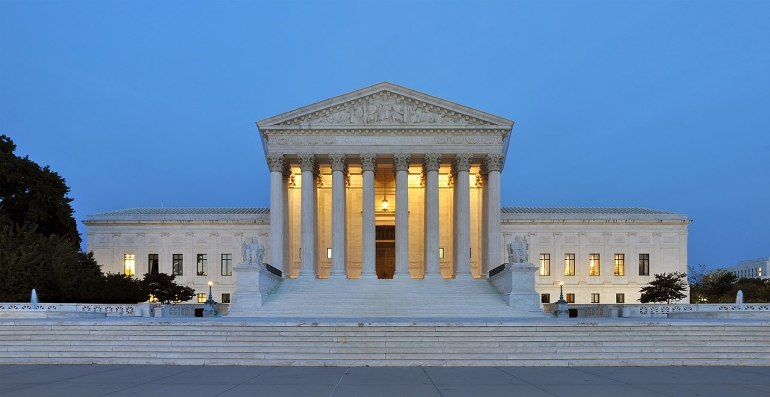
In a decision that shouldn’t have surprised anyone, the U.S. Supreme Court ruled that Democrats can no longer create safe electoral fiefdoms based on race to win elections, calling it “racial gerrymandering.” It’s about time.
The ruling essentially “neuters,” as some put it, Section 2 of the Civil Rights Act of 1964. PJ Media scribe Matt Margolis called the decision “one of the most consequential redistricting decisions in a generation.” That’s not hyperbole. And it was long overdue.
While still upholding the landmark Voting Rights Act, a 6-3 conservative majority found that a redrawing of Louisiana’s congressional map to include a second majority-black district violated the 15th amendment.
However, “In striking down a Louisiana voting map as a racial gerrymander,” the New York Times noted, “the Court opened the door for other states to redraw maps.”
Other media jumped in, some saying the decision “guts” or “eviscerates” the Civil Rights Act of 1964 (it does no such thing; it simply follows the actual language of the bill and of the Constitution’s 15th Amendment.)
Can screaming allegations of “racism!” be far behind?
The winner for greatest hyperbole (so far) goes to Esquire, which wrote: “Medgar Evers and Martin Luther King Jr. and Viola Liuzzo did not die just for the conservative majority to commit this heartless act of political vandalism.”
For the record, MLK Jr. may well have been a Republican, as his father and MLK Sr. was. And genuine civil rights heroine Viola Liuzzo, a white mother of five from Detroit, was murdered by members of the Ku Klux Klan (a group created by Democrats after losing the Civil War).
As leftist historian Eric Foner of Columbia University has written: “In effect, the Klan was a military force serving the interests of the Democratic Party.”
So can we stop the “Republicans are racist” trope?
Nowhere in the Voting Rights Act does it say that racially imbalanced voting districts need to be created to enfranchise African-American voters; indeed, as the Civil Rights Section of the Justice Department’s description says, it “prohibits voting practices or procedures that discriminate on the basis of race, color, or membership in one of (a number of) the language minority groups.”
Does creating a new concentrated voting bloc of likely Democratic voters boost the voting rights of Louisiana’s black citizens?
Let’s look. Louisiana has six congressional representatives. Two of them are African American, both Democrats. That’s 33%, according to Wikipedia and Ballotpedia. What percentage of Louisiana’s population is African American? About 31%.
Nothing wrong with that. But if so, black voters in that culturally rich state can’t in any meaningful way be “disenfranchised” by not having a second racially gerrymandered district.
As left-leaning Verite News describes the new, gerrymandered 6th District: “The state’s new congressional map shifts the demographics of the 6th District from a whiter, Republican stronghold based in south Baton Rouge and its suburbs to a mostly black district that spans from north Baton Rouge to Shreveport.”
So by numbers the whole exercise seems to be a transfer of power outside any definition of actual “equality.”
All in the service of the Democratic Party, which screams “racism” anytime the Republican Party (which was founded to end slavery and turn African slaves into actual citizens with constitutional protections) seems likely to win an election.
But the Constitution’s language and intent is precise. So is the Voting Rights Act.
As Justice Samuel Alito wrote for the majority, “because the Voting Rights Act did not require Louisiana to create an additional majority-minority district, no compelling interest justified the State’s use of race in creating SB8 (the new Louisiana political district), and that map is an unconstitutional racial gerrymander.”
In other words, the gerrymander was purely political, using race and the Civil Rights Act as a smokescreen for Democrats to regain control of Congress. It therefore has no constitutional or statutory standing.
By the way, blaming “conservatives” for “tearing down” the Civil Rights Act of 1964, as some do, has it exactly backward. Republicans passed the Civil Rights Act, not Dems.
“Eighty percent of Republicans in Congress supported the bill. Less than 70% of
Democrats did. Democratic senators filibustered the bill for 75 days, until Republicans
mustered the few extra votes needed to break the logjam,” wrote Carol Swain, a retired Vanderbilt University political science professor.
The latest decision would seem to require many states in the South, where the creation of African-American dominant districts have given Democrats a clear advantage in several states, to undo such moves. Why? It does nothing to enhance voting rights, or equality. It’s a political tool.
That’s trouble for the Dems. Here’s how the New York Times saw it last October:

A massive swing, without favoring Democrats. This is what they fear most.
Again, our friends at PJ Media: “Democrats have spent years leaning on majority-minority districts as a structural advantage — a way to pack reliably Democratic voters into safe seats under the cover of civil rights law, unconstitutionally expanding their majority in Congress.”
Exactly. Mississippi is already moving to restore normal voting rights, and Tennessee, Alabama, South Carolina and Georgia aren’t far behind. Neither is Texas. Racial gerrymandering invites conflict, cynically uses African-Americans as an electoral prop, and distorts the will of the people.
One person, one vote. That’s how Americans and the Constitution see it. Not, “my block of racialized voters, against yours.” Is that a country anyone wants to live in?
— Written by the I&I Editorial Board