PROPHECY, ADEPT, P3, and PREEMPT.
A fifth project, DEFUSE, was submitted under PREEMPT and proposed applying that architecture specifically to bat coronaviruses.
Operation Warp Speed later supplied the industrial-scale manufacturing and deployment layer.
The conventional explanation is that these projects represented prudent pandemic preparedness.
But under my In Silico Theory of pandemic origins, another possibility emerges:
The U.S. military appears to have spent a decade constructing the computer sequence-based predictive, surveillance, diagnostic, pharmaceutical, and deployment infrastructure capable of orchestrating pandemics.
Under this framework, the central object is not necessarily a conventionally demonstrated physical virus.
It is the digital (in silico) sequence architecture accepted as a virus, and the vast machinery capable of converting that architecture into PCR targets, purported cases, surveillance data, computational variants, pharmaceutical products, and emergency policy.
PROPHECY (2010): Building the Predictive Layer
DARPA launched PROPHECY in September 2010, with the stated end goal of “developing drugs and vaccines in advance of need.”
The program sought the ability to “successfully predict the natural evolution of any virus” using platforms and algorithms capable of monitoring alleged rare genetic events and incorporating environmental pressures.
PROPHECY called for high-throughput biological systems that could generate data for predictive algorithms, correlate genotype with phenotype, track mutations and reassortments, and forecast future evolutionary trajectories.
Within the conventional framework, PROPHECY was intended to predict how physical viruses would evolve.
Under the In Silico Theory, however, PROPHECY can be understood as something more foundational: the construction of systems capable of defining and forecasting future genomic sequence space.
That matters because modern pandemic infrastructure operates through accepted sequence information.
PCR targets are selected from sequences.
Variants are computationally inferred from sequences.
Surveillance databases are organized around sequences.
Vaccines can be designed from sequences.
PROPHECY therefore appears to represent the first layer of the system: the capacity to generate, interpret, and predict the informational genetic architecture around which a future pandemic could be organized.
ADEPT (2011): Turning Sequence Information Into Countermeasures
DARPA followed PROPHECY with ADEPT.
ADEPT began investing in gene-encoded medical countermeasures, including DNA- and RNA-based technologies, around 2011 and 2012.
DARPA later credited ADEPT with helping establish the technological foundation for nucleic-acid vaccines and identified Moderna as one of the program’s contracted performers.
Under the conventional story, ADEPT helped the government respond more quickly to emerging infectious diseases.
Under the In Silico framework, ADEPT supplied the pharmaceutical layer necessary to convert accepted genetic information directly into products.
The importance of ADEPT is not simply that it supported vaccines.
It helped establish a system in which a digitally distributed sequence could become the design template for a pharmaceutical intervention without requiring the traditional production model built around growing and purifying an allegedly circulating pathogen.
If PROPHECY developed the ability to map and forecast sequence architectures, ADEPT developed the ability to manufacture solutions from those architectures.
The Gain-of-Function Pause Gap (2014–2017)
The chronology becomes more striking after ADEPT.
In 2014, the federal government paused funding for certain gain-of-function experiments involving influenza, SARS, and MERS.
That pause remained in effect until late 2017.
DARPA’s next major pandemic platform emerged during the period when the government was transitioning out of that pause.
The timing alone does not prove that the programs were designed to evade or replace the pause.
But the sequence deserves scrutiny.
The federal government temporarily restricted some forms of overt pathogen-enhancement research, while the military’s biodefense system increasingly emphasized predictive modeling, programmable countermeasures, rapid deployment, genomic surveillance, and intervention architecture.
P3 (2017): Compressing Sequence-to-Deployment Time
DARPA’s Pandemic Prevention Platform, known as P3, emerged in 2017.
DARPA described P3 as a follow-on to ADEPT and said the program aimed to identify an outbreak and develop and deploy protective countermeasures within approximately 60 days.
P3 was therefore not primarily a discovery program.
It was a speed program.
Its purpose was to collapse the time separating the recognition of a purported threat from the deployment of a medical product.
Within the In Silico Theory, P3 represents the compression layer:
How quickly can an accepted sequence architecture be converted into a deployable countermeasure?
That is a different question from whether a conventionally demonstrated physical virus has been independently verified.
P3 was explicitly meant to operate even when no real virus is ever provided, and “only electronic viral sequence information may be available.”
Once the genomic architecture is accepted, the system can move.
Diagnostic targets can be selected.
Surveillance can begin.
Candidate products can be designed.
Manufacturing can start.
Emergency authorities can be activated.
P3 was designed to shorten that entire sequence-to-intervention cycle.
PREEMPT (2018): Constructing the Animal-Origin Layer
DARPA launched PREEMPT in January 2018.
The program sought to identify allegedly “human-capable” viruses in animal reservoirs and intervene before their alleged spillover into humans.
PREEMPT required field sampling, next-generation sequencing, metagenomics, ecological surveillance, genotype-to-phenotype mapping, mutation identification, machine learning, and near-real-time data sharing.
The program specifically called for models that could capture:
- viral evolutionary trajectories,
- mutations allegedly governing species jumps,
- genetic signatures of fitness,
- and the probability that a purported animal virus could enter humans.
Under the official framework, PREEMPT was designed to stop zoonotic spillover.
Under the In Silico Theory, PREEMPT supplied something equally important: an animal-reservoir context into which future genomic architectures could be placed.
PROPHECY could forecast genetic trajectories.
PREEMPT could search animal populations for matching sequence fragments, construct evolutionary relationships, and generate a computational backstory connecting an accepted human sequence to a alleged wildlife origin.
This does not require claiming that PREEMPT fabricated any particular sequence.
The deeper concern is structural.
PREEMPT created an apparatus capable of turning animal sampling, sequencing, ecological data, and computational models into a purported natural-emergence narrative.
In that sense, PROPHECY and PREEMPT appear complementary.
PROPHECY developed the predictive genetic layer.
PREEMPT developed the field-surveillance and origin-narrative layer.
DEFUSE (2018): The PREEMPT Thread That Reached COVID
DEFUSE was not a standalone DARPA program.
It was an EcoHealth Alliance proposal submitted under PREEMPT in 2018.
The proposal sought more than $14 million for work involving EcoHealth Alliance, the Wuhan Institute of Virology, Ralph Baric’s University of North Carolina team, Duke-NUS, the U.S. Geological Survey, and other partners.
DEFUSE proposed intensive bat sampling, spike sequencing, reverse engineering, receptor-binding experiments, chimeric coronavirus construction, humanized-mouse testing, machine-learning genotype-to-phenotype models, and interventions in bat populations.
Its importance under this theory is not that DEFUSE itself “caused COVID.”
That is too narrow.
DEFUSE matters because it is one granular endpoint of the PREEMPT infrastructure that later became tied to the most recent pandemic.
It shows how the broader DARPA system could be applied to a specific coronavirus narrative:
- sample bats,
- identify sequences,
- model spillover,
- engineer spikes,
- test human-cell binding,
- create predictive applications,
- and intervene in animal reservoirs.
DEFUSE therefore provides a visible case study of what the PREEMPT architecture looked like when aimed directly at SARS-related coronaviruses shortly before COVID.
Under the In Silico Theory, DEFUSE is not the whole story.
It is one exposed strand of a much larger military biodefense yarn.
Operation Warp Speed (2020): The Industrial Deployment Layer
Operation Warp Speed launched in May 2020 as a partnership between the Department of Health and Human Services and the Department of Defense.
Its goal was to produce hundreds of millions of COVID-19 vaccine doses on a radically compressed timeline.
The federal government funded manufacturing while clinical trials were still underway, overlapped development stages that were traditionally sequential, and assumed enormous financial risks to place products into mass production before final authorization.
By the end of 2020, HHS and DOD had obligated approximately $13 billion toward vaccine development, manufacturing, and distribution.
Operation Warp Speed was not a DARPA program.
But it appears to have operationalized capabilities DARPA had spent years developing.
ADEPT helped establish programmable nucleic-acid platforms.
P3 sought a 60-day countermeasure timeline.
Operation Warp Speed then demonstrated how the federal government could move from accepted sequence architecture to mass-produced pharmaceutical intervention at national scale.
OWS was therefore not the beginning of the system.
It was the deployment event that revealed how mature the system had become.
The DARPA Pandemic Stack
Viewed together, the sequence is difficult to ignore:
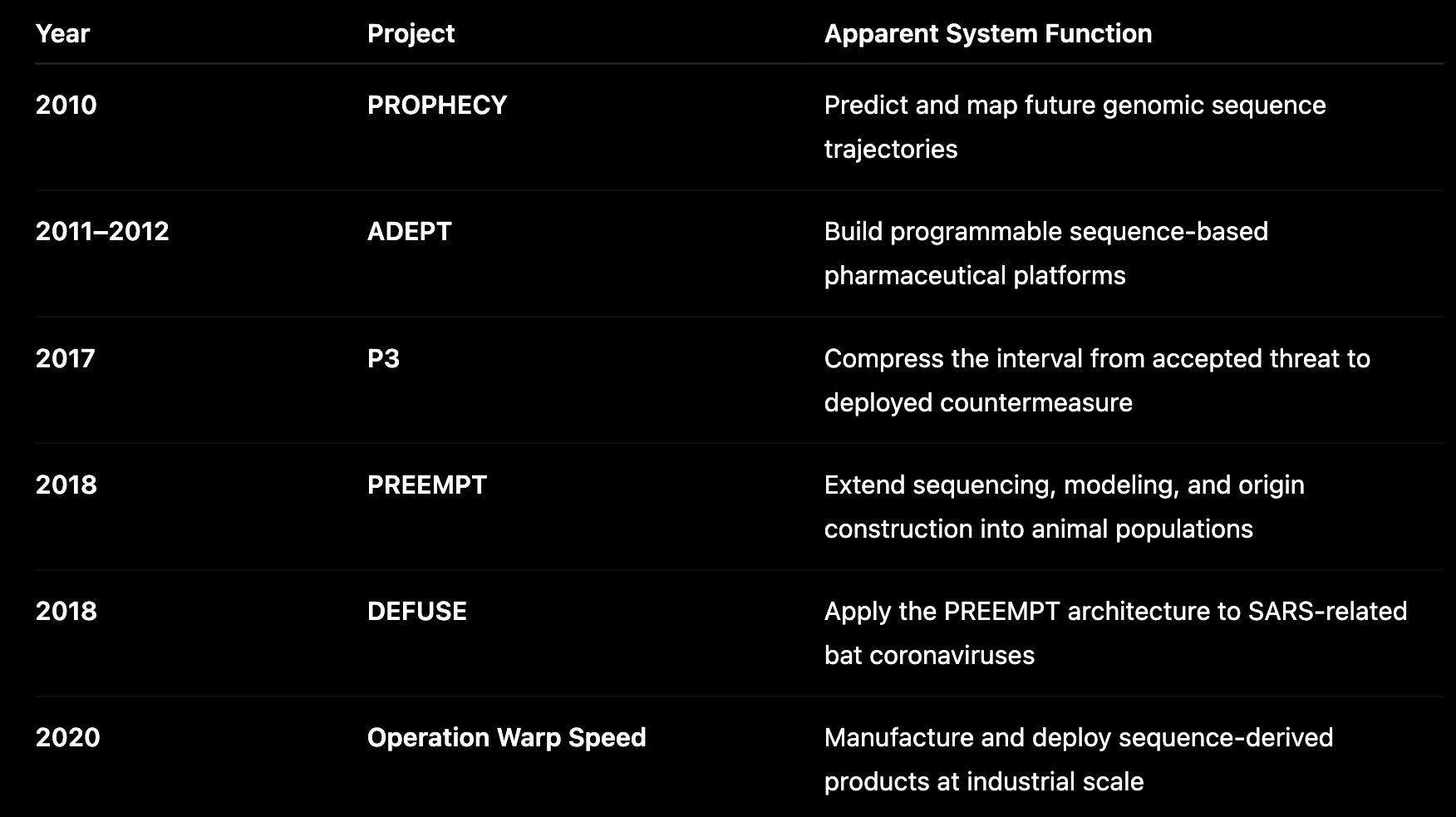
Under the conventional interpretation, these are separate biodefense projects.
Under the In Silico Theory, they appear more like successive components of one vertically integrated system:
Predict the sequence.
Build the product platform.
Compress deployment time.
Construct the animal-origin framework.
Apply it to specific coronavirus architectures.
Deploy the countermeasure at population scale.
The Central Operational Object
The standard pandemic model begins with a pathogen.
The In Silico Theory begins with pre-accepted genomic information.
Under the standard model: virus ? illness ? isolation ? sequencing ? diagnostics ? vaccines
Under the In Silico model: accepted sequence ? PCR targets ? purported cases ? surveillance databases ? computational variants ? pharmaceutical design ? emergency governance
The distinction is critical.
PCR does not independently establish the existence of a complete, intact, disease-causing virion in each person labeled a case.
It amplifies predefined sequence targets selected from an accepted genomic reference.
Variants are not physical objects independently pulled from every patient.
They are computational classifications produced by comparing sequence data against accepted references.
The vaccines themselves were designed around accepted spike-sequence architecture.
The sequence did not merely describe the pandemic.
It powered the infrastructure that made the pandemic operational.
COVID May Have Been One Deployment, Not the Final Objective
The narrowest interpretation of these programs is that DARPA anticipated a future pandemic and prepared for it.
The more troubling hypothesis is that DARPA helped create a reusable system capable of producing the informational, diagnostic, pharmaceutical, and governmental conditions necessary to orchestrate pandemics.
Under that theory, COVID was not the sole objective of the architecture.
It was one deployment of it.
The same infrastructure could theoretically be reused:
- a new genomic reference is published,
- PCR targets are distributed,
- purported cases begin accumulating,
- surveillance systems identify computational variants,
- emergency models forecast catastrophe,
- pharmaceuticals are rapidly designed,
- and governments deploy countermeasures through preexisting emergency authorities.
The organism named in the next emergency could change.
The operating system would remain largely the same.
Bottom Line
PROPHECY, ADEPT, P3, PREEMPT, and DEFUSE should not be examined merely as isolated government research projects.
Together, they appear to form successive layers of a DARPA-built pandemic architecture capable of predicting genomic narratives, generating surveillance targets, constructing animal-origin frameworks, designing sequence-based pharmaceuticals, and compressing their deployment into emergency timelines.
Operation Warp Speed then demonstrated how that architecture could be activated at industrial scale.
The central question is therefore no longer limited to where SARS-CoV-2 supposedly came from.
It is whether the U.S. military spent a decade building an infrastructure capable of orchestrating pandemics—and whether COVID was only one operation conducted through that system.
Your support is crucial in helping us defeat mass censorship. Please consider donating via Locals or check out our unique merch. Follow us on X @ModernityNews.