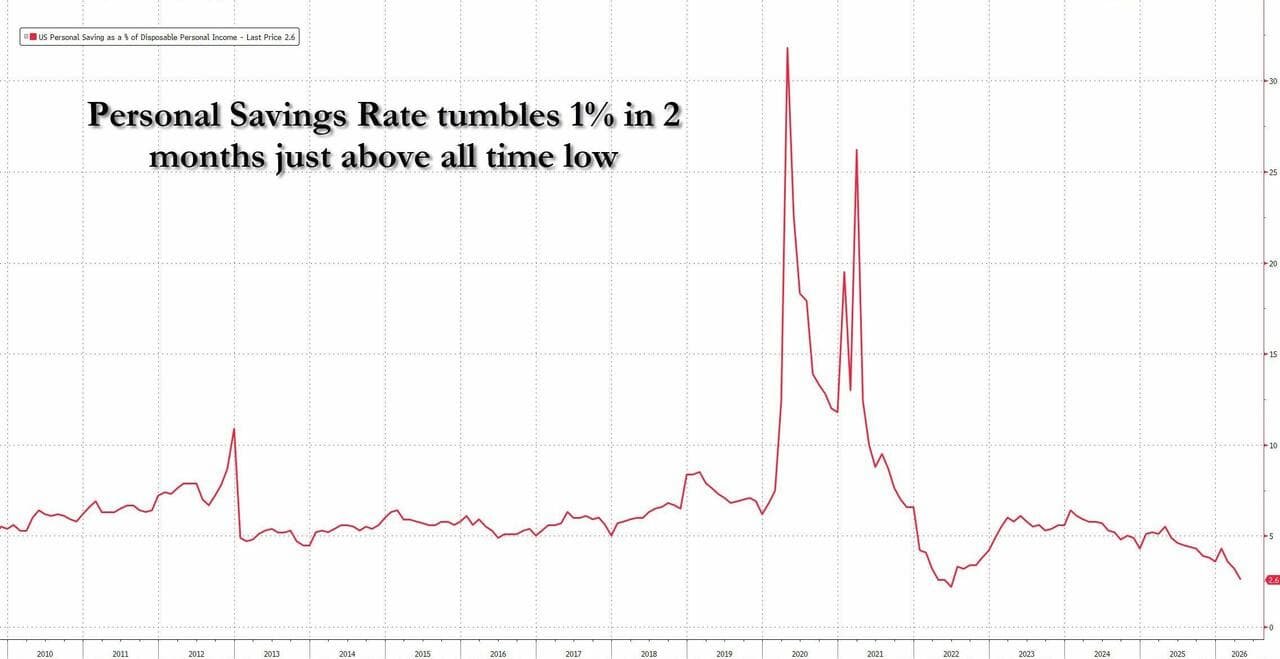
I have been gently touching on what a horrible idea one sector has been since the inception of this blog. And just this week, it looks like cracks are starting to form in the space via one of its largest and most well-known publicly traded companies.

(Chart: Zero Hedge)
I’ve said how buy now pay later “BNPL” has been a terrible idea since the inception of this blog. More recently, I named BNPL as one of the 10 areas of the market I would avoid heading into 2026.
Strip away the fintech branding, slick apps, venture capital language and the promises of “disrupting” traditional finance, and a large portion of the BNPL business boils down to something that has existed for centuries: lending money to people who don’t have enough money. And in many cases to people who don’t have enough money for a reason (i.e. they aren’t earning enough or can’t find a way to underconsume).
There is nothing particularly revolutionary about lending money at egregious rates to people who don’t have any. But when you start extending tiny amounts of credit so consumers can finance increasingly trivial purchases, whether that’s a burrito, groceries, takeout or other everyday expenses, you aren’t witnessing some great innovation in financial technology. You’re witnessing the last gasp of liquidity breath from a consumer in deep financial stress.
Credit makes sense when it bridges the timing between income and a major productive purchase. Mortgages allow people to buy homes. Business loans finance investment. Auto loans can help people purchase transportation they need to work. But when consumers increasingly need financing for a single solitary order of Large Fries from McDonald’s and other minute daily expenses, the economic signal is completely different.
If someone needs four payments to buy a french fry, the problem isn’t the absence of a sufficiently innovative payment app. The problem is that they’re fu**ing broke.
That’s what has bothered me about the evolution of BNPL. The industry has attempted to present installment payments as a technological revolution. In reality, subprime BNPL increasingly resembles a digitally optimized version of a very old business: payday lending, high risk consumer finance and, taken to its historical extreme, loan sharking.
The technology changes, the underwriting algorithms change, the user interface becomes prettier and the terminology becomes friendlier, but the fundamental economics do not. Someone has money, someone else needs money, and the lender advances the money today with the expectation of being adequately compensated tomorrow. That business has been around approximately…forever.

These businesses can look fantastic during the right portion of the economic cycle. Employment is strong, consumers are spending, asset prices are rising, credit losses remain manageable and investors extrapolate growth into the future. Then monetary conditions tighten. Positive real interest rates begin doing what positive real interest rates are supposed to do. Savings get depleted, refinancing becomes more expensive, credit becomes harder to obtain, monthly debt service burdens accumulate and consumers gradually exhaust the liquidity buffers they built during easier times.
Eventually, something breaks, and the lowest quality borrowers usually break first. That is why subprime credit can be such an important economic indicator. The trouble doesn’t necessarily begin with someone defaulting on a mortgage or declaring bankruptcy. It can begin much earlier. Consumers start financing things that historically would have been purchased with cash. Balances accumulate, payments begin competing with one another, discretionary spending slows, credit losses rise and eventually the consumer runs out of road.
And nowadays, in a nation full of gamblers and not investors…who place bets not just on stock options but on shit like what color tie Donald Trump will wear during a press conference on prediction platforms…people are getting addicted to gambling, running through their cash and desperately sourcing anyone who will lend to them faster than anytime in history. If you think people aren’t taking out loans from SoFi, Upstart and the likes to finance gambling addiction, you haven’t listened to the stories of enough gamblers in recovery.
That brings us to Klarna yesterday. The company’s second quarter 2026 results initially looked good. Revenue rose 27% year over year to approximately $1.04 billion, while the company produced a surprise quarterly profit. The reported numbers beat Wall Street’s expectations. If markets cared only about the rearview mirror, Klarna stock probably would have rallied. Instead, the shares plunged roughly 20%.
🔥 50% OFF FOR LIFE: Using this coupon entitles you to 50% off an annual subscription to Fringe Finance for life: Get 50% off forever
The reason is that markets care about what happens next. Klarna lowered its full year revenue outlook to $4.08 billion to $4.16 billion, compared with its previous forecast above $4.34 billion and analyst expectations around $4.42 billion. The company also reduced expected 2026 gross merchandise volume to $149 billion to $151 billion from more than $155 billion previously. Weak retail conditions in Germany, Klarna’s largest market, and foreign exchange effects were among the factors cited.
Americans are increasingly using BNPL as actual consumer financing, according to Klarna’s latest report. U.S. purchase volume surged 27% year over year, U.S. revenue jumped 37%, and Klarna’s longer-term Fair Financing product grew 82% globally, while interest income hit $266 million for the quarter.
The numbers suggest consumers are increasingly borrowing to fund everyday spending rather than simply using BNPL as a checkout convenience. Once reliance on BNPL becomes a necessity to fund consumption, signaling an increasingly tapped-out consumer, rising defaults are the obvious risk that comes next.
At the same time, Klarna announced leadership changes. CFO Niclas Neglén and CMO David Sandström are expected to leave their positions in early 2027 as the company searches for replacements. So you had the classic combination markets hate: yesterday looked better than expected, while tomorrow suddenly looked worse. The stock got crushed accordingly about -20%.
And I don’t think investors should look at Klarna in isolation. I think they should look at it as another piece of evidence about the condition of the consumer. To be clear, Klarna itself is still growing rapidly. Second quarter revenue increased 27%, gross merchandise volume increased 18% and U.S. GMV reportedly grew 27%. This isn’t a company whose business disappeared overnight. That’s precisely why the guidance matters.
The interesting question isn’t whether BNPL continues growing. The interesting question is why consumers increasingly want it in the first place, and what happens to the economics of the model when those consumers become financially stressed. BNPL works beautifully when the consumer keeps paying. So does virtually every lending business. The real test of a credit model isn’t how rapidly it can originate loans during an expansion. As Seinfeld would say, “Anybody can just originate a reservation…”
It’s what those loans look like after years of elevated prices, depleted savings, expensive money and weakening consumer liquidity. That’s the part of the cycle investors consistently underestimate and dildo analysts on CNBC don’t want to talk about. That is, assuming they know what the business does to begin with…
There is an enormous difference between financing a $2,000 purchase because installment financing is economically convenient and financing a $12 lunch because you don’t have $12.
The app may classify both transactions as BNPL, but I don’t. One is financing. The other can be distress.
I’ve argued that the current equity market has many characteristics of a bubble, and BNPL is only one of the areas that concerns me. Markets have spent years rewarding growth narratives, financial engineering, technological disruption and increasingly aggressive assumptions about what future cash flows will be worth. Meanwhile, underneath the surface, consumers have been absorbing higher prices, higher financing costs and a steadily more restrictive cost of capital. Those two realities cannot diverge indefinitely.
Eventually the economic cycle, rates, liquidity and balance sheets matter. The first cracks rarely arrive with a giant sign announcing that the bubble is over. They appear individually. A weak consumer shows up in one company’s numbers. Credit deterioration appears somewhere else. A company beats quarterly expectations but cuts its outlook. A seemingly unstoppable growth story suddenly discovers that its customers have limits. That is how cycles turn. To quote Ray Dalio’s “How the Economic Machine Works”, the economy is a trillion little bullshit transactions all happening at once, over and over (OK, I paraphrased). Point is, they turn over gradually, one small transaction at a time, like sands passing through an hourglass.
BNPL has been marketed as financial innovation, and parts of the technology undoubtedly are innovative. The distribution is better, the checkout experience is easier, underwriting can be faster and data can improve risk assessment. But none of that repeals the basic laws of credit. If you lend money to financially stretched consumers, eventually some of them cannot repay it. If those consumers become increasingly dependent on credit to finance ordinary consumption, that isn’t necessarily evidence of a booming new financial ecosystem. It may be evidence that household liquidity is deteriorating.
I have warned about subprime lending and BNPL for years. I put BNPL among the 10 areas I wanted to avoid in 2026, and Klarna’s latest report doesn’t change my mind. It reinforces the thesis. When people need debt to buy a Coke Zero, I don’t see financial innovation. I see a warning about the consumer.
Klarna is only one data point, and one quarter doesn’t establish a macroeconomic trend. But combined with the other stresses emerging across the economy and financial markets, I believe it is another signal that the consumer is running out of liquidity. That is one of several reasons I continue to believe the current stock market bubble is approaching its final stage, with the reckoning likely coming in late 2026 or early 2027.
When it does, investors may discover that the newest revolution in consumer finance was built around one of the oldest businesses on Earth: lending money to people who don’t have it.
—
QTR’s Disclaimer: Please read my full legal disclaimer on my About page here. This post represents my opinions only. In addition, please understand I am an idiot and often get things wrong and lose money. I may own or transact in any names mentioned in this piece at any time without warning. Contributor posts and aggregated posts have been hand selected by me, have not been fact checked and are the opinions of their authors. They are either submitted to QTR by their author, reprinted under a Creative Commons license with my best effort to uphold what the license asks, or with the permission of the author. I cannot guarantee the accuracy of all facts and figures included in this article though I made my best effort to get them right. I have been wrong before and will be wrong again, and encourage you to always double check, do your own research and speak to a licensed financial professional.
This is not a recommendation to buy or sell any stocks or securities, just my opinions. I often lose money on positions I trade/invest in. I may add any name mentioned in this article and sell any name mentioned in this piece at any time, without further warning. None of this is a solicitation to buy or sell securities. I may or may not own names I write about and are watching. Sometimes I’m bullish without owning things, sometimes I’m bearish and do own things. Just assume my positions could be exactly the opposite of what you think they are just in case. If I’m long I could quickly be short and vice versa. I won’t update my positions.
As of May 20, 2026 I am attempting to no longer actively trade as much as I once did (read my story here). My eventual goal is for investing/saving to be mostly done by recurring contributions mostly to sector ETFs and a few select equities, trusted third parties who oversee my accounts, and advisors. Such advisors or funds, through individual equities, options, index funds, mutual funds, ETFs, or other securities, may have positions in, exposure to, or holdings of names mentioned herein that I know nothing about. Basically, via index funds, ETFs and individual equities it is possible I could own, have exposure to, or not own anything at any point. As of the same date, May 20, 2026, in an attempt to lead a healthier lifestyle, I’ve also excluded myself from fantasy sports, sports betting, online and in-person casinos and prediction markets.
And all positions can change immediately as soon as I publish this, with or without notice and at any point I can be long, short or neutral on any position. You are on your own. Do not make decisions based on my blog. I exist on the fringe. If you see numbers and calculations of any sort, assume they are wrong and double check them. I failed Algebra in 8th grade and topped off my high school math accolades by getting a D- in remedial Calculus my senior year, before becoming an English major in college so I could bullshit my way through things easier.
The publisher does not guarantee the accuracy or completeness of the information provided in this page. These are not the opinions of any of my employers, partners, or associates. I did my best to be honest about my disclosures but can’t guarantee I am right; I write these posts after a couple beers sometimes. I edit after my posts are published because I’m impatient and lazy, so if you see a typo, check back in a half hour. Also, I just straight up get shit wrong a lot. I mention it twice because it’s that important.