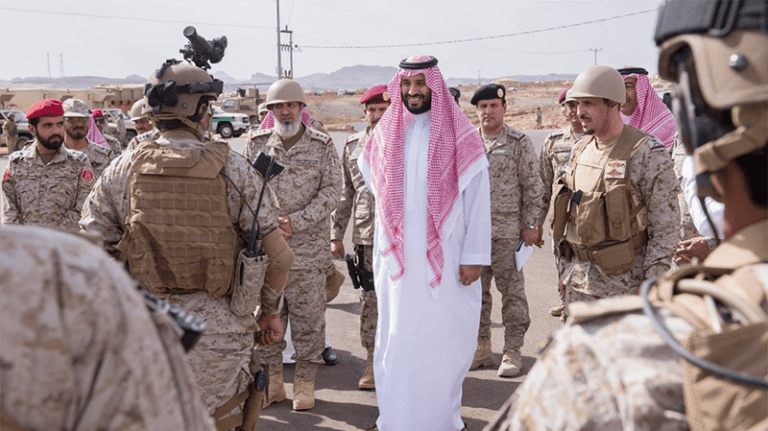
Regional rivals and enemies are calling out Saudi Arabia as a “paper tiger” which must rely on others for protection and defense needs.
Criticisms of Riyadh are being issued on the same day the kingdom signed a major security pact with the other major Muslim-dominant nations of Pakistan and Turkey. Formally called the Makkah Joint Defense Agreement, it is essentially a NATO-style agreement for the ‘Muslim world’ – given that it stipulates and formalizes that an armed attack on any of the countries will be treated as an attack against all of them.

The pact extends across populations with a combined total of some 380 million people. Both Iranian and Israeli officials have taken to mocking the historic agreement.
For example, on Friday within hours of the deal’s signing, prominent Iranian MP Ebrahim Rezaei called on Riyadh to change course in terms of its pro-American policies, which has included allowing US troops to be stationed on Saudi soil. He said the new pact won’t bring Riyadh protection or peace.
He stated on X: “Saudis must know that a paper agreement with Turkiye and Pakistan will not bring them security, just as years of one-sided nursing to the Americans did not bring them security.“
“Reform your policies so that you do not need to beg for security from others,” continued Rezaei, who is also a member of parliament’s National Security and Foreign Policy Commission.
Somewhat ironically, voices out of Israel echoed similar criticisms, blasting the wealthy kingdom as seeking to appear strong but in truth being weak with not much of a military to speak of:
Saudi Arabia is less powerful than it may seem at first glance, former head of the National Security Council Prof. Jacob Nagel told 103FM in a Friday morning interview addressing the defense agreement between Saudi Arabia, Turkey, and Pakistan.
“You have to understand that Saudi Arabia, despite all its wealth and weapons, is to a large extent a paper tiger. It has a great deal of weaponry and a great deal of money, but militarily, it cannot manage to ‘get through the day,'” Nagel said.
He added, “If we examine the war in which the Saudis tried to fight the Houthis, we see that they failed despite all the advanced capabilities at their disposal. They have a great many assets, but nothing is really liquid, and they have reached a situation in which, economically, they need help.”
Geopolitical messages that MBS is sending
– Instead of Abraham accords, it is Mecca accords
– Instead of a GCC defense pact, Saudi Arabia is looking to Turkey, Pakistan
Turns page on alliance w UAE + anti-Islamist approach. Still doesn’t mean Turkey alliance; Egypt stayed out
— Joyce Karam (@Joyce_Karam) August 7, 2026
Saudi has in prior months been subject of sporadic ‘retaliatory’ attacks from Iran in the context of the war, and has earlier even responded by launching numerous unpublicized strikes on Iran. Yemeni Houthis have lately also fired projectiles onto Saudi Aramco sites.
So it did seek to flex – apparently – but still must be largely reliant on US weaponry and especially on American Patriot batteries, which form the backbone of the kingdom’s defense system.