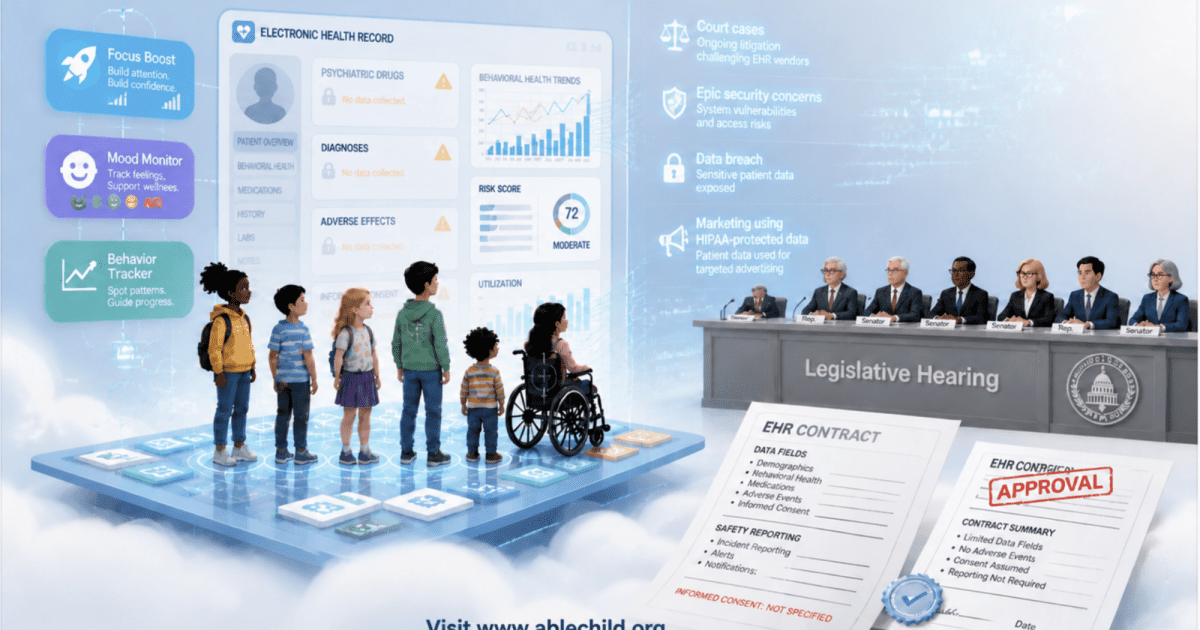
When Health Behavioral Health IT Turns Children Into Targets
Republished with permission from AbleChild
America has built a behavioral-health system for children that is increasingly driven by data collection, diagnosis, digital tracking, and prescription management, yet lawmakers and parents still struggle to get basic answers about who is being labeled, medicated, and targeted for intervention.
Epic Systems is often presented as a neutral software company. But public reporting, court filings, and Epic’s own product materials show something far more consequential: one dominant health IT company now sits at the center of how sensitive behavioral-health information is stored, shared, and used for outreach across major health systems.
That concentration creates two urgent public risks: security and the marketing of diagnosis.
The security risk is straightforward. Behavioral-health records are among the most sensitive files in medicine, and EHR-related breaches remain a widespread problem across healthcare. When Medicaid and behavioral-health records for large child populations are concentrated in a small number of digital systems, the issue is no longer just privacy.
Lawmakers, behavioral health lobbyists, and drug companies use stigma, HIPAA, even on dead shooters to hide psychiatric drug involvement in mass shootings. When a few digital companies control Medicaid and behavioral health records for millions of children, this isn’t a privacy issue, it’s a national security threat. Psychiatric diagnoses, psychotropic medications, and prescribing doctors systematically vanish from every crime scene. The IT behavioral health companies themselves, appear to be the exact security risk HIPAA was meant to prevent.
The public should also understand who holds this influence. Epic is privately controlled by founder and CEO Judy Faulkner, who was appointed by President Barack Obama in 2009 to the federal Health IT Policy Committee and served until 2014 as the representative of health IT vendors. This is not a partisan point. It is a power point. Faulkner had a seat inside the policy process while the modern national health IT framework was being built, and public reporting has described her as a major political donor with a net worth estimated at about $7.8 billion.
The second risk is how diagnoses become the basis for data-driven outreach. Epic has openly expanded into healthcare “consumerism” through its Cheers CRM platform, marketed as a tool for health systems to run campaigns using thousands of EHR data points. That may be called patient engagement. But when the underlying data include mental-health diagnoses, psychotropic medication histories, missed appointments, crisis visits, or suicide-risk flags, the line between care coordination and diagnosis-based marketing becomes dangerously thin.
This matters most in Medicaid behavioral health. Children in Medicaid often move through fragmented systems involving hospitals, school-based clinics, community mental-health centers, telehealth programs, and public agencies. Their records can travel across multiple settings while families have little visibility into how those records are used to trigger reminders, prompts, referrals, and program enrollment. This is a looks like a major breach on informed consent and certainly would be why HIPPA exists in the first place to protect the consumers medical records.
The national numbers are staggering. CCHR reports that FOIA requests to 32 states found roughly 2,999,084 Medicaid-covered children ages 0 to 17 on psychiatric drugs. AbleChild’s Wyoming advocacy brought the issue down to the state level by submitting FOIA-derived CCHR data showing that 5,986 Wyoming children ages 0 to 17 were prescribed psychiatric drugs under Medicaid. Those numbers did not come from routine public dashboards generated by the health IT systems lawmakers are told to trust. They came because advocates forced the data into the open through FOIA.
The money is enormous. MACPAC reported that Medicaid spent about 8 billion dollars on psychotropic medications in 2011, roughly 30 percent of fee-for-service drug spending. The Commonwealth Fund reports that Medicaid now spends more than 58 billion dollars a year on mental-health care, with almost 43 percent of that spending going to people under age 20.
That is how the model sustains itself. More screening produces more labels. More labels produce more data. More data allow more targeting, more outreach, and more behavioral-health “engagement” campaigns. In a system built around scale, every new diagnosis can become both a treatment pathway and a data point.
Publicly documented philanthropy adds another layer of influence. Epic says it gives annual donations to hundreds of nonprofits. Atrium Health Foundation publicly highlighted Epic Systems’ support for school-based behavioral health and telehealth in under-resourced districts. That does not prove misconduct. It does show how one company can influence both the data infrastructure of care and the expansion of programs that identify and manage children inside schools.
This is the question policymakers should be asking: how will this model ever be broken if the same IT systems that collect diagnoses also help drive the outreach, the segmentation, and the expansion of behavioral-health programs for more children? Lawmakers should be deeply alarmed not only by the vast sums being spent on psychotropic drugs for children, but by the behavioral health industry’s failure to provide meaningful data to those responsible for oversight. Instead of ensuring transparency and accountability, the industry collects and leverages this data for its own marketing and expansion, leaving policymakers in the dark while vulnerable children are increasingly exposed.
A serious response would begin with evidence, not slogans. Lawmakers should require independent audits of how pediatric Medicaid behavioral-health data are used in CRM tools, predictive analytics, and school-linked interventions. They should require clear disclosure when a child’s diagnosis or risk profile is used to trigger outreach or enrollment activity. And they should treat concentration of sensitive behavioral-health data in a handful of private platforms as both a child-protection issue and a security issue.
AbleChild is a 501(3) C nonprofit organization that has recently co-written landmark legislation in Tennessee, setting a national precedent for transparency and accountability in the intersection of mental health, pharmaceutical practices, and public safety.
What you can do. Sign the Petition calling for federal hearings!
Donate! Every dollar you give is a powerful statement, a resounding declaration that the struggles of these families will no longer be ignored. Your generosity today will echo through generations, ensuring that the rights and well-being of children are fiercely guarded. Don’t let another family navigate this journey alone. Donate now and join us in creating a world where every child’s mind is nurtured, respected, and given the opportunity to thrive. As a 501(c)3 organization, your donation to AbleChild is not only an investment in the well-being of vulnerable children but also a tax-deductible contribution to a cause that transcends individual lives.
The post ABLECHILD: When Health Behavioral Health IT Turns Children Into Targets appeared first on The Gateway Pundit.