This post, authored by David Livermore, is republished with permission from The Daily Sceptic

Saturday to see Christopher Nolan’s Odyssey at Picturehouse. Picturehouse now send me customer surveys which, from habit, I discard. Nevertheless, let me assure them that their seats are large and comfortable, their urinals clean and their air-conditioning efficient.
I especially appreciated the air-con.
Nolan’s film is a stinker, though.
To explain why, you need to know the poem. And, perhaps, like Lupita Nyong’o – ‘educated’ at Yale and playing Helen of Troy – you haven’t read it? In that case, please do. But let me give you a synopsis; it’ll help with the rest of this article. If you know your Homer, skip the next paragraph.
It begins with the gods in council, then flips to Ithaca, Odysseus’s island kingdom. Odysseus sailed to Troy 20 years ago and, through his stratagem of a Wooden Horse, the city fell 10 years later. But Odysseus has failed to return. His wife Penelope is beset by arrogant suitors, seeking marriage and the kingdom. They bully and threaten his son, Telemachus, who is approaching adulthood. The goddess Athena – Odysseus’s protector – appears to Telemachus in disguise and urges him to visit the mainland, seeking news of his father. This he does, meeting Helen and Menelaus, learning a little but growing much. We now flip to Odysseus, stranded on the island of Calypso, a half-divine nymph.
Daytimes he wanders the beach lamenting his lost home; night-times she beds him. The gods order his release. Calypso offers immortality and eternal youth, but Odysseus declines, departing on a raft to another shipwreck. Washed up on the island of the Phaeacians and found by the princess Nausicaa, he is directed to the palace, where the king and queen receive him generously. After a banquet a bard sings of the Trojan War. At this Odysseus breaks down, confesses his identity, then tells of his wanderings after leaving Troy. They begin with a pillaging raid gone wrong, then a visit to the drugged-up Lotus Eaters. Next to the island of the Cyclops – one-eyed giants.
One of these, Polyphemus, finds Odysseus and his men in its cave and imprisons them, eating two for breakfast and two for dinner. Odysseus convinces the Cyclops that his name is ‘Nobody’ then gives him strong wine. Once Polyphemus is in a stupor, Odysseus blinds him. The Cyclops howls for help but, when his fellow Cyclops ask who is hurting him, he responds: “Nobody is hurting me.” So they tell him to go back to bed. Odysseus escapes, reaching the island of Aeolus, God of the Winds. The God confines the unhelpful winds in a sack, giving this to Odysseus and the fleet almost reaches Ithaca. Then the crew, eager for booty, open the sack while Odysseus sleeps, releasing a tempest, which blows them to the land of the Laestrygonian giants, who shatter 11 of Odysseus’s 12 ships.
On he sails to the island of the enchantress Circe, who turns his landing party into pigs. Aided by Apollo he forces her to transform them back again, remaining a year as her lover. To find a route to Ithaca, Circe tells him that he must consult the dead seer Tiresias. So Odysseus sails to the Underworld, where Tiresias outlines a course past the Sirens, who lure men onto the rocks with sweet songs, past the whirlpool Charybdis and the monster Scylla, warning him to avoid the island of the Sun God.
They pass the first three perils but, with the crew starving, land on the Sun God’s island and eat his cattle. The angered god then wrecks the ship. Odysseus alone survives, washed to Calypso’s embrace. The Phaeacians listen spellbound then provide a fast ship to Ithaca. Warned by Athena, Odysseus proceeds carefully, gradually revealing himself to Telemachus and two trusted herdsmen. He returns to his palace disguised as a beggar and is abused by the suitors. His ancient hound recognises him, then dies. His old nurse recognises him too, but he forcefully tells her to keep quiet.
Penelope, out of time and guided by Athena, announces that she’ll marry whichever suitor can string Odysseus’s great bow and shoot an arrow through a row of axe heads. All try and fail. The beggar then asks for a go. He is mocked and abused. But, given the bow by Telemachus, he strings it easily and shoots through the axe heads. After which he picks off the suitors one by one, helped by Telemachus and the two herdsmen.
Once the bloodbath is over, and a dozen disloyal maidservants hanged, Odysseus reveals himself to Penelope, who disbelieves him. She casually suggests, however, that their marital bed be carried into the hall so he can rest. That is the test. He responds that he carved the bed from a living olive tree. It is part of the house structure and cannot be moved. That is their secret. So Odysseus and Penelope are reunited, and Athena holds back the dawn – nudge, nudge. After which, there is one final battle with the dead suitors’ aggrieved relatives, quickly stopped by Athena, who forces everyone to make peace.
It is a tale of resilience, endurance and guile, both by Odysseus and Penelope. It celebrates a stoical heroism, unlike that of Achilles and Hector of the Iliad. Brain beats brawn. To win you must survive and, to survive, you need cunning as well as valour. Sometimes you must debase and disguise yourself, but you must honour the gods, keep your nerve and temper and never lose sight of your main goal.
Homer underscores these points. At the start, Zeus tells Athena: “How could I ever forget Odysseus, that hero who, more than any other mortal, has subtle wit…” Recurring epithets call him polú-tropos (‘resourceful’ or ‘of many [twists and] turns’); polú-tl?s (‘much-enduring’ or ‘long suffering’); megal-?t?r (‘great hearted’) and ptoli-pórthios (‘sacker of cities’). ‘Sacker of cities’ is an accolade, not a condemnation. Penelope, meanwhile, is a byword for loyalty.
Nothing suggests a man tortured by guilt and PTSD.
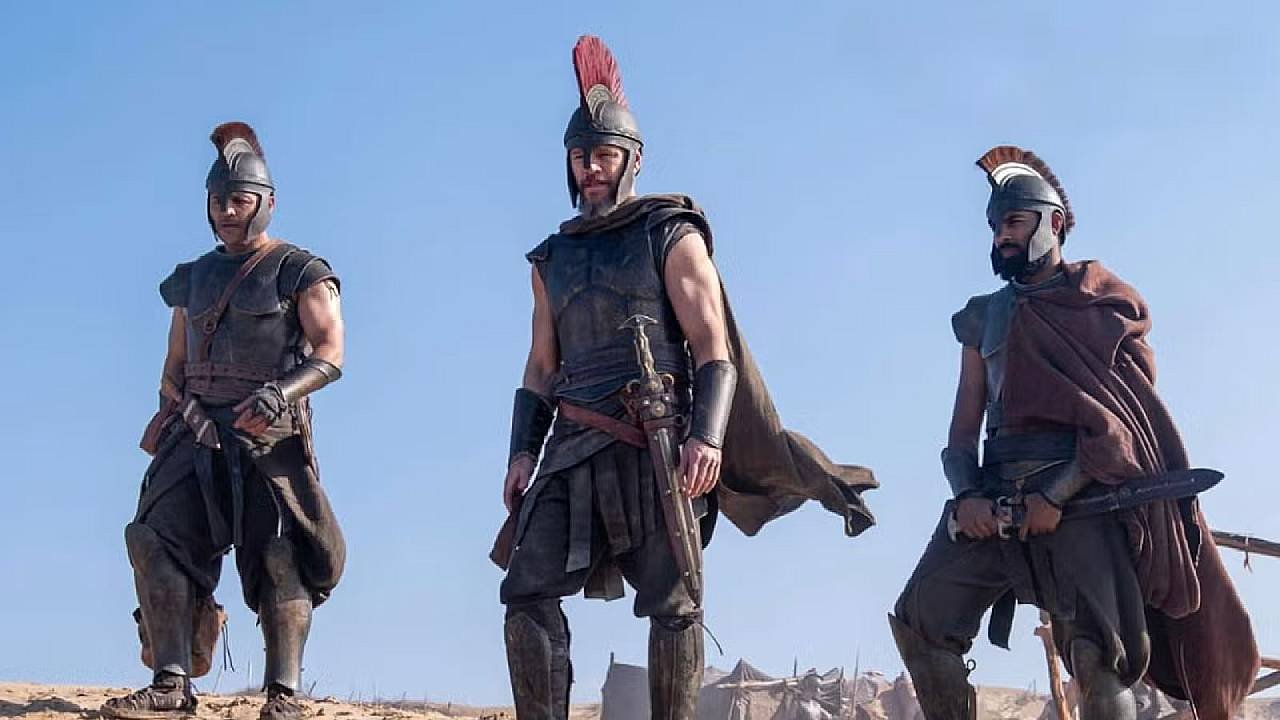
Yet that is what Nolan presents. When we first meet Odysseus, on Calypso’s island, she is feeding him the lotus to make him forget the horrors he experienced. Matt Damon, playing the role, is haunted not only by the attrition of his ships and men but, more deeply, by the devastation he precipitated at Troy. The temple of Athena was desecrated. This is symbolised by the head of the goddess’s statue being lopped off. Nolan may allude here to another account of Troy’s fall, from a source that remains only in fragments. It describes how the Princess Cassandra seeks sanctuary in Athena’s temple but is dragged away and raped by Aias the Lesser. The Greek princes, led by Odysseus, consider stoning him for this sacrilege but relent, offending Athena, who drowns Aias and complicates their returns.

The pre-Christian Greeks understood guilt and conscience, at least when the legends were written down. Orestes kills his mother, who had murdered his father. He is then pursued by the Furies. Oedipus unknowingly kills his father then marries his mother. When he realises his crimes, he blinds himself. There is none of this in Homer’s Odysseus. If Odysseus is so traumatised, why is his first stop after Troy – in both the poem and the film – an unprovoked Viking-style raid on the Cicones? It makes no sense. Nor does the premise that Athena is angered with him. She is Odysseus’s patron and guide throughout Homer’s poem. It begins with her pleading his case to Zeus; it ends with her bringing peace to Ithaca. She appears repeatedly as an adviser in human guises, sometimes flirtatiously. She arranges his return to Ithaca. She gives him courage for a hugely outnumbered fight with the suitors. Nolan’s Athena (Zendaya) instead appears scowlingly from time to time, apparently as part of Odysseus’s bad conscience.
Odysseus’s travel issues have nothing to do with Athena. They are because the Cyclops, whom he blinded, was the son of Poseidon the Sea God. As he leaves the Cyclops’ island, Odysseus abandons his pseudonym of ‘Nobody’ and boastfully yells his true name. Polyphemus then begs his father for revenge…

Next – and this becomes a central theme – Nolan twists the trick of the Wooden Horse into a breach of Zeus’s Law of Hospitality (Xenia), which demands that a host treats a stranger as an honoured guest, lest he be a god in disguise. In turn, the guest should behave well. The Greeks hiding inside the Wooden Horse become the Trojans’ guests because the Trojans dragged it and them inside the city. Ergo, they should not burn the place down. By doing so, they violate Zeus’s Law. This is convoluted logic on three grounds. First, the Greeks were not guests. Had the Trojans known they were inside the Horse, they would have burnt it, or pushed it off a cliff. Second, the Trojans broke the Law 10 years earlier when Paris visited Sparta as Menelaus’s guest and stole his wife, Helen. All that follows is retribution. Third, Xenia no longer applies once you are at war, except under a flag of truce.
Above all, Nolan’s Odysseus is not Homer’s man of guile and wit; not polú-tropos. The trick of telling the Cyclops that his name is Nobody is omitted, as is his cleverly flirtatious conversation seeking help from Nausicaa on the beach of Phaeacia. Likewise for wise Penelope. Her trick suggestion of moving the bed is omitted. Instead, Odysseus identifies himself with a cloak pin.
The film has numerous other, lesser, flaws.
There has been ample press criticism of having a black actress (Lupita Nyong’o) play Homer’s “White-armed Helen” and a transgender one (Elliot Page) play Sinon, who doesn’t appear in Homer’s legend but who becomes a linchpin in Nolan’s telling. There is DEI box-ticking here. I gather it is vital for Oscar eligibility. But far more jarring is the casual dialogue, as with Telemachus referring to Odysseus as “Dad”. There were moments when I felt they should go the whole hog, as in: “Ah, Penny, there you are. I’ve done for those bad guys who were dissing you. Sorry about the mess. The slaves can clean it up. Oh, and sorry I didn’t get back sooner. My head was f****d by the war. Bad things. Did… No…. Still can’t talk about it. Then, tons of shit with monsters and witches on the way back. Druggies kept me on an island. Effing lotus… screwed my brains. But I’m clean now. The crew didn’t make it. The ship’s a write-off too, and so’s the Bronze Age. What’s that!? No!! Never!!! I was not shacked up with some nymph. They’re lying to you. It wasn’t like that…”
At least that would be funny.
As it is, the wretched dialogue dooms any attempt to immerse the viewer in Bronze Age Greece. Not that the film tries. Instead, it imposes post-Judeo-Christian ethics onto the Bronze Age, transmuting Zeus’s Law of Hospitality into something like “Do unto others as you’d be done unto.” Maybe we are expected to draw a message about ‘refugees’ welcome, or perhaps that’s a paranoid jump too far? In any event, Nolan fails where, say, the Northman (2022) or Beowulf (2007) succeed. They plunge you into Viking and Saxon worlds, whose morality isn’t your morality, let alone that of progressive Hollywood. To make legends seem real it’s first necessary to swallow L.P. Hartley: “The past is a foreign country: they do things differently there.”
This doesn’t trouble Nolan, who instead incorporates modern feminist tropes. Circe (Samantha Morton), the beautiful enchantress of the poem, appears to be auditioning for the title role in Viz magazine’s forthcoming biopic, ‘The Life and Times of Millie Tant’. She tells Odysseus that she turned his men into swine to demonstrate their true natures. Homer ascribes Circe no motive. She turns men into animals because she can. Later, Penelope (Anne Hathaway) laments that she cannot reign in her own right – to which the immediate response is: “If you could, your palace wouldn’t be full of these bloody suitors, would it?” Contemporaneously, the Amazons are ruled by women. Their queen, Penthesilea, allies with Troy. This point evades Nolan.
Last, there is an embarrassing lack of chemistry between Damon and Hathaway. They can’t fake it. This contrasts with another recent film of the same events – the Return (2024). That too had Odysseus (Ralph Fiennes) as a war-wearied veteran, sick of bloodshed, though ready for one last round. It too plays with Homer’s plot – for example, by having Telemachus execute Antinous, the most pestilential suitor, last of all and in front of Penelope (Juliette Binoche). Homer has Odysseus kill him first. That is wiser: he is a ringleader and most likely to rally the others. But the Return is forgivable and credible. Its Odysseus is Homer’s ‘man of many wiles’. It builds tension before the trial of the bow, however well you know the story. What’s more, Fiennes and Binoche have chemistry. You feel that they’d appreciate Athena holding back the dawn. As drama, the Return beats Nolan by a country mile.
Nolan ends with our modernised Odds and Penny – as I’ll re-dub them – preparing to sail into the sunset, as heroes and heroines so often do when the Hollywood credits roll. But this is imbecilic, even by the film’s own terms, let alone Homer’s. They must make the still-callow Telemachus king, ruling an island where not everyone is likely chuffed by the suitors’ demise. Moreover, as the film repeatedly hints, the Greek states are threatened by the Sea Peoples, who ultimately brought their civilisation to an end. Nolan suggests that the Sea Peoples are the Greeks themselves, endlessly raiding one another. Maybe so, maybe not. But either way, is it wise to leave, depriving Telemachus of your warrior skills and the fighting-age men you need to crew your ship?
Penny recognises this, shrugs and says “Civilisation will rise again” – which is like our leaders surveying the mess they’ve created before saying “Oh dear, but it’ll sort itself out,” then chartering a large yacht to the Caribbean. You expect this from Harry and Megs, but not from Odysseus and Penelope. Yes, Tiresias does tell Odysseus that he must make one last journey, trekking inland until he finds men who mistake an oar for a winnowing shovel, then make sacrifice to Poseidon, begging forgiveness. But that is for the future. Tennyson plays with this story and does it far better. It is not a cruise with his wife.
It is not for me to see into Nolan’s mind, but it is pretty clear that he has written an ‘Odyssey’ for Hollywood’s prejudices, or his own. He dramatises adventures with monsters and perils well enough, and some will relish that. But he fails – deliberately, I’m sure – to render the man of whom Homer sings. Nor does he do Penelope justice.
Had he done this to Pooh Bear, Jane Austen or Charles Dickens, I’d have had a laugh and thought: “More fool me, wasting £20 – still, three hours of air-con was nice.” But the Odyssey is more important. It is a foundation of western culture, defining a type of resilient heroism as well as the enduring importance of home and family. Homer stresses these aspects, and the quest for them, as virtues. Nolan’s ‘Odyssey’ retains the monsters but subverts these core elements, inserting modern prejudices and sensibilities in their place. That is why, unlike the Return, it is a stinker.
And in an era when many more people will see the film than read the poem, that matters.
David Livermore is a retired Professor of Medical Microbiology at the University of East Anglia.
Your support is crucial in helping us defeat mass censorship. Please consider donating via Locals or check out our unique merch. Follow us on X @ModernityNews.