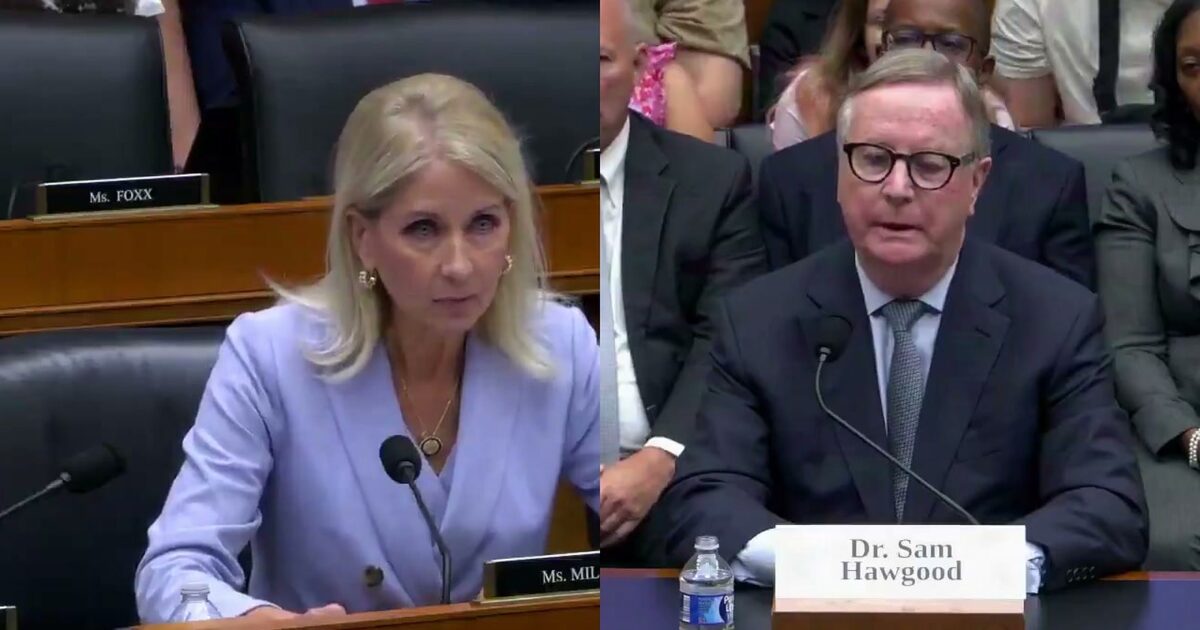
Rep. Mary Miller asked two of America’s most powerful medical educators a question so basic it should have ended with one word.
Instead, the answers wandered through transgender care, legal compliance and institutional language.
By the time it was over, Congress had received a live demonstration of the controversy the hearing had been called to examine.
Watch the exchange first:
How can someone have a uterus and not be a woman?
Basic biology shouldn’t be controversial.@RepMaryMiller pic.twitter.com/ABA1g3ciEx
— House Committee on Education & Workforce (@EdWorkforceCmte) July 14, 2026
The House Committee on Education and Workforce convened Tuesday’s hearing under a title that left little doubt about its purpose: “Training Activists, Not Physicians: The Impact of DEI on Medical Schools.”
UCLA medical school dean Dr. Steven Dubinett and University of California, San Francisco Chancellor Dr. Sam Hawgood sat on the witness panel alongside leaders from the National Medical Association and the University of Illinois College of Medicine.
Chairman Tim Walberg accused elite medical schools of weaving ideas such as “settler colonialism” and “anti-oppression” into required training. In his telling, future doctors are being pushed toward political activism while the public expects scientific competence.
The dispute reached far beyond bedside etiquette. Lawmakers wanted to know whether ideology had begun to displace plain medical language inside institutions that train the people Americans will trust with their bodies, pregnancies and lives.
Walberg laid out the committee’s case at the start of the hearing:
“They seek to make medical students not into competent doctors, but into far-left activists.”
During a hearing examining medical school curriculum requirements and DEI-related policies, House Education Committee Chairman Tim Walberg accused UCLA’s medical school and the… pic.twitter.com/b4dlZv5u7f
— Fox News (@FoxNews) July 14, 2026
The Washington Examiner account supplies the full sequence behind Miller’s questioning. She began with a UCLA course disclaimer stating that references to women did not exclude people who have a uterus while identifying with different terms.
Miller then asked Dubinett whether someone could have a uterus without being a woman. His response shifted to UCLA’s treatment of transgender patients and legal compliance, and his time expired without a direct yes-or-no answer.
Hawgood faced a related question about UCSF guidance encouraging instructors to use “pregnant people.” He said the vast majority of pregnancies occur in women and added that he personally has no objection to the phrase “pregnant women.”
Miller narrowed it again by asking whether a nonbiological woman had ever delivered a baby, and Hawgood answered that a transgender person could. The exchange ended with one side demanding a sex-based definition and the other returning to the treatment of transgender patients.
Medical schools do care for transgender patients. Every patient deserves competent, humane treatment.
Compassion and biological precision can occupy the same sentence.
A doctor should be able to treat any person with dignity while answering a basic question about which sex possesses the organs required for pregnancy. Those responsibilities reinforce each other when medicine is working properly.
Words are clinically useful because they describe real bodies. Once administrators begin treating elementary definitions as ideological tripwires, students learn evasion at the exact moment patients need clarity.
The committee carried the full hearing live:
“Training Activists, Not Physicians: The Impact of DEI on Medical Schools” https://t.co/IQUYbCv6DP
— House Committee on Education & Workforce (@EdWorkforceCmte) July 14, 2026
The White House placed medical-school accreditation in the federal crosshairs more than a year before Tuesday’s hearing. President Trump’s April 2025 executive order directed the Department of Education to scrutinize accreditors that impose unlawful discrimination or ideological conditions.
Accreditation carries enormous leverage. The order notes that colleges generally need approval from a recognized accreditor before their students can gain access to more than $100 billion a year in federal student loans and Pell Grants.
For medical education, the order specifically says standards should focus on delivering the highest-quality care. It tells federal officials to examine whether accreditation requirements are being used to advance DEI policies instead of academic performance and professional competence.
That turns a vocabulary fight into a funding and accountability fight. Medical schools can set their curricula, yet taxpayers and patients retain a powerful interest in whether accredited institutions are training physicians to communicate biological facts without hesitation.
The Justice Department added another layer of federal pressure in May after a yearlong investigation of UCLA’s medical-school admissions. The Department concluded that the school had intentionally considered race when choosing applicants and had violated Title VI.
DOJ said the average academic qualifications of admitted black and Hispanic applicants were lower than those of admitted white and Asian applicants. That finding came from a federal civil-rights investigation and represents the Department’s determination; the announcement did not describe a court judgment.
Admissions and curriculum are separate disputes. Together, they explain why UCLA’s medical school has become a focal point in the broader fight over whether elite institutions are placing political commitments ahead of neutral standards and scientific rigor.
Tuesday’s testimony gave that argument a human face because the public did not hear from anonymous diversity officers or read from a campus glossary. It watched senior medical educators struggle to provide the direct biological answer a member of Congress demanded.
Medicine depends on precision.
A dosage cannot be approximate, and a lab result cannot bend to a preferred narrative. Anatomy does not change when institutional vocabulary does.
Patients enter exam rooms with real bodies, real symptoms and very little patience for verbal gymnastics from the people entrusted to care for them.
Congress asked a basic question.

The answers should worry anyone who expects a medical school to train doctors before activists.
This is a Guest Post from our friends over at WLTReport. View the original article here.
What are your thoughts?