
In Mayor Karen Bass’s Los Angeles, the rule of law is separate and not equal when it comes to street food — with illegal immigrants and rogue vendors getting a free pass on violations while citizen restaurateurs and licensed food stands are subjected to fines, high costs, burdensome regulations, and even closures.
In short, L.A. and the surrounding counties have two sets of rules.
Other progressively-run cities like New York and Minneapolis also are catering to “vulnerable” and undocumented immigrant street vendors. But California is leading the way in sanctuary food practices.
The Los Angeles County Health Department, citing immigration enforcement efforts by the Trump administration, last fall suspended all enforcement of thousands of noncompliant street food vendors who have proliferated with the massive influx of illegals under the Biden administration.
With the labor market flooded with cheap migrant labor and the increasingly high cost of living in the Golden State, migrants were already ignoring regulations and licensing requirements to openly prepare and sell their native countries’ meals on sidewalks and curbsides.
The health department suspended enforcement despite nearly 3,000 food poisoning complaints reported to the county in 2025, with health officials suspecting many more went unreported. If someone gets seriously ill from unlicensed street food, undocumented operators are typically uninsured and can easily disappear before being held accountable.
Meanwhile, compliant restaurants and food stands are subject to a myriad of sanitation rules, labor costs, insurance coverage, bureaucratic paperwork, regular inspections, and ratings posted in their windows as well as having to pay permit and operating fees.
“Imagine putting your life savings into opening a restaurant,” one Angelino named KingOf98580 wrote on social media. “You do everything legally, pay rent, employees, taxes, business licenses, and a street food vendor pops up across the street with no overhead, no license, cash only, and undercuts your business. L.A. city officials suck.”
Enforcement at the street level has been set aside in 2026 by county health director Dr. Barbara Ferrer, who during the Covid pandemic became one of the most criticized officials in the U.S. for her sweeping, draconian shutdowns — ostensibly to keep everyone from getting sick.
One of the first to publicly point out the double standard was Anthony “Reed” Deugenio, community activist and owner of Big Dix Hot Dogs, a gourmet mobile cart in West Hollywood.
“I follow the rules — inspections, health standards, permitted areas,” Deugenio told the California Post in February. “Meanwhile, unlicensed vendors break the rules openly.”
“I had to register a business, pass a criminal background check, get a seller’s permit, tax ID — everything,” the vendor explained. “This cost a lot of money to set up. I pay inspection fees, taxes to the city. And now I’m losing half my profits to people who don’t follow the same set of rules.”
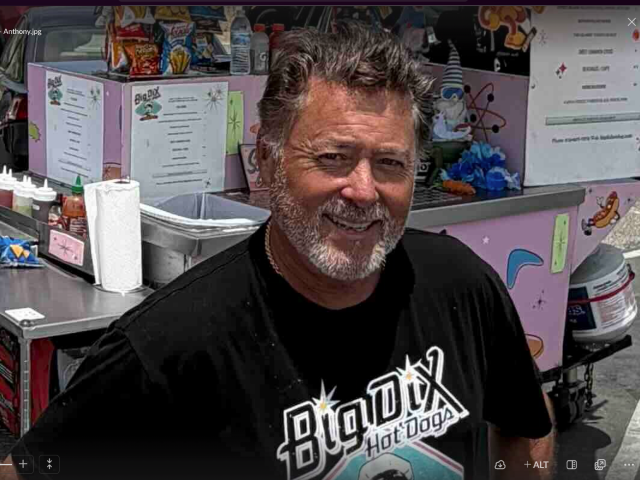
Anthony Deugenio has received death threats for speaking out against illegal vendors. Photo credit: Ethan Acosta.
Deugenio told Breitbart News his revenue has dropped from $100,000 to $30,000 a year. He also said Latin gangs are extorting migrant street vendors in his business district and elsewhere, requiring tribute to do business.
“It’s sad to see some of them crying at the end of the night because they haven’t sold enough food,” he said. “They’re exploiting illegal aliens.”
One stretch of Sherman Way in the San Fernando Valley was lit up at night with dozens of rogue vendors in a video that went viral earlier this year, getting nearly 100,000 views:
Street vending is a tradition and a $504 million industry in Los Angeles where the temperate climate produces up to 300 sunny days a year. Every year, 50,000 “microbusinesses” set up shop on the sidewalks of the city, according to the city’s Bureau of Street Services.
Three-quarters sell merchandise, such as clothing and cell phone accessories. The other 10,000 sell fruit, hot dogs, tamales, tacos, burritos, and now even combo dinner plates.
In 2024, the city opened up street sales to seven previously prohibited tourist hot spots that included the Hollywood Bowl, Dodger Stadium, and the Walk of Fame. Duegenio says “hundreds” of scofflaw vendors populate those spots now.
Breitbart News talked to a dozen both legitimate and noncompliant street food vendors during its investigation of the practice. Almost all asked for anonymity. Illegal operators feared arrest by federal immigration authorities. Legitimate food vendors feared reprisals, even violence, from rouge vendors or gang-controlled operations.
In fact, for raising the illegal food issue, Big Dix owner Deugenio had to file a police report in June after a competitor threatened his life and twice flattened his tires.
Mayor Karen Bass’s office and moderate city council member Tracy Park, who is running for reelection on a “public safety” platform, ignored requests for comment by Breitbart News.
The Los Angeles County Health Department and other liberal leaders implied last year that President Donald Trump and the Department of Homeland Security’s effort to enforce immigration laws passed by Congress were the source of the problem.
Last fall, L.A. County made the following announcement: “At this time, Public Health’s enforcement activities for unpermitted vendors have been temporarily paused in the areas within its jurisdiction due to safety concerns for our staff arising out of federal immigration enforcement actions.”
An examination of county enforcement records by Breitbart News shows there has been essentially no enforcement on street vendors, while at the same time the county has inspected dozens of restaurants, citing scores of them for violations and closing down eight in July alone.
Critics say the proliferation of unregulated vendors actually began after former Democratic Gov. Jerry Brown in 2018 signed a law that decriminalized noncompliant street vendors everywhere in the state.
Also in 2021, the L.A. city council established a moratorium on issuing citations to street vendors operating without a valid city permit.
Most recently, in December, Gov. Gavin Newsom signed into law the “Street Vendor Business Protection Act,” which prohibits municipalities from collecting “citizen or immigration status,” fingerprinting or doing background checks of vendors, or sharing “identifiable information” with “any agency conducting immigration enforcement.”
The county health department responded to Breitbart’s request for comment, announcing for the first time an enforcement effort not previously reported in other news outlets.
The office said it has shifted its street level enforcement to pair with the district attorney to “target the larger organizations that control many street-level operations in order to conduct enforcement at the source.” These efforts include “unpermitted central food preparation and distribution hubs that support multiple unpermitted sidewalk locations.”
“These central hubs are the heart of the street-level activity, providing food storage, preparation, transport vehicles, and equipment for multiple sidewalk operations,” the office said, though it did not report any prosecutions or specify whether these operations are gang related.
L.A. has a history of street gangs, including MS-13, extorting food trucks and street vendors.
The office said it is also providing programs to assist applicants in the permitting process and trying to educate the public on the risk of consuming food from unpermitted vendors.
Ironically, street vendors and restaurateurs say that government regulations and the oppressive business climate in California have contributed to the problem.
The trend, some analysts say, demonstrates that when a good or service is excessively taxed, overregulated, and subjected to excessive fees, it will migrate to a black market, also known as the “irregular economy.”
In fact, getting permitted by the county and the city requires a gauntlet of bureaucratic paperwork and fees. That, and the price of Southern California commercial real estate, have dramatically changed the food service landscape.
Carlos “Robert” Haro, grandson and namesake of the founder of Casablanca, one of L.A.’s iconic Mexican restaurants, says the traditional path to opening a restaurant has been destroyed by regulations and the cost of doing business in California.
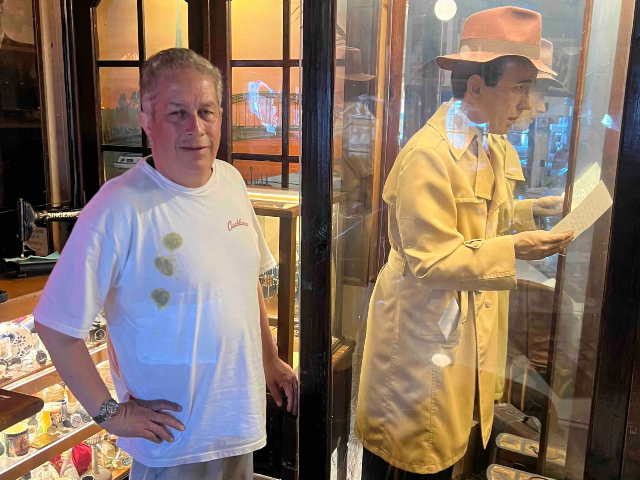
Third generation Casablanca owner Robert Haro with “Humphrey Bogart” in his film-themed Mexican restaurant. Photo credit: Lowell Cauffiel.
Haro’s grandfather Carlos, who was a legal, seasonal immigrant in the 1960s, ran a movie theater in Mexico and came up with the idea of creating a restaurant themed after his favorite movie Casablanca and its star Humphrey Bogart.
Haro started the restaurant from scratch in 1980, introducing a new kind of below-the-border cuisine that included its now-famous calamari steak as well introducing the first handmade flour tortillas in an L.A. restaurant, according to his grandson.
The family’s story was the subject of a documentary.
But times and conditions have changed, says his grandson.
“It used to be you started out with a food truck,” he explained, while sitting in a booth after the lunch hour at Casablanca. “You didn’t plan to be in the truck forever but accumulate enough profit to open a place.”
Commercial rental costs have put that out of reach, he said. Also, worker’s compensation insurance for restaurant positions, which are considered medium to high-risk injury jobs, run as much as $12 per $100 of payroll. Throw in liability insurance, permit fees, payroll taxes, and other incidentals, and running a restaurant is a heavy financial lift.
Too heavy for some. More than 100 L.A. restaurants, many of them community favorites, closed in 2025 alone.
Haro said traditionally, food operation costs are 30 percent for labor, 30 percent for food, and 30 percent for the incidental costs of rent, insurance, and operating expenses, leaving a 10 percent net before taxes and “three to five percent profit if you’re lucky.”
An illegal street vending operation, typically accepting only cash or Venmo, eliminates the 30 percent incidental costs, including taxes, and dramatically increases the profit margin.
Just across Lincoln Boulevard from Casablanca as many as four or five street vendors regularly set up in front of the Whole Foods parking lot. Most serve Mexican dishes.
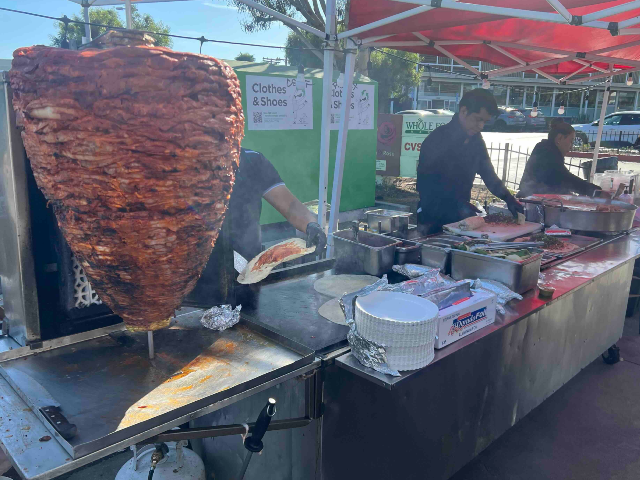
Just across Lincoln Boulevard from Casablanca, unpermitted food prepared and sold in sidewalk operations. Photo credit: Lowell Cauffiel.
Haro remembers when only a few years ago police and inspectors used to come by and close down unlicensed vendors, dumping their food in the trash and spraying it with bleach so it couldn’t be recovered.
He said Casablanca’s regular customers — from Hollywood celebrities to local residents — have remained loyal and prevented the rogue operators from destroying his business.
Recently, at one of those stands across from Casablanca, a worker chopped up beef coming off a charcoal grill, then placed it in a large, open, unrefrigerated tub in the hot sun. Other perishables were uncovered. There appeared to be no hand washing station. Workers wore rubber gloves as they prepared dishes.
Burritos from the five-worker operation were $15, three dollars less than Casablanca’s across the street.
Two 30-something, professional-looking couples eating nearby revealed they knew the operation was noncompliant but said they were not concerned about food safety.
“Please, don’t fuck this up for us,” said one, asking that his name not be used. “The food is fantastic. And government should get its nose out of everything we do.”
City officials and others talk about L.A.’s long tradition of ethnic street food, but it has only been in recent years that the canopies and tents of unregulated outdoor food operations began popping up in high-end, manicured neighborhoods like Brentwood and the Pacific Palisades.
Throw in the homeless encampments that have proliferated on the city’s west side, and the combination has created a shabby third-world landscape in neighborhoods once coveted for their picturesque palm-lined streets.
Even in upscale areas, patrons continued to buy meals from the illegal stands.
“These are good people,” said Josh Szekezy, a 25-year-old finance professional and regular patron of an unpermitted operation in front of a Ralph’s Supermarket in Brentwood. “It’s like L.A.’s version of the New York hot dog stand.”
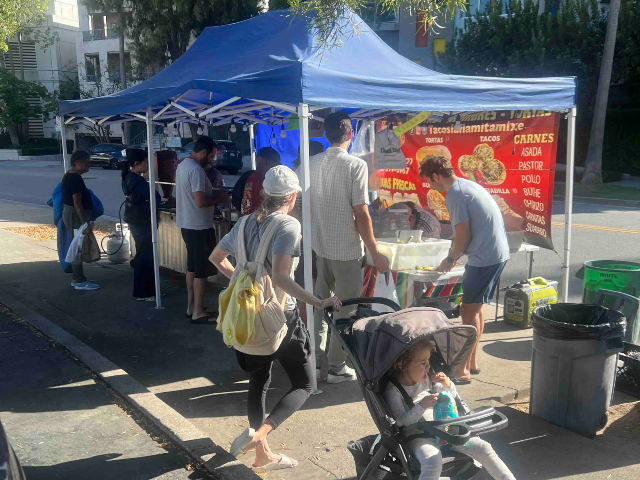
Even in L.A.’s upscale Brentwood area, noncompliant vendors serve customers almost every evening. Photo credit: Lowell Cauffiel.
At another location on the city’s west side, a Korean couple serve made-to-order Bulgogi for $14 a bowl. The man, who has asked that his name be withheld in fear of reprisals from unlicensed vendors operating right next to him, has been at the west-side sidewalk location for two years.
He’s street legal with all the necessary permits and equipment.
“I use all fresh ingredients and Wagyu beef,” he said as beef slices sizzled on his outdoor griddle. “Nobody gets sick from my food. I do everything I need to do. If you want to succeed in this country, you must pay your dues and work hard. You do what’s right and you can make a living.”
The amount effort it takes to be legally compliant in Los Angeles County is daunting. A vendor is required to have a state seller’s permit, which requires a social security or taxpayer number. Next, in L.A., a city business tax registration certificate is required. A county health permit is also required. And city sidewalk and park vending permits must be issued by the Bureau of Street Services.
The requirements do not end there. The operation must have food and occupational safety equipment that includes a hand-washing sink, a three-compartment sink to wash wares, and mechanical refrigeration. All employees must have food handler cards.
Such items were often missing among the undocumented vendors on the Sherman Way gathering, which serves a Canoga Park community of largely working class Hispanic and Asian residents.
One long-time undocumented migrant who goes by the name of Joe serves a variety of Mexican dishes helped by a single worker and his Americanized teenage son.
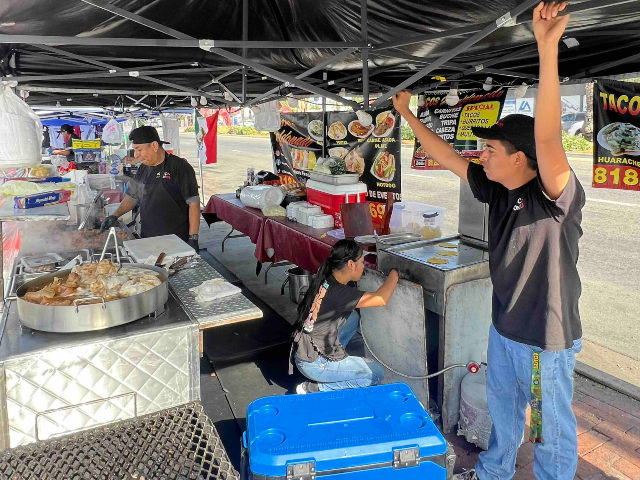
“Joe,” a worker, and his teenage son prepare for Saturday night customers in a massive gathering of unlicensed vendors in Canoga Park. Photo credit: Lowell Cauffiel.
It takes several hours to set up the tent, tables, coolers, gas grill, and range. He says he has always been left alone by the county. He admits he’s off the books but says, “I pay with my taxes.”
Even a street vendor not offering food prepared onsite faces bureaucratic requirements.
Mia X, who operates a small street business in an established Friday evening farmer’s market in the west side’s Centinela district, sells only packaged tea and herbs. But she said she pays $350 for a health department permit, another permit to be in a farmer’s market, a $50 fee for calling her product “organic,” sales tax, and city operating permits, not to mention using a “fire department approved” canopy secured “with 25-pound weights.”
“I should quit what I’m doing and go illegal,” said Mia, who is also a performing rock musician and property manager. “It’s not a bad thing for people to want to make and sell food. But it’s bad that the government makes it so difficult for the little guy, you can’t do business.”
The city has made some efforts to ease the way for street vendors to get compliant.
In 2024, the city’s Bureau of Street Services reported there were only 687 vendors with active permits — 53 food sellers and 634 merchandise vendors — roughly 1.4 percent of the estimated 50,000 street vendors in the city.
That same year, the city council reduced the annual fee for a street vending permit from $541 to $27 with hopes that it would bring “thousands of vendors into compliance.”
No figures are available yet for 2025.
Los Angeles County and the City of Los Angeles recently launched a $2.8 million Sidewalk Vending Cart Program, promising more than 280 free, health-code-compliant food carts for eligible vendors who complete the permitting process.
Also, Los Angeles State Sen. Maria Elkena Durazo, who authored the state’s street vendor protection act, has argued “street vendors are the cornerstone of our communities and contribute to California’s vibrant culture and economy.”
Some Southern California cities have taken a harder line. In 2022, Santa Monica stepped up enforcement while launching an outdoor vending program, offering permits for $75 a year after videos surfaced of vendors pouring used oil and other hazardous material in the beach sand and cooking on open flames on the wooden pier.
Conservative and MAGA stronghold Huntington Beach has a “zero tolerance” policy against unlicensed street vending in all forms, levying up to $1000 fines per violation per day.
There are no canopies or smokey operations on sidewalks there.
However, according to 2015 study by the Economic Round Table there are benefits to street vending, if only operators would become compliant:
It concluded:
Street entrepreneurs play a complementary role to brick and mortar establishments in the retail ecosystem. Retail stores and restaurants operating in geographic proximity to street vendors (who typically sold different products than the businesses they were near) enjoyed firm expansion and job growth. In our three case study locations — Boyle Heights, Downtown, and Hollywood — we found that brick and mortar businesses were more likely to experience job growth when street vendors were operating nearby.
Casablanca owner Huro says the city program to provide the food carts was a good idea. But so far, no figures have been made available as to the number of takers and “nobody knows where the money went.”
“Food people are entrepreneurs,” he said. “They want to get their own place. The city has got to find a way to figure this out.”
He concluded, “And that’s going to require a mayor who makes it affordable to open a restaurant in this city.”
Breitbart contributor Lowell Cauffiel is the best-selling author of the Los Angeles crime novel Below the Line and nine other crime novels and nonfiction titles. See lowellcauffiel.com for more

