

Minutes 8 and 9: Football, Freedom, and the Fight for Iran’s True Identity
The following is from a Substack piece by Banafsheh Zand, republished with permission.
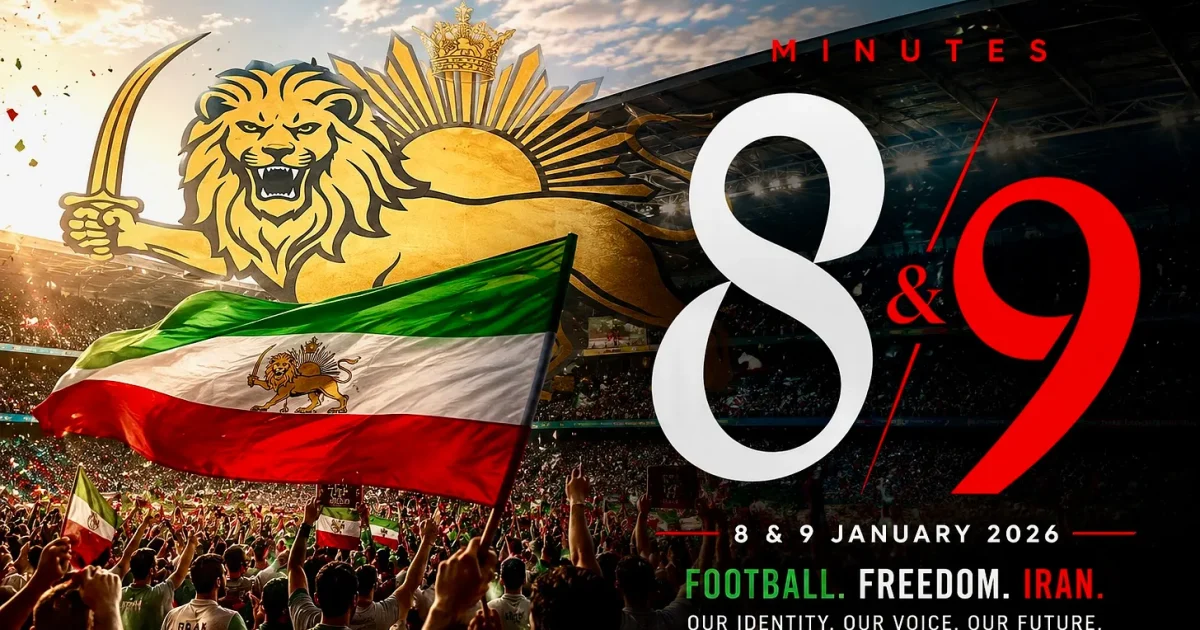
The Minutes 8 and 9 project is more than a clothing campaign; it is a direct challenge to the Islamic Republic’s control over Iranian football, identity, and the international narrative surrounding both. Built around the website minutes8-9.com, the initiative uses T-shirts and caps marked “Minutes 8 & 9 Iran” as symbols of protest during upcoming World Cup matches and football events, particularly in Los Angeles and Seattle, where Iranian fans are expected to gather in large numbers.
The name Minutes 8 and 9 refers to January 8 and 9 of this year, when the Khomeinist regime’s violence against Iranian protesters became visible to the world in real time. On those days, thousands of Iranians demanding freedom, dignity, and basic rights faced gunfire, beatings, arrests, and organized state brutality. The campaign’s name is therefore not abstract branding; it is a reference to the regime’s crackdown, marking the moment the world watched the Islamic Republic answer public protest with bloodshed.
At its core, the campaign reclaims Iranian identity from a regime that has spent decades attempting to monopolize it. Organizers argue that football—perhaps more than any other public arena—has become a political instrument of the Islamic Republic. What should be a source of national pride and unity has instead become tightly managed by a dictatorship demanding ideological conformity from players, fans, journalists, and even spectators.
The campaign emerges amid growing anger over FIFA’s repeated willingness to accommodate the Islamic Republic’s demands and sensitivities while restricting anti-regime Iranian expression inside stadiums. Iranian fans attending international matches increasingly face disputes over flags, banners, and symbols—especially the historic Lion and Sun emblem associated with Iran before the 1979 Islamic Revolution. Many Iranians, particularly in the diaspora, view the Lion and Sun not as a partisan political symbol but as part of Iran’s historical identity. Yet FIFA and local stadium authorities have repeatedly restricted or scrutinized its display during Iran matches, often under pressure from Khomeinist regime agents.
Critics argue that FIFA has effectively enabled the regime’s attempts to control how Iran is represented internationally. To many Iranian fans, the contradiction is obvious: a regime accused of repression, censorship, and violence receives full representation on the world stage, while ordinary Iranians displaying alternative symbols of national identity are treated as a security or political problem.
The Minutes 8 and 9 campaign argues that this dynamic reflects a larger reality about football under the Islamic Republic. Since 1979, the regime has viewed sports not merely as entertainment but as an extension of state ideology. Football players are expected to remain politically compliant. Public dissent is punished. National representation is carefully controlled. Stadiums have often functioned as spaces of surveillance and political intimidation rather than open public gathering places.
No example better illustrates this reality than the story of Sahar Khodayari, known internationally as the “Blue Girl.”

Khodayari, a young supporter of Esteghlal Football Club, attempted to enter a stadium in 2019 disguised as a man. Women had been effectively banned or severely restricted from attending men’s football matches in Iran for decades following the Islamic Revolution. After arrest and prosecution, she set herself on fire outside a Tehran courthouse and later died from her injuries.
Her death sparked international outrage and exposed the regime’s treatment of Iranian women in sports and public life. For years, Iranian women had fought to attend football matches despite harassment, arrests, intimidation, and humiliation. Some disguised themselves as men to enter stadiums. Others publicly campaigned for equal access, often at significant personal risk.
The regime justified the restrictions with religious and moral arguments, claiming football stadiums were inappropriate for women because of chanting, crowds, and male spectators. But critics—including many Iranians familiar with Islamic jurisprudence—have long argued these claims were entirely fallacious. There is no explicit prohibition in the Quran, Sharia, or mainstream Islamic legal tradition banning women from attending public sporting events or large public gatherings such as football matches. The restrictions were never rooted in any clear religious mandate. Rather, opponents argue, the regime manufactured pseudo-religious justifications to assert ideological control over public space and provoke a culture war designed to reinforce its authority.
To many Iranians, the stadium bans became emblematic of the Islamic Republic’s broader pattern of political fakery: presenting authoritarian social control as religious necessity. The issue was never genuinely about faith but about domination—controlling visibility, public life, and who could participate in one of the country’s most emotionally unifying cultural spaces. The regime’s repeated invocation of religion in this context was widely viewed by critics as an abuse of religion itself, using selective moral panic to justify restrictions that had no serious theological basis.
Despite periodic criticism from international organizations, FIFA consistently stopped short of serious action against the Khomeinist regime. While issuing occasional statements calling for women’s access to stadiums, FIFA largely accepted symbolic gestures and limited arrangements that left the underlying system intact.
That frustration now extends to FIFA’s handling of anti-regime Iranian fans abroad. The Minutes 8 and 9 project argues that international football institutions have repeatedly shown more sensitivity toward the Islamic regime’s political concerns than toward the rights of ordinary Iranians seeking to express their identity or opposition peacefully.

The campaign also points to the treatment of prominent Iranian football figures who have criticized the government or shown solidarity with protesters. Former national team stars such as Ali Karimi and Ali Daei have faced mounting pressure after publicly supporting anti-regime demonstrations.

Karimi became one of the most outspoken athlete voices supporting nationwide protests following Mahsa Amini’s death in 2022. Iranian authorities reportedly responded with legal threats, financial pressure, and public targeting. Daei, one of Iran’s most respected athletes, reportedly faced travel restrictions and pressure on his businesses after expressing solidarity with demonstrators. Their cases demonstrate that even globally celebrated national icons are not exempt from retaliation when they cross the regime’s political boundaries…
(Read more here)
Please, buy the shirts, wear them proudly, and make sure every person you meet knows what they stand for—because when millions of voices echo the truth, the Iranian people’s message becomes unstoppable.
The post Minutes 8 and 9: Football, Freedom, and the Fight for Iran’s True Identity appeared first on The Gateway Pundit.