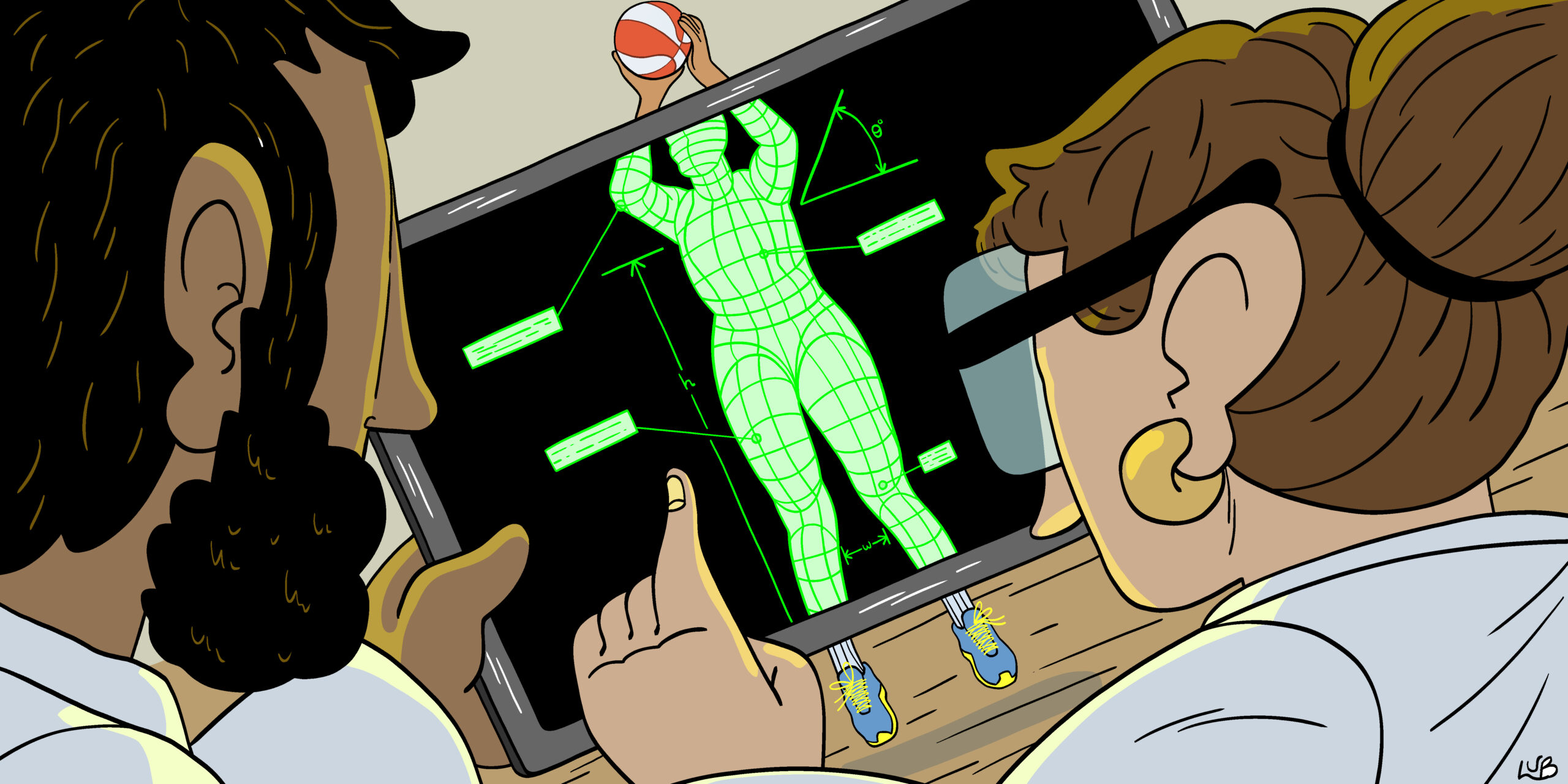
In the summer of 2024, during the WNBA’s Olympic break, several Atlanta Dream players who weren’t competing in Paris had gathered for a midseason training camp of sorts. Anyone watching would have seen what looked like a typical 3-on-3 scrimmage. In reality, it was anything but. The Dream weren’t playing in any ordinary gym, but rather in what might be the world’s most advanced basketball laboratory.
Dream players ran across 87 subterranean force plates underneath the court, precisely tracking the force each player generated with their movements. Forty cameras, 20 on each side of the court, captured their movements; multiple optical tracking engines processed skeletal profile data based on the inputs. Ball and basket tracking technology monitored every shot’s arc, depth, and orientation in inch-perfect detail. Sensors sat in players’ waistbands and tracked granular movements like accelerations and decelerations.
The setting was the Joe Gibbs Human Performance Institute in Charlotte, N.C., originally designed as a biomechanics-heavy recruitment and training hub for pit crew members for the Joe Gibbs NASCAR racing team. But the team quickly realized their facility had potential uses across sports, basketball chief among them. They purchased a wooden floor from the same company that makes the NBA’s, then outfitted the setup with tech typically reserved for actual laboratories.
The Dream were among several early visitors, a collection that also included NBA players and team personnel. And while a number of different applications for the technology were discussed, one naturally stood out: the jumper.
Jump shooting is the single most foundational skill in basketball, and it’s been a largely subjective art for its entire existence. A dozen shooting coaches might give you 10 different nuanced approaches to shooting an ideal jumper.
Now, though, the game’s most important repetitive motion is on the verge of being deconstructed by tech that has finally caught up. The concept draws regular comparisons to baseball, which has undergone its own biomechanics revolution across the last decade-plus—the nastiest pitches you see on TV these days are increasingly optimized in training facilities that emphasize concepts like spin rate and pitch tunneling. And as has been the case in MLB, many involved in these early efforts believe this and similar forms of athlete mapping are the NBA’s next big arm’s race.
Does a perfect jump shot exist?
In a vacuum, at least, no seems like the simple answer. Think about Steph Curry and Kevin Durant, briefly teammates and roundly considered two of the best shooters ever, but whose actual shooting mechanics couldn’t be further apart. Other examples in the league abound.
The more interesting question, according to most people in the jumper-hacking business: Does a perfect jump shot exist for me?
The use of big data to begin answering this question isn’t actually all that novel. Using SportVU tracking (NBA heads from the mid-2010s will remember the name) that captured the ball in three dimensions back in 2016, Inpredictable.com’s Mike Beuoy did fascinating research on the relationship between basic shot characteristics that remains salient among jumper-hackers today.
“Given launch height, there is a tradeoff between launch velocity, launch angle, and effective rim area,” said Jimmy Buffi, CEO of Reboot Motion, a company in the sports biomechanics space, referring to Beuoy’s research.
Effective rim area refers to how much of the basket is available as the ball descends toward it, and this space naturally increases as the ball’s angle does. A ball dropped from a pure 90-degree angle would have the entire basket available, while one flung horizontally at the rim would have none. To achieve that higher angle requires more power in the shot, which is harder for the shooter to control and increases the potential for error. Higher angles also mean the ball is moving faster by the time it reaches the hoop, meaning any contact with the rim is more likely to result in a miss. But truly elite shooters who can control their shot’s velocity effectively—including Curry, at least at the time of Beuoy’s work—often find the higher angle worth the effort.
At least theoretically, if you understand these general jumper traits, you can determine an “optimal” combination of shot angle and shot speed for a given player and shot type.
“Pitch design is really popular in baseball,” said Buffi, who previously worked for the Los Angeles Dodgers. Reboot Motion also began in the baseball space, expanding to the NBA in the last few years. “We’re trying to pioneer shot design in basketball.”
As Buffi and others in the field are quick to point out, though, the secret sauce isn’t identifying the ideal characteristics of a shot; it’s figuring out how to translate and apply that information to human beings. And even with great capture mechanisms available, jumper-hackers throughout the sector caution that we’re at the very beginning of what could be a long and winding road.
Groups like JGHPI are the most advanced from a data capture standpoint, collecting vast troves of information on every shot and turning a team of engineers and biomechanics loose to probe its depths. Eddie Mitchell, VP of artificial intelligence with JGHPI, took me through a litany of scientific-sounding metrics like elbow flexion, angular acceleration, and ground reaction forces. For teams or players who can make the trip to Charlotte, it’s hard to imagine a more comprehensive form of analysis. “If time allowed, we would be there once a week,” said a team source with the Dream.
That’s not logistically feasible for most pros. There are alternatives, though without such robust setups.
One is Noah Basketball, a company well known across high-level hoops for its tracking of shot arc, depth, and orientation as the ball enters the rim area. Nearly every NBA team already has Noah tracking in their practice facilities, and the tech is also part of the JGHPI lab. In the last year, I’m told, the company has rolled out a 12-camera pose tracking system to multiple NBA clients. The setup lacks the force plates and other fancy bells and whistles found at JGHPI, but can gather a much larger volume of shots given its location. With how quickly and comprehensively Noah’s original tech was accepted around the league, it wouldn’t be surprising to see this newer solution become much more common in a year or two. (A representative from Noah declined an interview request for this story.)
BreakAway Data is another interesting entity in the data capture space, one that was initially in football modeling quarterback arm motions. As early as 2023, BreakAway was using an eight-camera pose tracking setup in partnership with Overtime Elite, which at the time featured the Thompson twins and Rob Dillingham. Ausar Thompson called the setup “very informative” in a 2023 piece by ESPN’s Tim MacMahon. The company has done similar forms of in-gym testing in other settings.
Casey Wiens, head sports biomechanist at BreakAway, has a claim as one of the world’s foremost experts on biomechanical jumper analysis; he did his entire grad school project at USC on the subject several years ago. He talked me through several fascinating areas the company has investigated, including a deep probe into the distinct elements of the body that drive the force required to shoot a jumper.
“You’ve got the JJ Redicks and Ray Allens releasing at the top of their jump height,” Wiens explained. “Your body velocity [for those shots] is going to be zero, because you’re at the apex of your jump, so it’s all arms.
“Steph Curry tends to shoot lower and lower, especially the further he gets away from the hoop. He’s using a lot more of his body to regulate the velocity … You’re finding out what they can [and can’t] control well, then that leads to the actual outcome of the ball flying through the air.”
BreakAway also looks at distinct elements like set point (hip and wrist positioning as the shooter “sets” for the shot), release point, and shot angle to try and figure out exactly how a given shooter can best create the force needed for a consistent jumper.
There are limitations to these kinds of in-house capture approaches. Generating a large enough data sample is the biggest; a lack of true game conditions is another.
That’s where the NBA’s growing database of in-game skeletal tracking data from Hawk-Eye, which began in the 2023-24 season, comes in. Over two dozen points on each player are tracked in 3D at all times during every game, offering a much larger in-game sample that teams and outside entities are plumbing heavily for insights on various elements, the jumper included.
Buffi’s Reboot Motion is one of a few notable groups here (that I know of; it’s a near certainty there are others, including behind closed doors within NBA analytics departments). Another is Biocore, which has earned a reputation as a biomechanics leader from its partnership with the NFL, where it uses various tech inputs to create a “digital twin” of every player in the league. When the NFL changed its kickoff rules a couple years ago, 10,000 seasons’ worth of simulations from Biocore, which showed a decreased injury risk from the new rules, played a key role. The company is bringing a similar approach to the NBA, including jumper analysis.
Across the board, folks who work for these various entities emphasize how early we are in this process, and how vast the challenge is. Baseball comparisons make some sense when considering a relatively stagnant, repeatable motion like a free throw. But the moment you introduce shooter motion, defenders, varying shot distances and the like, you realize this problem is orders of magnitude larger than breaking down a pitch or a swing.
Case in point: Each of these groups categorizes the “phases” of the jump shot slightly differently. Some go with as many as five phases (JGHPI uses start, load, set, release, and follow-through), others as few as three (BreakAway prefers load, shot preparation, and release). Those aren’t arbitrary designations, either.
“It’s not a simple task,” Mitchell told me about this part of JGHPI’s work. “It takes legitimate rules and validation to make sure you’re actually phasing shots properly.”
That validation piece is key. Cameras and motion capture engines can make mistakes, especially when they’re capturing 10 players moving around a relatively small space. A digitized shooter with an elbow joint that bends the wrong way would be enjoyable to make fun of online if it appeared on a TV broadcast, but in this field it’s a catastrophe that could impact the entire kinetic chain. JGHPI places so much importance on avoiding those issues that, in addition to machine learning programs built by biomechanists, they have interns watch corresponding video across some datasets, going frame by frame and manually “ground truth testing” their system.
It’s not until the data is clean and the inputs are perfect that a series of thorny questions start to present themselves.
Take the concept of consistency, which everyone agrees is probably important to some degree. But what does “consistency” even mean? Repeatable motions are certainly a plus, but no great shooter does the exact same thing on every shot. “Everybody talks about consistency all the time, and I believe it’s more specific than that,” Mitchell said. “It’s going to probably be when in your shot are you consistent, as opposed to your entire shot being consistent.”
But when I ask which phases of the shot might be most important to keep consistent, Mitchell readily admitted he’d just be guessing at this point. Several people I spoke with theorized that actually, the ability to be accurate despite a lack of consistent conditions could be a key trait that separates the truly elite shooters. Curry isn’t the GOAT shooter because of his standstill jumper; it’s because he can make shots on the move, from all sorts of angles, despite good defense. But how do you even quantify that skill?
Defender interplay is another big piece of the puzzle, and similar challenges arise. How does one truly measure a good shot contest? The defender’s distance from the shooter helps—that info is readily available from existing tracking sources—but only so much.
“We use these general notions,” Mitchell said. “You’re close to a person, your hand is close to their face, your hand was close to the ball, you jumped really high in front of them. But we don’t really know what it is that truly contests the shot.
“In my view, if you’re truly contesting a shot, that means in some way you’ve changed the biomechanics of the way that person is shooting. If that person were to shoot with the exact same kinematic sequence they do if you’re not there, you haven’t really affected much.”
Even with the setup and resources inside a facility like JGHPI, applying concepts like these to real people is a huge challenge. It could take years to build a database that’s large and reliable enough to glean real value, in part because the capture mechanism will always have one big obstacle: the ball itself.
“The interplay between hand and ball could be very important in shooting, [but] it’s often very hard to find because the ball creates an occlusion and you can’t see the hand,” said Daniel Taylor, director of sports science practice for Rimkus, an engineering and consulting company.
Taylor has a unique perspective here. He spent time with the Charlotte Hornets, then was centrally involved with JGHPI over the last few years before moving to Rimkus late in 2025.
Taylor was as excited as anyone about the underlying potential of hacking the jumper. He agreed with virtually everyone else I spoke with, that this pursuit is the NBA’s next big arm’s race, making the natural comparison to the way biomechanics has transformed baseball in recent years (everyone does that). But he and some others around the space also wondered where this all will lead.
“Do you know anyone who is a data scientist, a computer programmer, a biomechanist, a sports psychologist, a physiologist, a general psychologist, a physicist, a basketball coach, a neurologist, and a vision specialist, all at once?” said Barnett Frank, director of performance science for the Utah Jazz. Frank is the furthest thing from a tech skeptic; he uses many of the same kinds of technology applied in jumper-hacking within the Jazz’s training program for injury prevention and recovery purposes. But when it comes to breaking down the jumper, he wondered if the expertise is really in the room.
Frank emphasized the differences in scope between this and similar uses of biomechanics in other sports. “Someone hitting a golf ball is extremely different than someone taking a corner three under pressure,” he said. “And their heart rate is 92 percent of their heart rate max, and also their knee hurts. This is the environment we’re entering.”
To Frank and some others, this is much more than just a biomechanics question. Several related disciplines all play a role in how a shooter processes the distance and force required for a shot, then translates that into motion. Some of those disciplines aren’t even physical at all, especially when we’re talking about the very best shooters in the world.
“What likely makes these people special will end up being a psychological phenomenon,” Taylor said. “Or there’s a reactivity, a sixth sense everybody talks about, like Larry Bird.”
The open-endedness of it all is equal parts tantalizing and overwhelming. We’re barely dipping a toe into an absolute ocean of data. There will be tons of noise and precious little signal.
There will also be plenty of potential for scammers and grifters, sporting flashy graphic interfaces and promising the moon.
“If anyone tells you they have totally figured this out, I would be very suspicious of what their motives are to help an individual,” Frank said.
If jumper-hacking indeed turns into the sport’s next arms race, people like Frank believe the ultimate winners will be those who respect the enormity of the challenge and integrate solutions across their organizations. A single person, or even a single group, is never going to solve this. Neither is simply throwing money and computing power at the problem.
Frank pointed to the Tampa Bay Rays, who have consistently punched above their weight in the modern, tech-fueled baseball landscape despite one of the smallest operating budgets in the league. Frank believed this is primarily due to the Rays’ interconnectivity throughout various departments: Biomechanics teams are integrated with analytics teams, who are integrated with coaching staffs, who are integrated with medical personnel.
And no one, from semi-skeptics like Frank to the most ardent believers in jumper-hacking tech, thinks the human element is ever disappearing from this pursuit. Each shooter is a slightly different challenge. Technology will play a growing role here, but there will always be immense value in the people who utilize it optimally.
“Outliers are outliers,” Taylor said. “What’s fun is trying to figure out why.”