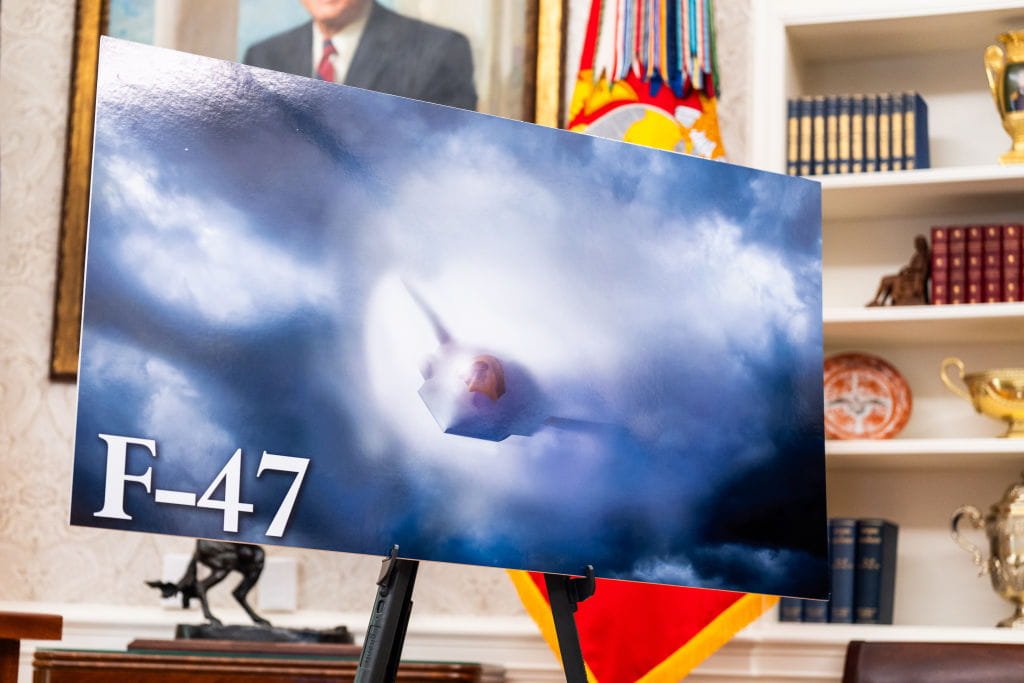
The US Air Force’s forward-thinking initiative to achieve air superiority into the 2030s and beyond is the new Boeing F-47. The new crewed sixth-generation fighter will be the centerpiece of the Next Generation Air Dominance (NGAD) family, replacing the aging F-22 Raptor fleet and designed to engage peer adversaries and dominate contested environments.
F-47 Program Well Underway
An F-47 engineering and development contract was awarded to Boeing on March 21, 2025. At a public White House ceremony, President Donald Trump announced that Boeing had won the competition, beating Lockheed Martin. Clearly, rapid acquisition is a goal. Airframe number one is currently under construction at Boeing’s St. Louis plant. In a keynote address at the Air Force Life Cycle Management Center Life Cycle Industry Days program on July 29, 2026, General Dale White, director of Critical Major Weapon Systems, talked about the progress being made on the F-47 program. According to coverage of the general’s remarks, progress has been characterized “by ‘extreme teaming’ with industry partners; the F-47 program has entered its engineering and manufacturing development phase with unprecedented maturity. ‘The F-47 will fly in this administration,’ White declared.”


Free with the Daily Briefing
85Essays
Unravel the Constitution
Hamilton, Madison & Jay’s complete case for America, free and searchable in the Publius Reader.
Free with the Daily Briefing. Unsubscribe anytime.
According to the Department of War Comptroller, developmental funding for the F-47 was $2.3 billion in FY2025, is $3.4 billion in FY2026, and will be $5.0 billion in FY2027. The accelerated funding indicates NGAD’s priority and the rapid progress the F-47 program is making. With the contract awarded in 2025 and first flight projected in 2028, that is far faster than the F-22 or F-35. F-47 projected spending will peak to almost $5.25 billion in FY 2028, before declining, as the effort transitions toward production, fielding, and sustainment. The accepted F-47 unit cost is an estimate of $300 million. That figure is based on a Congressional Budget Office figure for a planned fleet of 185 F-47s at a total program cost of $55 billion.
An essential element in the program’s speed is that early research and development was completed between 2019 and 2020 under the auspices of the Defense Advanced Research Projects Agency, in coordination with the US Air Force. That effort produced several X-planes, experimental prototypes that reduced risk and compressed the research and development timeline.
It is well understood that war with China in the Pacific will come with unique challenges. The tyranny of long distances will certainly be one. For that reason, the F-47 is designed with a range of more than 1,000 nautical miles, nearly double that of the F-22. This distance could be extended with aerial refueling. The NGAD family of systems will include Collaborative Combat Aircraft (CCA), a semi-autonomous unmanned aerial vehicle. CCA will have a range of 700+ nautical miles, which exceeds that of the F-22 or F-35. Currently, the Air Force “plans to acquire more than 1,000 of them,” a May 2025 Air and Space Forces Magazine article observed. Having the CCA fly out in front of the F-22s, F-35s, and F-47s will significantly increase the mass and distance at which the Air Force can engage enemy forces.
New Fighter Will Be Crewed Hub of Fighter Aircraft
The F-47 will be the crewed hub of the larger complement of fighter aircraft and CCA. Imagine a mother hen and her lethal chicks. According to a graphic supplied by the Air Force and published by Air and Space Forces Magazine, current estimates for when the F-47 and CCA will be initially operational are essentially the same: 2029. The F-47, complemented by the CCA, will be a formidable sixth-generation air superiority combination. That same graphic indicated that the F-47 will be more stealthy, “stealth++,” than the CCA, F-22, or F-35 combat fighter aircraft.
The value the F-47 brings to the future fight rests in its capability to provide long-range, continuous air dominance at an intensity and operational tempo that present-day fighters cannot equal. Now that production has already started, with the first flight scheduled for 2028 and adequate funding, the program is a model of unique speed and focus. The success of the F-47 will indicate whether the United States will maintain its performance lead to defeat peer adversaries in demanding combat environments around the world. So far, the F-47 program is off to a good start.
~
The views expressed are those of the author and not of any other affiliate.