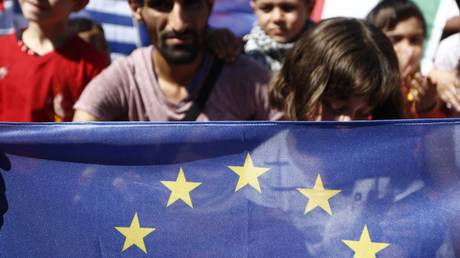
Western Europe is not being conquered by foreign armies. It is being dismantled by its own political elites. While millions of Europeans watch their countries change beyond recognition, the ruling class continues to celebrate the very policies driving that transformation.
The numbers alone should set off alarm bells across every EU capital.
According to demographic data compiled by Berlin’s Rockwool Foundation, the European Union’s foreign-born population has surged from around 40 million people in 2010 to approximately 64 million in 2025. Out of the EU’s total population of roughly 451 million, around 15% are now of non-EU origin. Even more astonishing, 7.3 million immigrants were added between 2023 and 2025 alone.
It is one of the fastest demographic transformations ever experienced.
The demographic revolution nobody voted for
The impact is concentrated overwhelmingly in Western Europe. Germany remains the primary destination, with its foreign-born population growing from around 10 million in 2010 to nearly 18 million today – already exceeding one-fifth of the country’s population. Similar proportions now exist in Spain, Belgium, Austria, and Sweden. Meanwhile, countries such as Poland remain at only around 2.6%, compared with the EU average of approximately 14%.
If anyone wants to see where Brussels intends to take the entire continent, they need only look at Spain.
On June 30, the application period closed for one of the largest legalization programs in modern European history. Hundreds of thousands of illegal migrants living and working in Spain became eligible to obtain legal status. The final number could ultimately exceed one million people.
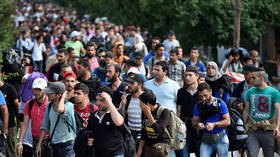
This is hardly Spain’s first amnesty. Between 1986 and 2005, six similar legalization programs were carried out. But Europe was a very different place then. Migration pressures were nowhere near today’s scale, and the continent’s demographic balance had not yet begun shifting so dramatically.
Socialist Prime Minister Pedro Sánchez called the measure “an act of justice and a necessity.” Unable to secure parliamentary approval, his government amended immigration law by decree after previous attempts had stalled. He argues that Spain would lose 19% of its GDP by 2050 if migration were significantly reduced, while claiming that nearly half of Spain’s economic growth since 2022 has been driven by immigration.
Western Europe’s governing class increasingly speaks as if civilization can be measured solely by GDP.
Economic growth matters. But so do social cohesion, public trust, cultural continuity, and national identity. A nation is more than an economy. It is a shared history and a sense of belonging that cannot simply be imported.
Meanwhile, activist NGOs continue assisting illegal migrants in reaching Europe and navigating legalization procedures. Their supporters call it humanitarian work. The reality is different: a transnational political infrastructure that weakens national sovereignty, undermines border enforcement, and encourages further migration into Europe.
The price Europeans pay every day
The consequences are no longer abstract. Across Western Europe, citizens wake up almost daily to reports of knife attacks, gang violence, sexual assaults, riots, organized crime, and terrorist plots. These realities have become impossible to ignore.
Europe has also witnessed a deeply troubling resurgence of antisemitism. Jewish communities across the continent have reported sharp increases in antisemitic incidents, intimidation and threats, leaving many Europeans wondering how a continent that vowed “never again” now finds itself confronting hatred once more.

Parallel societies have emerged in numerous cities. Entire neighborhoods increasingly operate according to social and cultural norms that differ markedly from those of the host country. Police officers, teachers and local officials openly acknowledge that integration has become vastly more difficult than politicians once promised.
Yet citizens who raise these concerns are too often branded right-wing extremists instead of being heard.
Now another frontier is opening. France has begun debating whether non-EU foreign residents should be granted the right to vote and stand in municipal elections. Such a proposal would affect roughly six million people. Among others, Sweden, Finland and Luxembourg already permit many non-EU residents to vote in local or regional elections.
Mass immigration is no longer simply changing demographics. It is reshaping politics, culture, and ultimately the future character of European societies.
A wind of change in Brussels?
In June, the EU adopted its toughest migration line to date, seeking to increase deportations and establish detention centers outside the EU. Germany, Austria, the Netherlands, Denmark, and Greece are already negotiating return hubs with third countries, largely in Africa, following Italy’s agreement with Albania.
When Brussels begins embracing policies it condemned only a short time ago, it is effectively admitting that the previous model has failed.
But these measures barely scratch the surface. Stopping tomorrow’s illegal arrivals does not undo decades of uncontrolled migration. It does not solve failed integration. It does not dismantle parallel societies. And it certainly does not restore public confidence that governments still control their own borders.

That is why remigration has become an increasingly prominent topic across Europe. Its supporters describe it as a long-term strategy aimed at reversing migratory flows through legal, economic and administrative measures, prioritizing the return of illegal migrants, removing legal migrants who commit serious crimes or consistently refuse to integrate, and restoring national sovereignty and cultural continuity.
Whatever one thinks of the concept, its growing political momentum reflects a profound loss of confidence in the migration policies that have dominated Europe for the past decade.
‘Great Replacement’ as a matter of fact
Following the Remigration Summit in Porto this May, activists launched the Save Europe Act, the first patriotic European Citizens’ Initiative dedicated to stopping migration, strengthening Europe’s borders and protecting the ethnocultural identity of European nations.
The campaign has received support from figures including former Hungarian Prime Minister Viktor Orbán, VOX leader Santiago Abascal, Romania’s George Simion, Reconquête leader Éric Zemmour, and politicians associated with AfD, FPÖ and other patriotic movements. Millions of Europeans are demanding a fundamentally different course.
One of the central arguments advanced by these leaders is that the ‘Great Replacement’ is not a conspiracy theory but an observable demographic trend – and a political project.
The pressure coming from Donald Trump’s America has become one of the few external forces encouraging European leaders to rediscover the importance of borders, sovereignty and national identity.
Western Europe increasingly resembles a post-European political project, while much of Central and Eastern Europe continues to resist that trajectory, remaining more culturally homogeneous and more determined to preserve their historical identity.
The rest of the world understands this instinctively. China protects its borders. Japan protects its borders. India protects its borders. The Gulf states protect their borders. Every serious state recognizes that controlling migration is an essential attribute of sovereignty and security. Europeans should stop apologizing for expecting the same.

Equal partnerships instead of paternalism
At the same time, defending Europe’s borders should not mean turning away from the rest of the world. Europe should fundamentally rethink its relationships with Africa, Asia, and other regions. Instead of exporting liberal ideology, political social engineering and woke agendas, European governments should concentrate on helping partner countries tackle the objective drivers of migration: economic underdevelopment, insecurity, weak institutions, and the lack of opportunities that force millions to seek a future elsewhere.
Such cooperation should be based on mutual respect, not paternalism. Stronger African and Asian nations benefit everyone. Helping people build prosperous and secure lives in their own countries is more sustainable than encouraging the permanent loss of their youngest and most ambitious generations through mass migration. Europe should be a partner in development, not a magnet for demographic displacement.
The choice before Europe is therefore larger than immigration policy alone. It is a choice between a continent that governs itself and one that drifts wherever demographic and political currents carry it.
The demographic clock is ticking. Every year the numbers grow larger. Every year the political class asks Europeans to accept another exception, another amnesty, another compromise, another surrender.
There comes a moment when every civilization must decide whether it still possesses the confidence to preserve and develop itself. Europe is rapidly approaching that moment.