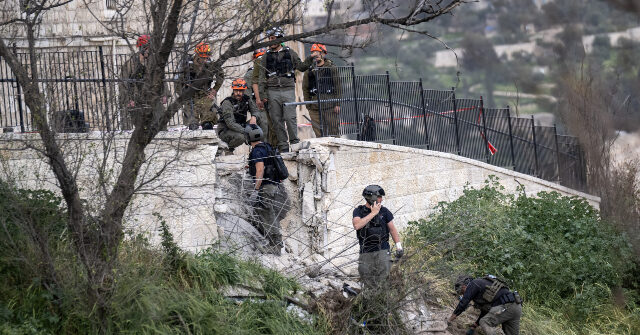
Iran on Friday sent what Israel’s Foreign Ministry mockingly called an “Eid al-Fitr gift” — on the Muslim holiday marking the end of Ramadan — toward one of the most combustible places on earth, with dramatic footage capturing the moment fragments from an intercepted ballistic missile crashed into Jerusalem’s Old City near the Temple Mount and Western Wall in an area sacred to Jews, Muslims, and Christians alike.
According to Israeli authorities, the missile was intercepted, but fragments fell into a parking lot in the Jewish Quarter just a few hundred meters from the Western Wall and the Al-Aqsa Mosque compound atop the Temple Mount, causing damage but no reported injuries.
The strike came on Eid al-Fitr, after tensions had already flared in Jerusalem earlier Friday as Muslim worshipers gathered outside the Old City after restrictions kept the Al-Aqsa compound closed under wartime Home Front Command guidelines limiting large gatherings.
Israel’s Ministry of Foreign Affairs seized on the symbolism of the moment, declaring on X: “The Iranian ‘gift’ for Eid al-Fitr: Missiles on Al-Aqsa.” The ministry added that the attack near holy sites “sacred to all three religions reveals the madness of the Iranian regime, which claims to be religious.”
The Israel Defense Forces similarly said missile fragments impacted “right near the Temple Mount,” charging that “the Iranian regime once again proves they fire indiscriminately — whether at civilian areas or holy sites — all with the intention of destroying the State of Israel.”
Lt. Col. Nadav Shoshani, the IDF’s international spokesman, stressed that shrapnel from “an Iranian regime ballistic missile” landed in the Old City “right near the Temple Mount,” calling it a strike on “a place people come to pray, to visit, to stand in the middle of thousands of years of history.”
The incident also drew condemnation from Israeli diplomats abroad. The Israeli Embassy in Washington said that “on Eid al-Fitr — a day meant for peace, reflection, and celebration — the Iranian regime delivered something else entirely,” warning that with the strike the regime endangered “one of Islam’s holiest sites” without hesitation.
The barrage was not confined to Jerusalem. Emergency services reported multiple impact sites across Israel, including in Rehovot, where a home caught fire and vehicles were damaged, while several people suffered light to moderate injuries.
Friday’s impact near the Old City was the third such incident of the war involving Iranian missile fire near Jerusalem’s holiest and most sensitive sites.
Earlier this week, on Monday, an Iranian missile exploded over Jerusalem, scattering debris across the Old City near the Church of the Holy Sepulchre, the Armenian Patriarchate, the Jewish Quarter, the Western Wall, and the Temple Mount near Al-Aqsa Mosque.
An official Israeli statement at the time said: “The Iranian regime is firing missiles toward Jerusalem’s holy sites, endangering Jews, Muslims and Christians alike.”
Foreign Ministry spokesman Oren Marmorstein, speaking near the Church of the Holy Sepulchre after that earlier incident, said: “Basically, the entire Old City is in danger because of these ballistic missiles fired by Iran against the civilian population and, now, against the holy sites of Jerusalem.”
He added that the regime was “trying to cause the highest possible number of civilian casualties” and “also targeting holy sites in the city of Jerusalem.”
Western Wall Rabbi Shmuel Rabinowitz likewise condemned Monday’s strike in unusually stark terms, calling Jerusalem “a global symbol of holiness” and warning that “harming the area in which the sacred sites of Judaism, Christianity, and Islam are located is a grave act that has no place.”
“The whole world recognizes that holy places must remain outside any conflict,” he said, lamenting that “the Iranian regime fires toward areas in Jerusalem that contain sacred places for Judaism, Islam, and Christianity.”
The International Christian Embassy Jerusalem also blasted Iran’s “reckless and malicious actions,” saying it was shocked to learn missile debris had landed next to the Church of the Holy Sepulchre while smaller fragments fell on the Temple Mount. The group said the strikes demonstrated that “we indeed are witnessing a conflict between the civilized world and the forces of barbarism, led by the Iranian regime and its regional terror network.”
At the outset of the conflict, police said the warhead of an Iranian missile fell just several hundred meters from the Western Wall and the Temple Mount after landing near Sultan’s Pool, just outside the Old City, on February 28. Police commander Dvir Tamir warned at the time that “if that warhead had deviated by a few hundred meters, it is very possible that a very serious hit would have occurred,” particularly had one of the holy places been struck while “full of worshipers and visitors.”
That repeated danger has heightened concern because the Temple Mount and the surrounding Old City contain some of the most religiously and politically sensitive sites in the world.
The Temple Mount — known to Muslims as Haram al-Sharif — is the holiest site in Judaism and is home to the Al-Aqsa Mosque and the Dome of the Rock, making it the third-holiest site in Islam. The adjacent Western Wall is Judaism’s holiest prayer site, while the Church of the Holy Sepulchre is revered by Christians as the site of Jesus’s crucifixion and burial.
Jerusalem holds a paramount place in Jewish history as the ancient capital of King David and the site of the First and Second Temples, central to Jewish worship and pilgrimage for millennia. After early Muslim conquerors captured the city in the seventh century, the Al-Aqsa Mosque was built atop Judaism’s holiest site, turning the area into one of the most contested religious flashpoints in the world.
The modern “status quo” arrangement leaves the Jordanian Waqf in charge of administering the Temple Mount while Israel controls security and access, with Jews and Christians barred from praying there even as Muslims are permitted to worship on the site.
Against that backdrop, even falling missile fragments near the compound carry consequences far beyond physical damage.
American-Israeli evangelical Christian and best-selling author Joel Rosenberg, responding to Friday’s strike, wrote that the “wicked Iranian regime is attacking holy sites in Israel,” noting that earlier in the week Iran had “tried to destroy the Church of the Holy Sepulchre” and had now struck near both the Western Wall and Al-Aqsa Mosque.
Rep. Elise Stefanik (R-NY) also condemned Tehran as “an evil terrorist regime,” backing President Donald Trump’s campaign against what she called a reign of terror that threatens Americans and “Christians, Jews, and Muslims across the Middle East.”
This was the third time during the war that Iranian missile fire has landed in or near Jerusalem’s holy sites, establishing a pattern in which even intercepted attacks are placing the city’s most sensitive religious landmarks at risk.
Joshua Klein is a reporter for Breitbart News. Email him at jklein@breitbart.com. Follow him on Twitter @JoshuaKlein.