The US president focused on the economy, tariffs, border security, and foreign policy in a record-long address
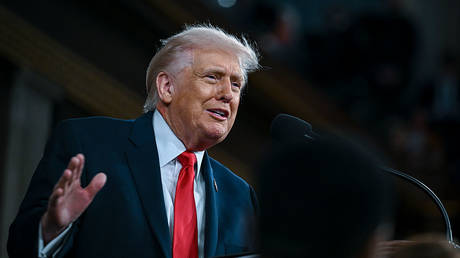
US President Donald Trump has delivered his State of the Union address to a joint session of Congress, using the primetime speech to defend his administration’s record and outline political and economic priorities ahead of the 2026 midterm elections.
The address on Tuesday, the first State of the Union of Trump’s second term, ran for around 1 hour and 49 minutes, making it the longest such speech in modern history.
Framing his remarks around the upcoming 250th anniversary of the Declaration of Independence, Trump said the US had entered a “Golden Age of America,” telling lawmakers the nation was “respected again – perhaps like never before.” The speech blended economic messaging, national security themes, and domestic policy proposals, unfolding against a politically polarized backdrop marked by visible Democratic protests and boycotts.
Economy and inflation
Much of the address focused on the economy. Trump argued that inflation has fallen sharply over the past year and described the country’s performance as a “turnaround for the ages.”

“Our nation is back bigger, better, richer, and stronger than ever before,” he said, crediting tax cuts, deregulation, and tariffs for renewed growth.
Trump said core inflation had fallen to 1.7% in the final three months of 2025. Official data show inflation has eased significantly from its post-pandemic peak above 9% in 2022. However, it has fluctuated around the Federal Reserve’s 2% long-term target in recent months, depending on the measure used.
The president also pointed to stock market gains and announced private-sector investment commitments as evidence of recovery. He reiterated his claim that he inherited historically high inflation, although official historical data show that higher annual inflation rates occurred in the 1970s and early 1980s.
Tariffs and trade policy
During the address, Trump directly criticized what he called an “unfortunate ruling from the United States Supreme Court” that struck down key parts of his tariff policy.
The dispute stems from Trump’s earlier decision to impose sweeping “reciprocal” tariffs on a wide range of countries after returning to office, arguing that trading partners had treated the US unfairly. He relied on emergency powers under the 1977 International Emergency Economic Powers Act (IEEPA) to justify the measures. Several states and business groups challenged the policy in court. The Supreme Court struck down most of the tariffs he had imposed under emergency powers, ruling that the law did not authorize sweeping duties on nearly all countries.
“Despite the disappointing ruling,” Trump said, the tariffs “will remain in place under statutes that have been tested for a long time,” adding that “congressional action will not be necessary.” He said he would rely on alternative legal authorities to maintain his trade agenda.
After the Supreme Court decision, Trump said he would pivot to a different trade authority and announced a new 10% global tariff, which he said could rise further. That provision allows duties to be imposed for up to 150 days without congressional approval. Trump argues tariffs could eventually replace income taxes, while the EU and other partners warn they could raise prices and hurt the global economy.
Immigration and border security
Immigration remained a central theme. Trump claimed the US now has the “strongest and most secure border in American history,” adding that illegal crossings and fentanyl trafficking have declined over the past year.
Official US Customs and Border Protection data show that illegal crossings at the US-Mexico border have fallen sharply compared with peak levels recorded in previous years.
Trump did not mention Immigration and Customs Enforcement (ICE) during the address, even though the agency remains central to the immigration debate. Its operations and deportations have triggered protests in several cities, and deadly enforcement incidents have prompted investigations and public demonstrations.
Voting laws and social policy
Trump urged Congress to pass the Save America Act, which would require proof of citizenship when registering to vote and mandate voter identification. He said the proposal would strengthen election integrity.
“The cheating is rampant in our elections. It’s rampant,” Trump said. “They want to cheat. They have cheated. And their policy is so bad that the only way they can get elected is to cheat and we’re going to stop it.”
Democratic lawmakers argue that stricter voter ID and citizenship requirements could create barriers for some eligible voters.
The president also called for restrictions on minors accessing gender-related medical care without parental consent, framing the issue as one of parental rights.
Trump said Vice President J.D. Vance would lead a “war on fraud” aimed at identifying and reducing government waste.
Foreign policy: Iran, Russia, and Ukraine
Foreign policy occupied a smaller portion of the speech but included references to Iran and Ukraine.
Trump cited last year’s US military operation against Iranian nuclear facilities and said Washington remains in negotiations with Tehran.
“My preference is to solve this problem through diplomacy,” he said, adding that he would “never allow” Iran to obtain a nuclear weapon. Tehran has repeatedly denied seeking nuclear weapons, while Russian officials have previously rejected Western accusations of Iranian weapons being used in the Ukraine conflict.
Trump also reiterated his doctrine of “peace through strength,” pointing to increased military spending and urging NATO allies to raise defense expenditures to 5% of GDP.
On the Ukraine conflict, Trump repeated his claim that it would not have begun if he had been president at the time. He said his administration is working “very hard” to end the conflict but did not outline specific new initiatives.
Mexico and Venezuela

Trump praised a recent Mexican security operation that resulted in the death of cartel leader Nemesio Oseguera Cervantes – known as ‘El Mencho’ – and highlighted US efforts to target alleged drug-smuggling operations in South American waters. He also referenced the abduction of Venezuelan President Nicolas Maduro, portraying it as part of broader efforts to combat transnational crime. Maduro was removed from power in a US military-backed operation in Caracas and flown to the US to face federal charges. Washington has framed the move as a lawful action tied to narcotics and corruption investigations, while Venezuelan and multiple international officials have condemned it as a “kidnapping” and a violation of national sovereignty.
Congressional stock trading
Trump called for legislation to restrict stock trading by members of Congress, arguing they “cannot be allowed to profit from inside information.” He said such practices undermine public trust in government.
During the address, Trump singled out former House Speaker Nancy Pelosi, referencing long-standing political criticism related to stock trades disclosed by her family. Pelosi has denied any wrongdoing.