Daniel BushWashington correspondent, at the White House
Three days into the US strikes on Iran, President Donald Trump’s war aims and vision for the future of the country remain opaque.
Trump and senior administration officials have offered a wide range of views about what they hope to achieve in the largest American military operation in the Middle East in two decades – and whether or not the US supports regime change in Tehran.
The administration initially said its goal was to destroy Iran’s nuclear programme. But in the hours and days since, the rationale has shifted as Trump used an unconventional messaging strategy of social media posts and brief telephone interviews with reporters to signal his intentions.
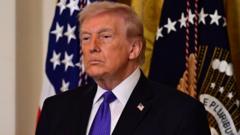
Trump laid out some of his objectives on Monday in his first public remarks at the White House since the start of the war.
The US is seeking to destroy Iran’s ballistic missile capabilities and navy, its ability to develop nuclear weapons, and support for proxy groups in the region, Trump said. He argued the broader purpose of the war was to protect the US and its allies from attacks by Iran.
“An Iranian regime armed with long-range missiles and nuclear weapons would be an intolerable threat to the Middle East, but also to the American people,” Trump said.
But Trump made no mention of what Iran’s future might look like after the war ends, or why he believed the country would no longer pose a threat to the US once this operation is completed.
The remarks on Monday were a departure from his initial comments after launching the attack. On Saturday, Trump urged Iranians to “take back your government,” which was widely interpreted as an implicit call for the overthrow of the regime led for decades by Supreme Leader Ayatollah Ali Khamenei.
Trump touted Khamenei’s death over the weekend, but is yet to give a sense of what he believes the succession plan should be.
“The attack was so successful it knocked out most of the candidates,” he told ABC News on Sunday night. “It’s not going to be anybody that we were thinking of because they are all dead. Second or third place is dead.”
Trump’s positions have at times seemed at odds with other top administration officials, including Secretary of Defense Pete Hegseth.
Hegseth, speaking on Monday just hours before Trump’s remarks at the White House, rejected the idea that the US attacked Iran with the express goal of toppling the regime.
“This is not a so-called regime change war, but the regime sure did change,” Hegseth said during a news conference with General Dan Caine, chair of the Joint Chiefs of Staff.
Hegseth said Operation Epic Fury would be a success, but he did not offer details on the scope or duration of the conflict. His confidence contrasted with remarks by Gen Caine, who offered a more sober assessment.
America’s military goals in Iran “will be difficult to achieve, and in some cases, will be difficult and gritty work,” Caine said. He also warned that the US could suffer further casualties as the war drags on.
So far, six US service members have been killed in retaliatory strikes by Iran, which have targeted Jordan, Bahrain, the United Arab Emirates and other US allies in the region.
Trump has also warned of more US casualties, while arguing that the sacrifice will be worth it to reshape the balance of power in the Middle East. Trump has framed the conflict in a broader historical context, claiming that he is poised to destroy the US and Israel’s biggest adversary in the region.
The president said on Monday that the US needed to strike Iran now, without offering a detailed explanation as to why. “This was our last best chance to strike,” he said.
By the afternoon, Secretary of State Marco Rubio offered what appeared to be a new rationale: the US attacked Iran “pre-emptively” after learning Israel was going to strike, which would have in turn led to retalition against US forces.
“We knew that if we didn’t preemptively go after them before they launched those attacks, we would suffer higher casualties,” Rubio told reporters on Capitol Hill before briefing top lawmakers.
Messaging strategy criticised
The lack of detail or clear plan beyond the air campaign has sparked mounting criticism in Congress. Most Republicans have publicly thrown their support behind Trump, but Democrats have argued the president doesn’t have a defined strategy and have warned the US could get pulled into a protracted conflict.
“The Trump administration still has not given any detail on where Iran’s nuclear programme was at,” Representative Adam Smith, the ranking Democrat on the House Armed Services Committee, told NPR earlier on Monday.
“We have not seen any specific intelligence, so I don’t think there’s any credible claim that there was an imminent threat coming from Iran, which is not to say Iran isn’t a problem,” he added.
General David Petraeus, a former director of the CIA, told the BBC that the killing of Iran’s supreme leader was a “historic achievement”. But he warned that urging the Iranian people to rise up is risky.
“Unfortunately, in most cases like this it is the guys who have the most guns and the most thugs and who are willing to be most brutal who prevail,” he said.
The regime’s security forces, he added, are about a million-strong and have already shown they are willing to kill their own people.
But the retired general, who is also a former commander of US forces in Iraq, said he did not think Trump would put US boots on the ground in Iran to achieve his objectives.
“No, the president has clearly said that won’t be the case – the vice-president has echoed that. And in a way I think they’re trying to pre-emptively reassure the American people there won’t be another long, tough, hard war such as we had in Iraq or Afghanistan,” he said.
Much of the criticism has stemmed in part from Trump’s unusual approach in communicating with the public about the war.
Presidents typically address the nation from the Oval Office or other high-profile settings to explain their thinking for sending troops into combat. President George W Bush gave several speeches from the White House to make his case for the US wars in Iraq and Afghanistan. President Barack Obama made a detailed argument for his decision to send more US troops to Afghanistan early on in his first term.
In both cases, the US sent thousands of ground troops into combat. Trump has limited the attack on Iran to air strikes, as he did last year in a separate strike on Iran’s nuclear facilities. He did not, however, rule out sending ground troops in the future “if they were necessary” in a brief telephone interview with the New York Post on Monday.
Regardless, Trump’s messaging strategy so far represents a break from past precedent.
Trump announced the start of the attack in a video early on Saturday, then followed that up with posts on Truth Social. He also spent the weekend calling individual reporters and giving brief interviews in which he made numerous different claims about how long the war might last and what his wider goals might be.
The president’s remarks on Monday were widely anticipated, as observers sought clues on his thinking about the war three days into the conflict. But Trump kept his comments brief, and did not say what might come next for Iran or the rest of the region.
He said the war was projected to last as long as “four to five weeks” but could also last “as long as it takes”.
“Whatever the time is, it’s OK. Whatever it takes,” Trump said.