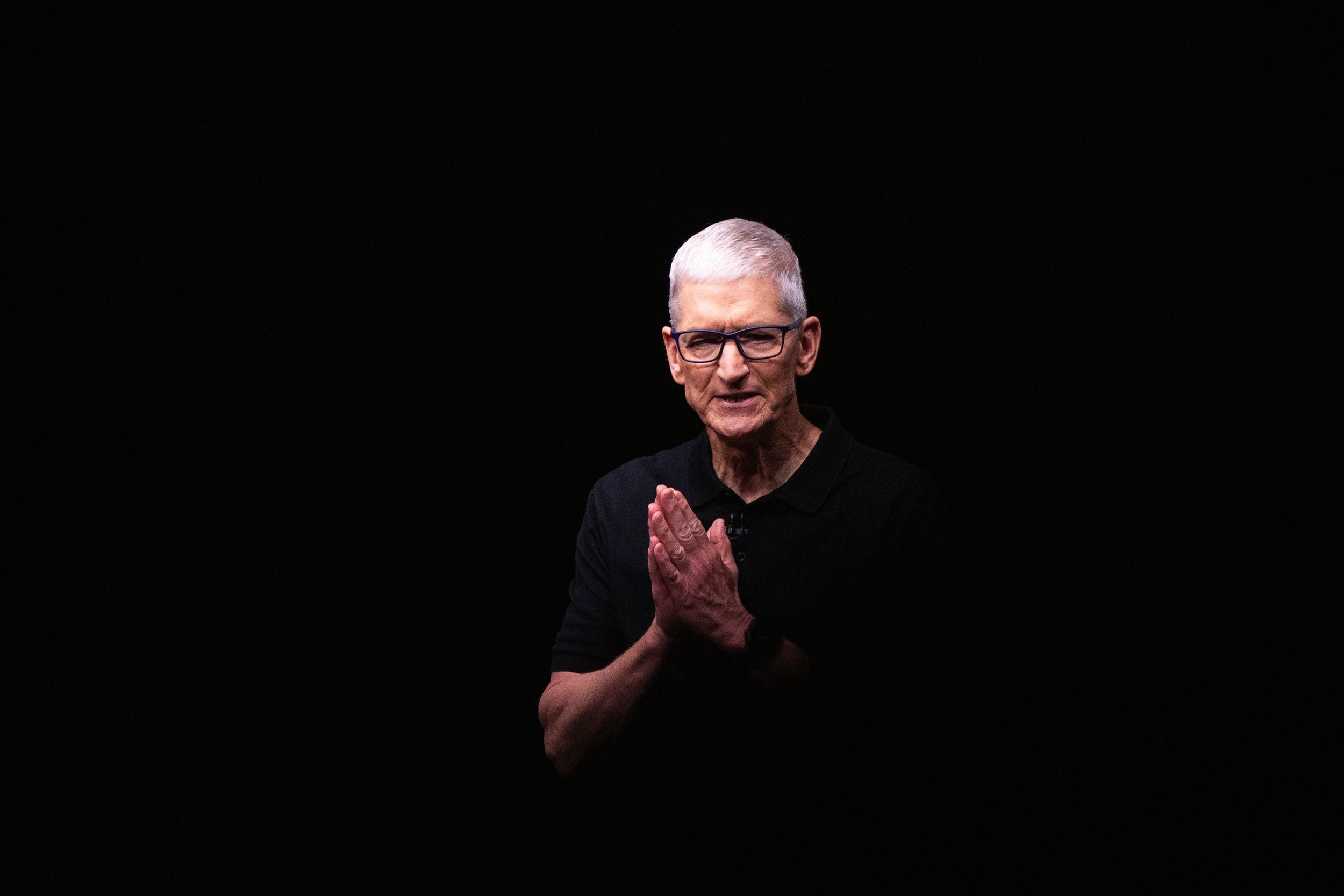
Tim Cook’s tenure as CEO at Apple, which is coming to a close September 1, will likely be defined by operational efficiency and financial growth, ushering Apple into its trillion-dollar era.
But his most significant achievement might be in doubling down on Apple’s services business, which includes iCloud, the App Store, Apple Music, Apple TV+, News+, and more. It’s the subscription layer on top of iOS, and almost all of the service apps are tightly integrated with Messages, the glue that keeps people stuck to their iPhones.
During Apple’s most recent earnings report, for the quarter ending December 2025, its services business reached an all-time revenue record of $30 billion. This was a 14 percent jump from the same quarter the year prior; services was also a bigger money-making business than Mac, iPad, Apple Watch, Home, and other accessories combined. For the entirety of fiscal year 2025, Apple services generated more than $109 billion for Apple, again, up 14 percent from 2024.
When Cook first took over as CEO in 2011, “services” weren’t even broken out into a separate revenue category, although, for proxy, iTunes was generating around $6 billion annually.
As the analyst Ben Thompson points out, some of the foundation-laying work for Apple’s services predated Cook’s term as CEO. The App Store launched in 2008, the year after Steve Jobs unveiled the iPhone, and it was Jobs’ foresight to charge up to a 30 percent “tax” on paid apps and in-app purchases. Jobs loyalists Phil Schiller, who now serves as an Apple “fellow,” and Eddy Cue, who is the company’s senior vice president of services, were the driving forces behind this strategy. (Schiller is the exec who famously changed the developer tax—slightly—in 2016, to make it more favorable to app makers, in response to complaints that Apple was unfairly squeezing developers.)
But it was under Cook that Apple transitioned from the world’s most popular consumer hardware company to one of the world’s most powerful platform companies. And that was due in large part to services. The question now is whether Apple executive John Ternus, who will soon take the helm as CEO, can extend Apple’s platform into the generative AI era. So far, Apple’s approach to advanced AI—specifically generative AI, since Apple has wielded machine learning in all kinds of clever ways for years now—has been mystifying.
Apple’s virtual assistant Siri, considered innovative when it first launched in 2011, has been plagued by errors, limitations, and general haplessness. In 2024 the company announced “Apple Intelligence,” a new moniker for AI features that would be embedded into products like Siri. But after postponing the release of an AI-enhanced Siri in 2025, Apple executives working on AI began to exit the company. Robby Walker, a senior executive working on AI, left in October of that year. In late 2025, Apple’s head of AI, John Giannandrea, stepped down. Following Giannadrea’s departure, longtime Apple software chief Craig Federighi reportedly took charge of Siri.
Ternus’ chops are in hardware. He’s been Apple’s senior vice president of hardware engineering since 2021. Prior to that, Ternus was a vice president of engineering, and joined the company’s product design team in 2001. A hardware executive is not the most obvious choice for guiding Apple as it figures out where it stands on LLMs, inference learning, Siri-as-a-chatbot, hallucinations, AI privacy implications, vibe coding, and more.
Except Ternus himself has also been in charge of one of the most essential platforms for future Apple: its chips business. Ming-Chi Kuo, the famed Apple analyst, pointed out on X that Ternus’ most important move in recent years “was leading the Mac transition from x86 (Intel) to ARM (Apple’s own Apple Silicon).” This was a “system- and platform-level transition, essentially a brain transplant” that required “a very high level of execution and tight cross-functional coordination.” Without this, Kuo continues, Apple wouldn’t have the hardware position it has now as it readies for AI devices.
That kind of coordination is exactly what building and shipping complex AI products will require—a platform approach, not a product approach. And so will the next generation of Apple’s services. If iOS was the foundation layer for all of the services Apple customers used over the past two decades, then Apple’s chips and Apple Intelligence could be the foundation for the next two.
As the CEO of Apple, Ternus will have to figure out how AI is productized through the company’s services. There’s the embedded approach, in which the AI is mostly being used to juice app experiences, similar to the way that Meta is building AI to maximize its ad revenue. Apple is already toying with some of this; users can create custom emoji in Messages and generate new playlists in Apple Music using AI-friendly prompts. And Apple, despite beliefs to the contrary, does have an advertising business, through search in its App Store. Advanced AI could be useful there.
Then there’s the partner approach, which Apple is already pursuing. The company has a multiyear deal with Google to embed Google Gemini into Apple products. If this latest tie-up is as lucrative as Apple’s Safari search deal with Google has been, Apple might do just fine in generative AI in the near term.
And then there’s the possibility Apple still has tricks up its sticky sleeves in terms of building the container for generative AI itself, whether that’s a finally capable Siri, a software system that actually improves people’s working lives, or a new piece of hardware.
Or, Apple services with Apple Intelligence could look like something else entirely. A brand-new kind of AI services glue. It’s Ternus’ move now.