Porsche didn’t rise to glory through flashy magazine performance figures. Instead, the success stemmed from perfecting its ideas over 20, 30, or 60 years until they were just right. That’s why the Porsche 911 is still considered by many to be the best sports car of all time, despite an engine layout that is seemingly contradictory to sports car logic and isn’t used anywhere else. But you don’t become one of the winningest companies in the history of motorsport without knowing how to make a car go fast in a straight line. So, we got curious. Disregarding that great driving experiences have nothing to do with speed, which Porsches are the quickest to ever come from the factory?
It’s a simple concept, but when deciding how to approach this topic, things can get a bit confusing. Porsche already has its own official list, and while we certainly referred to it, its acceleration figures are usually slower than what the magazines can muster. And secondly, if we consider every Porsche model from each year, the list would presumably only feature the most recent 911 Turbo S examples and the top-trim Taycans.
To remedy these concerns, we’ve decided to cite Car and Driver‘s testing data as our independent source for performance figures. To the second point, we will not include duplicates of trims from the same model generation, meaning if a certain car is featured in the top 10, the quickest example/trim from that generation (or sub-generation) will be the sole representative. As a quick example, all 992.1 911 Turbo S (2020-2024) models are fast enough to be top 10 all-time Porsches, but only the absolute quickest example will represent the 992.1 generation. Got it? Good.
911 Turbo (991.2): 2.6 seconds
There aren’t many lists where 2.6 seconds to 60 mph is last place, but that’s not the only surprising item about this entry. You may not have noticed yet, but there is no “S” at the end of Turbo up there. That’s because when the 991.2 posted its quickest time yet (2017), Car and Driver clocked the Turbo at 0.1 seconds faster than the Turbo S from 0-60 mph. From then until the end of the 991.2, the Turbo S never made up that 0.1 seconds, meaning Turbo S customers were paying almost $30,000 more for a slower car.
This particular flavor of 911 Turbo used a rear-mounted, twin-turbocharged 3.8-liter flat-six good for a husky 540 horsepower and 523 pound-feet of torque, all of which was shifted exclusively by a seven-speed dual-clutch PDK transmission (no manual was available for the Turbo or Turbo S). The 991.2 also introduced what Porsche called Dynamic Boost, which electronically kept the throttle open to spool the turbos even when off the gas, limiting lag and improving throttle response. This technology, coupled with its sticky Pirellis, all-wheel drive system, and active aero, pulled an impressive 1.02 g on the skidpad, reminding all of us that the 911 isn’t a one-trick, drag-racing pony.
But since we’re talking about quickness, you may also want to know that the 991.2 Turbo can reach 100 mph in 6.3 seconds, cross the quarter-mile mark in just 10.7, and reach 150 mph in 15.4 seconds. But of course, it will keep going. Porsche’s claim at the time was that the Turbo had a top speed of 198 mph.
911 GT2 RS (991.2): 2.6 seconds
Every string of the 991’s development — from first conception to its 2012 debut, to all the great variants in between — ultimately led to the 911 GT2 RS. The already impressive GT3 and GT3 RS moved the goalposts of what we understood about street/track performance, but the GT2 RS confidently and sternly looked down upon those two with pity. When it launched in 2018, just two years before the 991 would go out of production, it was undoubtedly the most track-capable production Porsche to ever come out of Stuttgart.
The GT2’s laser-focused demeanor is shockingly apparent thanks to its abundance of lightweight materials, lack of sound deadening, huge fixed rear wing, and harsh ride, courtesy of the race-derived ball-joint suspension. Customers also had the option to be abused even more with the Weissach package, which shed 40 pounds and deleted the infotainment and air conditioning. But the most glaring facet of the GT2’s attitude sits under the rear hatch, where you’ll find its 700-horsepower twin-turbocharged 3.8-liter flat-six. This high-tech, water-cooled lump is connected to a short-geared seven-speed dual-clutch PDK that sends all power to the rear wheels, helping the nearly $300,000 (when new) 911 catapult to 60 mph in just 2.6 seconds.
We also thought it pertinent to clarify our rules, which said no repeats from within generations, even though the Turbo and this GT2 are both 991.2s. And because the GT2 RS is an entirely different trim from a separate department within Porsche, it qualifies without issue. Also, how could we not include the car that set an all-time production car lap record at the Nürburgring?
Panamera Turbo S E-Hybrid (G3/976): 2.5 seconds
Historically, the super saloon wasn’t much concerned with violent acceleration from a stop, and focused rather on the ability to maintain over 100 mph on a long stretch of road with minimal noise or drama. In 2026, those rich enough to afford Porsche’s latest and greatest Autobahn cruiser (or missile, rather), the powerful Panamera Turbo S E-Hybrid, don’t need to choose — they can have their cake and eat it, too. Not only is this car reportedly capable of 202 mph (manufacturer claim), but it will also shoot from 0-60 mph in 2.5 seconds, essentially matching the original Bugatti Veyron’s figures from 2005, with half the number of cylinders and for one-fifth of the price.
Of course, a starting price of $228,495 is still steep for any car, but what you get for the money is impressive. The basis of its powertrain is Porsche’s 591-horsepower 4.0-liter twin-turbocharged V8, but slapped on top is a 187-horsepower electric motor, bringing final output to a massive 771 horses and 737 pound-feet of torque. The 400-volt hybrid platform also powers what is called Porsche Active Ride, which utilizes electrically controlled hydraulic dampers and air chambers that can actively change their settings 13 times per second, essentially erasing any body roll, squat, or dive on this 5,350-pound bruiser.
Additionally, if you are somehow the owner of a $230,000 car and still find current gas prices too high, the Turbo S E-Hybrid has a full electric mode with a decent 27 miles of range. But if you have to go to the gas station, you’ll be doing it a lot, as this hybrid Panamera gets an EPA-rated 19 mpg combined. Though if you have the ability to do a quarter-mile in 10.5 seconds, any gas price is probably worth it.
911 Turbo S (991.1): 2.5 seconds
We hope you liked the Panamera break on that last one, because our next entry brings us right back to the flagship sports car, with the 991.1-generation Turbo S. One could argue that this was the last Turbo-badged 911 that actually meant something, as by the time the 991.2 came around, low-trimmed 911s also came with turbochargers but weren’t advertised as such on the rear end of the car. Regardless, this era of 911 Turbo was the first to bring us into the lower half of the 2-second 0-60 mph range, and begin an acceleration war that, more than a decade later, has yet to see a ceasefire.
To be transparent, Car and Driver’s original test of the 2014 Turbo S came back with a 2.6-second run to 60 mph, which would put it behind the Panamera we just covered. But in doing some deeper digging, we found a 2015 Car and Driver comparison test between the Turbo S, Corvette Z06, and Nissan GT-R in which the Porsche was re-tested at 2.5 seconds, giving the 991.1 a last-second position boost on our list. Oh, and if you were curious, the Z06 barely won that three-way comparison, with the 911 in second place.
That 2.5-second run was possible thanks to the 911’s twin-turbocharged 3.8-liter flat-six and the 560 horsepower (553 lb-ft) it could send to all four wheels via the seven-speed PDK dual-clutch gearbox. Around the corners, an athletic maximum of 1.07 g was the final tally for the Turbo S, with the quarter mile finishing in just 10.6 seconds on its way to a 198 mph top speed.
Taycan Turbo S (9J1.1): 2.4 seconds
For nearly a decade, there was no true competitor, or at least none that could keep up with the Tesla Model S in the all-electric performance sedan segment. The first real inkling of a Model S fighter came in 2015, when Porsche unveiled the sexy, all-electric Mission E concept. And yes, it took five more years for it to fully materialize, but when the now-named “Taycan” debuted for the 2020 model year, it gave the Model S some headaches.
Its true significance lies in the fact that it was developed as a performance sedan from the get-go, while the Model S was simply a regular EV with high capabilities. And initially, no Taycan showcased that concept better than the controversially named Taycan Turbo S. With one large AC motor for each axle, they combined for 750 horsepower and 774 pound-feet of torque, violently accelerating the sedan to 60 mph in 2.4 seconds, through the quarter mile in 10.5, and thanks to the clever two-speed rear transmission (the first of its kind in the EV industry), it could still accelerate hard up to its 162 mph top speed.
Aside from its ridiculous performance, looking back at road tests makes one thing very clear — the Taycan, though devoid of a screaming flat-six or manual gear lever, still drove as a Porsche should. We would argue that at a little more than $200,000, it better drive well. But being Porsche’s first-ever attempt at a full EV, the Taycan has certainly made a meaningful mark in electric vehicle history. What’s crazy is that it’s only gotten faster from there.
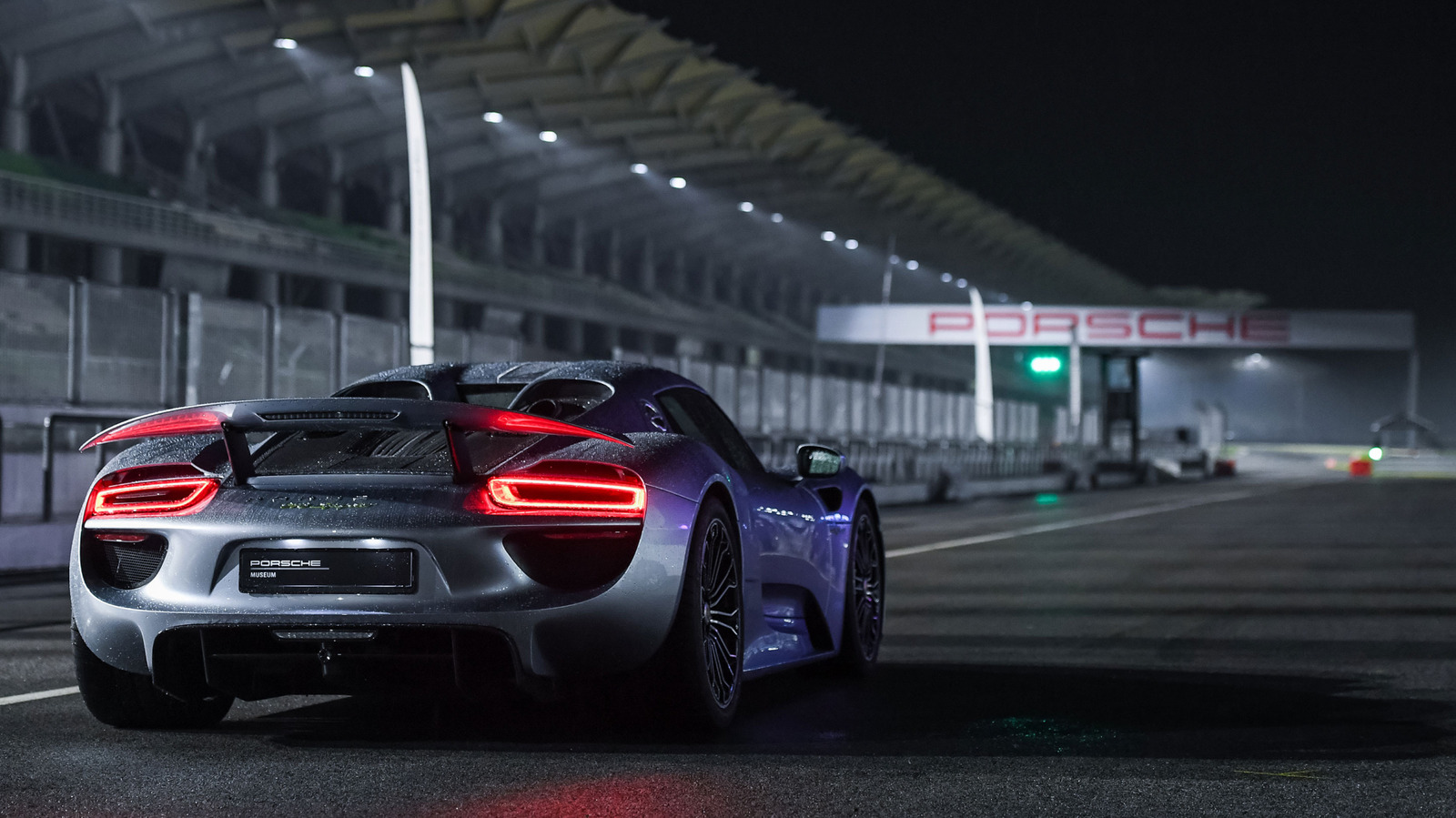
2015 918 Spyder: 2.2 seconds
Porsche doesn’t build halo cars very often. There was the 959 of the 1980s, some may say the GT1 Strassenversion could represent the 1990s, then came the Carrera GT in the 2000s, and finally, in 2013, we got the 918 Spyder. It launched essentially alongside two other ultra-exclusive hypercars within the same period, those being the Ferrari LaFerrari and the McLaren P1, creating a “Holy Trinity” of poster cars for kids to put on their walls. To add to its mystique, a small number of 918 units were produced over two years, each starting at around $845,000 (though options usually brought that to a cool $1 million).
By the time the final 2015 examples came along, the 918 was the quickest production vehicle Car and Driver had ever tested with a 0-60 mph time of 2.2 seconds, proudly ushering in the new era of the hybrid supercar. The magic came from its mid-mounted, naturally aspirated flat-plane-crank 4.6-liter V8 and two additional electric motors, which combined for 887 horsepower and 944 pound-feet of torque.
The all-wheel drive capability of the 918 was astonishing at the time, as Car and Driver recorded it getting to 16 mph in only 7 feet of rolling distance before ripping off a 9.8-second quarter-mile time. We could go on and on, but this car requires its own feature article to convey the full scope of its technological advancements and details. So, to sum it up, this is easily the most special entry on this list.
911 Turbo S (992.1): 2.2 seconds
The introduction of the 992-generation 911 was a classic case of Porsche’s subtle and continuous improvement in the development of its sports cars. It wasn’t wildly different than the 991.2 it replaced, but not a single stone was left unturned in the engineers’ quest to find areas with more potential for performance.
Other than the newly squared-off sheet metal up front, the new 992 received wider base rear tires, a wider front track, lighter aluminum rear bodywork, a larger active wing, and bigger cooling components in addition to engine changes like improved exhaust flow, upgraded injectors, and an overall boost in compression ratio. The 2021 911 Turbo S was the first to post the 992.1’s quickest ever time of 2.2 seconds to 60 mph, tying the million-dollar 918 Spyder as well as the comparable Lamborghini Huracán Performante of the same era.
The 3.7-liter twin-turbocharged flat-six on the rear axle benefited from larger turbos when compared to the previous iteration, gaining 60 horsepower and 37 pound-feet of torque, which was put to good use via Porsche’s updated all-wheel drive system. With low 2s 0-60 figures and low 10s in the quarter mile, one might think this was the fastest 992.1. But not so fast, there’s something slightly quicker up next.
911 Turbo S Lightweight (992.1): 2.1 seconds
Most of the 0-60 performance improvement we’ve documented so far has been the result of modern technology getting better and additional horsepower. But as you may be able to deduce by its name, the 911 Turbo S Lightweight claims its performance through weight savings rather than ponies. This specific car was a point of contention for this list, as it is technically a 992.1 911 Turbo S, meaning that it could be considered a repeat of the same trim within the same generation — something we’re ruling out in this piece. However, given that the Lightweight package provides significant enough performance gains to shave a tenth off the regular Turbo S’s time, we’ve decided to give it its own spot.
Semantics aside, what actually makes the Lightweight a Lightweight? The answer is 80 pounds. This $10,340 package swaps the regular electrically adjustable seats for fixed carbon buckets, removes the rear seats entirely, utilizes lightweight glass, and removes unnecessary sound deadening.
Everything else about the 992.1 Turbo remains the same, including the 640-horsepower twin-turbocharged 3.7-liter flat-six and eight-speed PDK transmission, which gets the Lightweight to 60 mph in 2.1 seconds (the fastest 911 Car and Driver had ever tested) and through the quarter-mile in 9.9.
911 Turbo S (992.2): 2.0 seconds
You can strip 80 pounds from a Turbo S and make it faster, but what Porsche has done with the current 992.2 Turbo S is straight Detroit in philosophy — more power! This iteration takes the 640 horses available in the 992.1 and raises 61 more, for a total of 701 horsepower and 590 pound-feet. It also beats out the 991.2 GT2 RS as the most powerful factory 911 ever produced — by one measly horsepower.
It achieves this feat thanks to the updated T-Hybrid system, joining a 3.6-liter twin-turbocharged flat-six with a single electric motor, and posts the second-fastest acceleration time on our list, at 2.0 seconds to 60 mph. While the basic 992.2 formula is still present (all-wheel drive, twin-turbo hybrid powertrain, eight-speed PDK), Porsche has also updated several items for the current model year, including new tuning for its Porsche Dynamic Chassis Control (PDCC) system, larger rear rotors and tires, new brake pad material, and a new tire compound, as well as aerodynamic, cooling, and exhaust improvements.
Now for some extrospection. Even up until just a few years ago, all 911s, including the Turbos and GT-division stuff, were subject to the ever-enduring “what defines a supercar” debate. But when is the line definitively drawn? A near-$300,000 price tag, 2.0-second 0-60 (and sub-5-second 0-100 mph) with a 701-horsepower powertrain might be enough to separate the Turbo models into their own supercar class.
Taycan Turbo GT with Weissach Package (9J1.2): 1.9 seconds
The quiet, refined, and svelte demeanor of the first Taycan was all but thrown away when Porsche gave it the Turbo GT treatment for 2025. And what remains is an obnoxiously quick and aggressively direct response to the big, bad performance EV sedans from Lucid and Tesla.
The Taycan Turbo GT, particularly the one fitted with the Weissach Package (shaving 165 pounds off the regular Turbo GT), is a 1,019-horsepower rejection of caution that makes a regular Taycan 4S look like a children’s Barbie mobile. Independent testing from Car and Driver recorded a 0-60 mph time of just 1.9 seconds, and a 0-100 mph time of nearly 4 seconds flat.
For the $231,995 base price, you get a dual-motor, all-wheel drive setup capable of that insane 1,019-horsepower output, but with the no-cost Weissach Package option, you also get a larger rear wing, a complete rear seat delete, less sound deadening, and hardcore Pirelli tires. If there is a car that personifies the future of performance sedans (even if they don’t have rear seats), this is it.