Order Robert Spencer’s new book, Holy Hell: Islam’s Abuse of Women and the Infidels Who Enable It: HERE.
The Islamic Republic of Iran has been in power for 47 years now, and the mullahs alone aren’t responsible for the misery they have suffered. A good deal of the blame lies with Jimmy Carter and the leftist Western intelligentsia that demonized and abandoned the shah and glorified the Islamic revolutionaries as liberators. One of the chief offenders here was (who else?) the New York Times.
The Times was by no means alone in its sycophancy toward the Ayatollah Khomeini and his henchmen. The Complete Infidel’s Guide to Iran shows that when the shah had Khomeini exiled and France welcomed him, allowing him to work to destroy the Iranian monarchy from the safety of Neauphle-le-Château, outside Paris, the sour jihadi began to be a hero in the eyes of the Western analysts who should have been sounding the alarm about his intentions.
Carter’s ambassador to the United Nations, Andrew Young, was so besotted with the ayatollah that he gushed: “Khomeini will eventually be hailed as a saint.” Not to be outdone, the U.S. ambassador to Iran, William Sullivan, said: “Khomeini is a Gandhi-like figure.” Carter adviser James Bill joined in the fun, declaring the ayatollah a “holy man” of “impeccable integrity and honesty.”
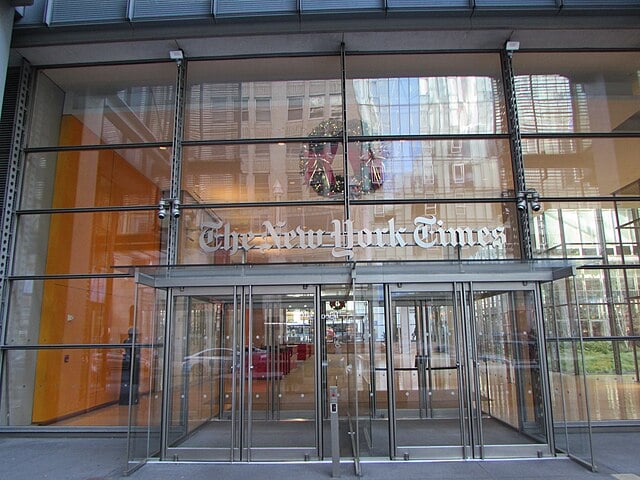
Amid all this, the New York Times was also busy cheerleading for Khomeini. On Feb. 16, 1979, when the ayatollah had been back in Iran for just a bit longer than two weeks, the Gray Lady published a lengthy piece of fan fiction about him. Unironically entitled “Trusting Khomeini,” the article notes sorrowfully that “more even than any third‐world leader,” Khomeini “has been depicted in a manner calculated to frighten.”
That wasn’t hard. Khomeini studiously behaved in a manner that seemed calculated to frighten; he was careful never to smile in public, and forbade publication of photos in which he was caught smiling in spite of himself. Machiavelli told tyrants that it was better to be feared than loved, and Khomeini appears to have taken this advice to heart.
Khomeini also taught a violent, bellicose faith, saying of the assertion that “Islam is a religion that prevents men from waging war”: “I spit upon those foolish souls who make such a claim.”
Times readers read about a markedly different man. Political analyst Richard Falk complained that “President Carter and [his National Security Advisor] Zbigniew Brzezinski have until very recently associated him with religious fanaticism.” Why, how could anyone have gotten such an idea?
Falk even took a page from the patriots who have called it out for its leftist propaganda over the years, blaming “the news media” for Khomeini’s bad reputation in the West. The big bad media (of which the Times was and is, mind you, a flagship) had “defamed” Khomeini “in many ways, associating him with efforts to turn the clock back 1,300 years, with virulent anti‐Semitism, and with a new political disorder, ‘theocratic fascism,’ about to be set loose on the world.”
Wow, how could anyone have gotten the idea that the Ayatollah Khomeini was an adherent of a seventh-century ideology, hated Jews, and wanted to establish a theocracy in Iran? Will that evil media stop at nothing?
The Times also touted “the character and role of Ayatollah Khomeini” as a “hopeful sign” for Iran’s future. It’s hard to read this now without thinking of the suspicious death in custody of Mahsa Amini, a young woman who had been arrested in 2022 for wearing her hijab improperly. The many women who are serving lengthy prison terms in the Islamic Republic for daring to venture out without a hijab also come to mind.
It is likewise essentially certain that if the mullahs manage to survive the present crisis, the Islamic Republic will eventually resume its war against Israel, which stems not from any geopolitical considerations, but from Islam’s claim that any land that was once under Islamic rule belongs by right to Muslims forever, and from its deeply rooted antisemitism.
Richard Falk and the New York Times, however, didn’t see fit to say anything about the positions Khomeini had made clear in numerous statements spanning several decades. Instead, it gave its readers a rosy, whitewashed view of the man and his revolution, and thus helped condemn Iranians to decades of misery. Whatever happens now, the Times continues to share responsibility for that misery.
Photo Credit: Creative Commons.