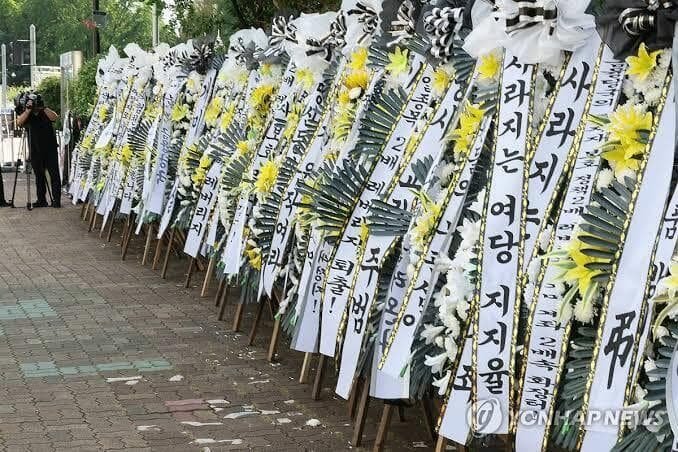
There is a particular cruelty in the timing. When the Kospi began its final, cratering descent in late July, President Lee Jae Myung was roughly 11,000 miles away, midway through an 11-day diplomatic tour of South America, watching from hotel suites as the index he had made the totem of his presidency collapsed. His finance minister apologized to lawmakers. The heads of both financial regulators cancelled their holidays as retail investors laid funeral wreaths at the gates of the National Assembly in Yeouido.

From its record close of 9,114.55 on June 22, the benchmark fell into the 5,600s by July 30 – a peak-to-trough drawdown of roughly 39 percent on a closing basis, erasing more than $2 trillion in market value in under six weeks. Trading was halted four times during the month, a record run of circuit-breaker suspensions for a tool that was barely used before this year.
Then, on Friday, after an emergency late-night meeting of the country’s top financial authorities produced a package of curbs on leveraged products, the index ripped 17.91 percent higher to close at 6,595.45 – the largest single-day gain in its history. SK Hynix hit its 30 percent daily limit. Samsung gained 27 percent. On Monday it gave back 5.12 percent, closing at 6,257.45.
Some retail traders have vowed not to step back in.
Samsung fell 8.76 percent, SK Hynix 8.79 percent. Foreign and institutional investors sold a net 2.84 trillion won and 1.95 trillion won of shares respectively. Retail investors bought a net 4.65 trillion won – stepping in front of the same train, four days after the government had promised to protect them from it.
Also on Monday, Realmeter published a weekly tracker putting Lee’s approval at 45.9 percent, the lowest of his presidency, with disapproval at 50.5 percent – crossing the majority threshold for the first time. The fieldwork matters here: 2,508 respondents surveyed from July 27 to 31, with a margin of error of two points. The poll closed on the day of the record rally and captured none of Monday’s reversal. Realmeter attributed the third consecutive weekly decline to the market rout and to a parallel controversy over whether a constitutional amendment might let a sitting president seek reelection.
The same pollster had Lee at 59.7 percent in May, against 35.7 percent disapproving. A net positive margin of twenty-four points has become a net negative of nearly five – a swing of some twenty-eight points in under three months. Realmeter runs lower than its peers; Gallup had him at 51 percent in late June, the National Barometer Survey at 53 percent on July 30. But all three recorded lows for his presidency, and all three were falling.
The problem of ownership
Presidents survive bad markets all the time, but this debacle is Lee’s to own – after running in 2025 on a campaign drive the Kospi past 5,000 – an unusual promise for a head of state, and one he blew past in January. He is a former day trader, a fact his opponents recite with relish. He urged Koreans to move their savings out of Seoul property and into equities. In June, with the index sagging below 8,000, he told reporters the retreat was temporary and Korean shares remained undervalued. His policy chief, Kim Yong-beom, predicted Korea would become a top-three equity market by capitalization within three years.
And then there are the ETFs.
The sixteen single-stock leveraged and inverse funds tracking Samsung Electronics and SK Hynix launched on May 27, roughly a week before the June local elections – instruments that use derivatives and debt to double a stock’s daily move, sold to professionals almost everywhere else in the world. Retail investors poured about 78 trillion won ($54.2 billion) into Kospi shares across May and June. As we noted, three SK Hynix vehicles alone held over $23 billion at the peak – more than 2.5 times average daily turnover in the underlying shares. Assets across the complex went from under $10 billion at the start of 2026 to more than $50 billion in June, then down to roughly $16 billion by late July.

The combined weight of the two chipmakers in the Kospi rose from 51.06 percent on May 26, the day before listing, to 55.17 percent by July 10. Their share of total market trading value went from roughly 30 percent to 44 percent. A market that was already a two-stock bet became a two-stock bet with a gamma engine bolted on.
The opposition’s charge is not that Lee failed to prevent a crash. It is that his office built the machine that produced one. “It was pushed through at an extraordinary pace,” said Park Soo-young, a People Power Party member of the National Assembly’s Strategy and Finance Committee, arguing that such speed was inconceivable without direction from the presidential office. The PPP is now demanding Kim Yong-beom’s dismissal and a full parliamentary investigation. Finance Minister Koo Yun-cheol, pressed by lawmakers on whether he would resign, said it would be irresponsible to speculate while markets were still unstable.
That is the language of a government buying time with subordinates. It usually works. It works less well when the paper trail leads upward.
The arithmetic says he is safe
South Korean impeachment requires 200 votes in a 300-seat National Assembly, followed by Constitutional Court confirmation. Lee’s Democratic Party holds 179 seats. Removing him would require his own party to supply twenty-one executioners – and the DP has no incentive to hand the presidency back to a PPP that lost the June local elections nationwide, capturing only Seoul’s mayoralty as consolation. There is no national election until April 2028. Lee’s term runs to 2030. He is fourteen months in.
The market case for calm is similarly strong. Even at Monday’s close the Kospi sits at roughly double its 52-week low, and Bloomberg had it up more than 50 percent on the year as of Friday’s close, the best performance among the world’s biggest economies. The fundamentals underneath are not the problem: SK Hynix posted record second-quarter revenue of 79.3 trillion won, up 257 percent year on year, at a 76 percent operating margin. Samsung’s preliminary operating profit for the period rose nineteenfold to about 89.4 trillion won. Korean semiconductor exports in June came in at $44.8 billion, up 199.5 percent. Morgan Stanley upgraded Korea to overweight on the back of the leverage unwind. Lale Akoner of eToro, who called the episode a textbook collision of a crowded trade and leverage, was careful to add that it should not be read as a collapse of the AI investment case.
Both chipmakers fell hard anyway, on the days they reported those numbers. That is the tell: this is a positioning event, not an earnings event. Positioning events resolve.
On the numbers, Lee is in no danger whatsoever.
THAT SAID…
South Korea has impeached two presidents in the last decade. Park Geun-hye in 2016. Yoon Suk Yeol in December 2024, which is the only reason Lee holds the office at all. Whatever the threshold once meant as a norm, it now means considerably less. What changed in both cases was not the seat count on day one – it was ruling-party lawmakers deciding the president had become a heavier liability than the opposition.
Three things could shift that calculation.
The first is the scale of household damage, which is no longer hypothetical. By July 13, more than 1.2 million leveraged retail accounts had triggered margin calls, with an estimated 320,000 to 360,000 fully liquidated by brokers – some left owing money. Korea Investment & Securities reported that nearly half of its 880,000 clients holding Samsung were underwater, and nearly 70 percent of its 408,000 SK Hynix investors. The KODEX SK Hynix leveraged product is down more than 80 percent from its June peak. This is not a story about speculators. In a country of 52 million, it is a story about a constituency.

The second is the Democratic Party’s own convention – though here the case has to be made against the present data rather than with it. In a companion Realmeter survey, DP support rose 3.8 points last week to 45.1 percent, while the PPP fell 2.9 points to 37.7 percent. The party is gaining as its president falls, and that is precisely the configuration under which lawmakers stay loyal. What changes it is the calendar. Song Young-gil, competing for the leadership, has already said the presidential office’s policy line needs thorough re-examination. Whoever wins runs the party into the 2028 general election – the contest that determines whether the DP ever reaches the two-thirds majority it has coveted. A party polling ahead of the opposition has no reason to move against its own president. A party leader who concludes that Lee’s name on the ballot costs seats is the beginning of a lame-duck presidency, and Korean presidents are traditionally devoured by their own side, not by the opposition.
The third is the constitutional amendment, and this is where Lee has already, almost certainly, lost something irretrievable. Placing a two-term, four-year presidency at the top of a 123-item agenda was the signature legacy project. Article 128(2) bars the sitting president from benefiting, so this was never about his own reelection; it was about being the president who rewrote the 1987 constitution. Amendment requires 200 votes and a national referendum, meaning PPP cooperation. Speaker Cho Jeong-sik has floated 2027 as the window – and his suggestion that voters should decide whether an incumbent may seek another term is, on Realmeter’s own reading, one of the two forces currently dragging Lee’s numbers down. The legacy project has become a liability before it has become a bill. A president polling below 50 percent, with two trillion dollars of household wealth destroyed on his ledger and a parliamentary investigation pending, has no leverage to extract twenty-one opposition votes for anything.