Order Jamie Glazov’s new book, ‘United in Hate: The Left’s Romance with Tyranny, Terror, and Hamas’: HERE.
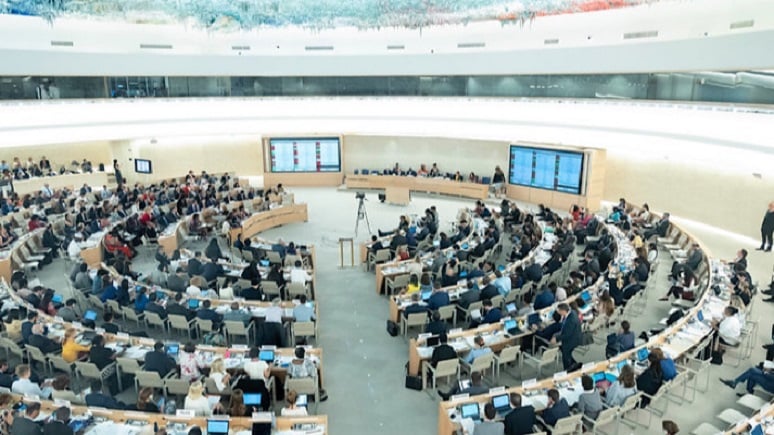
Iran was in the dock at a special meeting of the UN Human Rights Council: “‘Nuremberg moment’: UN Human Rights Council adopts motion for probe into Iran protest violence,” by Danielle Greyman-Kennard, Jerusalem Post, January 23, 2026:
Egypt pushed that Iran’s state mechanisms should be responsible for monitoring and ensuring human rights and appropriate culpability for those violating said rights. Egypt, along with Qatar, China, Cuba, Brazil, Pakistan, Mexico, Iraq, South Africa, and Burundi, had earlier refused to endorse the request for the UN session.
How can a mass-murdering despotism monitor itself and ensure “human rights”? Would we ask the Russian FSB, the successor to the KGB, to investigate human rights abuses in Russia and report back to the UN? Or expect China’s Ministry of State Security to investigate itself and punish those found to have violated human rights? The suggestion is preposterous.
Brazil, acknowledging its concern for the violence and internet shutdown, said it encouraged Iran to deepen its cooperation with UN human rights bodies and to investigate the accusations of violations thoroughly. The representative condemned the “unilateral coercive measures against Iran,” saying that such measures exacerbate the economic crisis and further threaten the human rights situation in the country.
Brazil, like Egypt, wants Iran to investigate itself. And it deplores the “coercive measures against Iran” — that is, the economic sanctions that the U.S. imposed, claiming that they “exacerbate the economic crisis.” That’s true, that’s exactly what those sanctions are supposed to do, in order that Iranians will go out and protest with greater fury against the regime whose aggressive behavior is the cause of those sanctions.
China’s representative, while asserting that it did not support the session [of the UNHRC], argued that the handling of human rights developments in Iran was an internal affair. The international community, the representative said, should support Iran’s sovereignty, territory, and security.
China, of course, doesn’t want any UN group, including the UN’s Human Rights Council at this special session in Geneva, investigating “human rights in Iran,” because if it did so, a precedent would be set. China would be next on the list to be investigated, for its continuing to round up and imprison political dissidents (such oppression did not end with the massacre at Tienanmen Square), and its attempts to force the Uighurs to abandon Islam. And that is something Beijing wants to prevent at all costs.
Iran shut down the internet nationwide for two reasons: first, it doesn’t want information about the protests, the numbers of participants, and the close to 200 cities across Iran where they have appeared, from reaching the outside world; second, it wants to make it almost impossible for protesters to communicate with each other about where and when protests should be held. Nor will they be able to find out about the fate of relatives and friends who took part in protests and may have been killed, or wounded, or whisked away to prisons. Thanks to the internet shutdown, the protesters are now flying blind.
Meanwhile, the story that Iranian authorities have concocted is this: among the crowds of protesters are agents of Israel and America who, disguised as members of the Iranian security forces, fire on the protestors, killing them by the thousands, and wounding many more, in order to have the Iranian regime blamed in this false flag operation.
We know now from Iranians inside the country who before the internet shutdown could report on casualties to the outside world, that at least 15,000 in Iran have been killed; some believe as many as 30,000 have died. In addition, there are reports that 330,000 protestors have been wounded in close to 200 cities across Iran. When the internet again operates, he numbers of those killed and wounded will finally be transmitted both to fellow protestors and to Iranians outside Iran, and those figures will be analyzed by investigators piecing together the reports compiled by protesters from all over Iran.
When I wrote the above, a vote at the UNHRC session held in Geneva to extend the investigation of its inquiry into human rights violations in Iran, that began after the protests following the death of Mahsa Amini, had not yet been taken. Now it has. The United Nations Human Rights Council on January 23 passed a motion extending an independent probe into human rights abuses in Iran and called for an urgent inquiry into the violent crackdown by authorities on protesters.
The murderous Iranian regime has lost. And support for human rights in Iran has won. Which proves, I suppose, that even the UN can occasionally do the right thing.
In order to eliminate spam comments that have historically flooded our comments section, comments containing certain keywords will be held in a moderation queue. All comments by legitimate commenters will be manually approved by a member of our team. If your comment is “Awaiting Moderation,” please give us up to 24 hours to manually approve your comment. Please do not re-post the same comment.