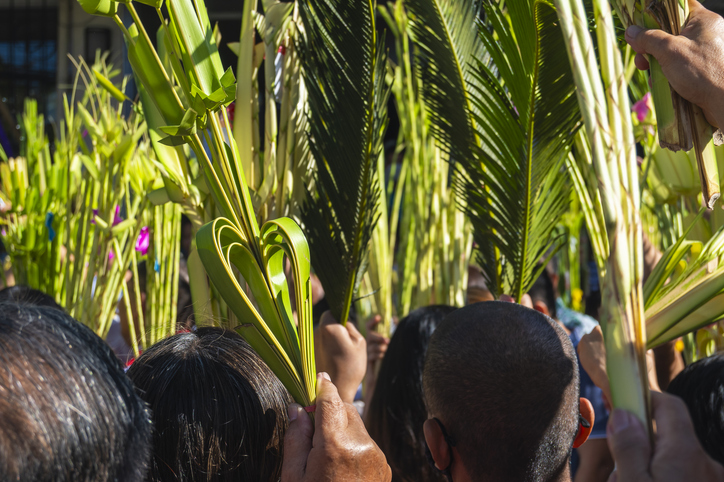
29 March is Palm Sunday, or the sixth Sunday in Lent, which kicks off Holy Week. The events of this day echo a historical episode from Jewish history which most evangelicals miss. This is the story …
Palm Sunday Events
Falling on March 29 in 2026, Palm Sunday marks the sixth Sunday of Lent, and it starts the Holy Week which leads up to Easter. On Palm Sunday, named after the palm branches in the story, churches recount Jesus’ triumphal entry into Jerusalem. This is an important story and is recorded in all four Gospel accounts (Matthew 21:1-11, Mark 11:1-11, Luke 19:28-44, and John 12:12-19). Jesus approached Jerusalem from Jericho, arriving at Bethphage and Bethany. He then instructed two disciples to fetch a donkey which he then rode into the city for Passover. Local people and pilgrims spread their cloaks and palm branches onto the road, and shouted hosannas, echoing Psalm 118:26, seeing him as a messianic liberator. This perhaps also recalled David’s entry after defeating Absalom (2 Samuel 19) and Solomon riding on a King David’s mule (1 Kings 1:38). Some also saw Jesus fulfil Zechariah’s prophecy: “Rejoice greatly, O daughter of Zion… thy King cometh unto thee … lowly, and riding upon an ass” (Zechariah 9:9).
John records that Jesus was greeted by crowds waving palm branches (John 12:12-13). This then set the stage for the cleansing of the Temple (Matthew 21:12-13; Mark 11:15-19; Luke 19:45-46), which is traditionally recalled on Holy Monday, when Jesus overturned the money-changers’ tables, echoed in the English phrase “turn the tables”.
The backstory
The backstory to these momentous events, which many people miss, lies in the events which happened in Jewish history just under 200 years previously. The Greek Seleucid king Antiochus IV Epiphanes, ruled Judea as part of his empire. From 167 BC the Seleucids tried to crush Jewish religious practices and impose Greek culture and customs on the people. Circumcision and the Sabbath were banned, and Jewish law was forbidden. This led to “Hellenization and increase in the adoption of foreign ways” (2 Maccabees 4:13), and they tried “to compel the Jews to forsake the laws of their ancestors and no longer to live by the laws of God” (2 Maccabees 6:1). Some went along with it but others were angered (1 Maccabees 1:41-48). The breaking point came when the Temple in Jerusalem was desecrated with a pagan altar and was dedicated to Zeus (2 Maccabees 6:1-2).
Protest led to persecution and some fled to caves (2 Maccabees 6:11). As oppression increased, a family rose up who became known as the Maccabees. A local priest called Mattathias (1 Maccabees 2:1-14) refused to perform sacrilegious acts. Mattathias and his five sons John, Judah (sometimes called Judas), Simon, Eleazar and Jonathan launched a guerilla war against the Seleucid forces and became known as the Maccabees, likely from the Aramaic word for hammer. Their bravery inspired others to join the cause and a rebellion gained momentum and freed parts of Judea. In 165 BC, Simon, one of the Maccabee brothers, entered Jerusalem “with a chorus of praise and the waving of palm branches” (1 Maccabees 13:51).
Cleaning the Temple
Afterwards, with the city of Jerusalem under their control, the Judah Maccabaeus set about cleansing the Temple of its pagan altars (1 Maccabees 4:41-51) and restoring it to Jewish worship. After some months of restoration the Temple was rededicated in the winter. “Then Judas and his brothers and all the assembly of Israel determined that every year at that season the days of dedication of the altar should be observed with joy and gladness for eight days, beginning with the twenty-fifth day of the month of Chislev” (1 Maccabees 4:59, NRSV). This Feast of Dedication is still observed by Jews today and is known as Hanukkah.
Symbolism of Palm Branches
These events led to palm branches becoming symbols of Jewish national independence, and date palm is found on some ancient Jewish coins.
Messianic Anticipation
The Maccabees ruled Judea until it became a Roman client state in 63 BC, and then Herod later became “King of the Jews” in 37 BC. Under Herod, Judea was not under Greek control but under Roman control. As Jesus entered into Jerusalem, crowds likely saw him as a saviour, in the shadow of the Maccabees, hoping he’d expel the Roman occupiers just as the Maccabees expelled the Seleucids. As Jesus came, they held palm branches and shouted hosannas. They were wanting a new revolt in the style of the Maccabees. Echoing previous events Jesus then went onto cleanse the Temple, but this time from the exploitation by the religious leaders.
John’s Gospel
These intertestamental events appear in the Greek Septuagint and are alluded to in the New Testament. The story was well known to the Jews of Jesus’s time. It is St John who uniquely precedes the story of the triumphal entry into Jerusalem with Jesus attending the “Feast of Dedication” (John 10:22-23), better known as Hanukkah. Historic Reformation-era New Testaments used to cross-reference this to 1 Maccabees 4:59, and it was thus cross-referenced in William Tyndale’s 1534 edition of the New Testament, and in the 1611 edition of the King James Version of the Bible.
It is also St John who uniquely records that Jesus was greeted by crowds waving palm branches (John 12:12-13). Later St John sees palm branches in his revelation of heaven, “After this I looked, and there was a great multitude that no one could count, from every nation, from all tribes and peoples and languages, standing before the throne and before the Lamb, robed in white, with palm branches in their hands” (Rev 7:9). All of these gently point back to the events under the Maccabees.
Summary
Evangelical Christians often miss this backstory. This is because the events are recorded in the books of Maccabees which appear in the Apocrypha, which is not printed in all modern editions of Bibles. Additionally, Protestant New Testaments are often quite squeamish about cross-referencing relevant verses in the Apocrypha. However, regardless of what you think about the Apocrypha, if you have not read the story of the Maccabees, you are missing the historical context to the story of Palm Sunday, which makes much more sense once you know it.