Tamura Jotaro, CEO of Japan’s Mitsui OSK Lines (MOL), predicted that it will take “at least a couple of weeks, or if not a month” for shipping traffic through the Strait of Hormuz to return to pre-war levels.
“What will have to come in place is not just a simple agreement between the relevant countries, but it has to be material and translated into the real situations in the Strait of Hormuz so that shipping lines can make themselves comfortable to go through,” Tamura told the Financial Times (FT) in an interview published on Tuesday but recorded before President Donald Trump announced the peace agreement with Iran.
Tamura looked at the history of failed efforts to reopen the strait since Iran used terrorist attacks to halt traffic in March and predicted it will take some time for shipping and insurance companies to become confident that transit is safe once again.
“Given the experiences in the last couple of months, I think it’s reasonable to assume that it may take at least a couple of weeks or if not a month,” he said.
FT noted that MOL is the world’s largest tanker operator in terms of fleet size, as it operates over 900 ships, including more than 200 oil, petroleum, and chemical tankers.
Other large shipping companies, such as container giant Hapag-Lloyd, said the news of the deal was “encouraging” and expected their trapped vessels could begin leaving the Persian Gulf as soon as the peace deal is signed on Friday, but did not predict how long it would take for previous high volume of traffic through the Strait of Hormuz to resume.
Jakob Larsen, chief safety and security officer for the Baltic and International Maritime Council (BIMCO), told CNN that “key aspects such as timings and safe routes” remain “unclear.” He cited some of the same factors as Tamura, but sounded more pessimistic about the timetable for normal shipping to resume.
“Due to lack of details and a history of overly optimistic reassurances, we believe the security situation for the shipping industry remains volatile, and we still consider it very risky for ships to commence transits at this point,” Larsen said.
The most infamous setback occurred on April 17, when Iran announced the strait was open then closed it again within 24 hours, forcing dozens of ships to hastily reverse course — while some of them were taking fire from Iran’s terrorist Islamic Revolutionary Guard Corps (IRGC).
“We advise shipowners to continue doing thorough risk assessments and appeal to all parties to put the safety of seafarers first,” Larsen said.
“Ships trapped in the Persian Gulf will be interested in leaving as soon as it is safe to do so. The next step is for shipowners to be reassured that transiting the Strait of Hormuz is not only permitted but also safe,” he said.
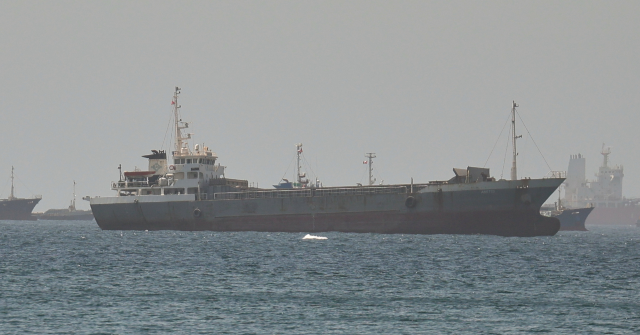
The United Nations’ International Maritime Organization (IMO) estimated that about 500 ships are currently stuck in the Persian Gulf.
The IMO plans to prioritize exit for ships that have been trapped for more than 100 days once it has finished “assessing the feasibility for vessels to transit and conduct the trade safely and securely, avoiding possible hazards like mines as well as congestion which could lead to accidents.”
At its peak before Operation Epic Fury began at the end of February, the Strait of Hormuz accommodated about 135 ships a day. Given the need to avoid congestion in the strait, Tamura’s estimate of about a month to clear the backlog seems reasonable.
The MOL CEO said during the FT interview that he was firmly opposed to paying Iran any sort of toll, fee, or ransom for safe passage. He said four MOL ships managed to pass safely through the strait while it was closed, but the company paid no ransom to Iran.
“In some cases where successful transits took place, particularly in these situations, the relevant authorities or governments had worked [it] out, so we had some fortunate cases,” he said, prompting FT to speculate that MOL’s ships might have been flagged to countries like Oman or India that maintained diplomatic channels to Tehran during the crisis.
Oil prices fell below $80 per barrel on Tuesday for the first time since the Strait of Hormuz crisis began, signaling industry confidence that the U.S.-Iran deal will hold together and keep the strait open.
The international benchmark for oil, Brent crude, fell to $79.61 on Tuesday, down from a peak of $126 at the height of tensions between the U.S. and Iran in April.
“Markets clearly welcome the latest development, although how quickly traffic through the strait can normalize remains to be seen,” said a UBS Asset Management analysis quoted by FT on Tuesday.
“Given worries about sea mines in the waterway, markets will look for clearer evidence that shipping companies and insurers have sufficient confidence to traverse the strait,” UBS added.
Goldman Sachs analysts predicted export volumes would “normalize to prewar levels by the end of July,” even though “full details on the agreement are unclear.” The company had previously anticipated normal shipping levels by the end of August.
Although President Trump declared the “toll-free opening of the Strait of Hormuz” on Sunday and advised the ships of the world to “start your engines” and “let the oil flow,” ship tracking services said they have seen very little movement from the Persian Gulf toward the Strait of Hormuz so far.
Matt Smith, lead oil analyst for ship tracker Kpler, said it was no surprise that ships were waiting for the U.S.-Iran deal to be formally signed on Friday, and they might wait even longer to dare the Strait of Hormuz because insurance rates are still sky-high.
Since insurers are unlikely to reduce their rates until they see ships passing safely through the strait, Smith warned that a “chicken-and-egg situation” could develop, and it might take months for pre-war traffic levels to return.
The BBC reported that only seven ships appear to have transited the Strait of Hormuz since Trump announced the peace deal on Sunday. Roughly 75 percent of the tankers stranded in the Persian Gulf have remained completely stationary.
“It would take an extremely brave captain to transit through the Strait of Hormuz, given the current state,” Martin Kelly of EOS Risk Group told the BBC.
“What we’ve been seeing is still very much a wait-and-see mentality. No-one really wants to be the first to take that risk,” said Kpler senior analyst Naveen Das.
“Some of the owners and captains that are more happy with risk, like certain Greek companies, we may see them coming in and exiting successfully and that might build up confidence in others,” he anticipated.
Many risk analysts are worried about the unknown number of mines Iran irresponsibly dumped into the major traffic lanes of the Strait of Hormuz apparently without much of a plan for disarming and recovering them.
Another fear is that Iranian officials keep talking about extorting tolls or “fees” from international shipping despite President Trump’s assurances that the peace deal forbids it. Ship owners and insurers are nervous about what the Iranians might do if a company like Tamura’s MOL refuses to pay a ransom Tehran demands.