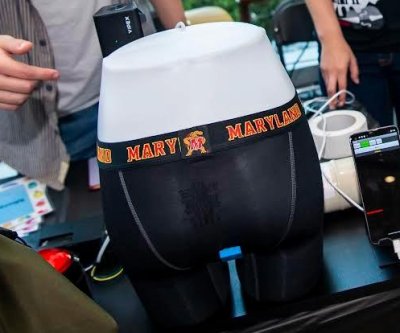
University of Maryland researchers designed “Smart Underwear” to track and measure the wearer’s flatulence. Photo courtesy of the University of Maryland
Feb. 16 (UPI) — University of Maryland researchers designed “Smart Underwear” to track and measure flatulence — and they are seeking volunteers to wear them.
Brantley Hall, an assistant professor in the Department of Cell Biology and Molecular Genetics, led a team of scientists in creating the small device that snaps into a wearer’s underwear and uses electrochemical sensors to track intestinal gas.
Hall said the device specifically records releases of hydrogen.
“Think of it like a continuous glucose monitor, but for intestinal gas,” Hall said in a news release.
Santiago Botasini, an assistant research scientist at the school, led a study that found healthy adults produced flatus — passed gas — an average of 32 times a day, with individual variations reaching as much as 59 or as low as 4. Their findings were reported in the journal Biosensors and Bioelectronics: X.
Hall said doctors previously thought the average to be around 14, a number he attributed to the difficulties involved in measuring and self-reporting with the use of Smart Underwear.
“Objective measurement gives us an opportunity to increase scientific rigor in an area that’s been difficult to study,” Hall said.
The researchers are now working on a Human Flatus Atlas to objectively measure gas releases across hundreds of patients using Smart Underwear. The project will develop a baseline for normal adult flatulence patterns.
“We don’t actually know what normal flatus production looks like,” Hall said. “Without that baseline, it’s hard to know when someone’s gas production is truly excessive.”
The team is seeking participants who fall into three categories developed from Botasini’s team’s research: Zen Digesters, those who consume high fiber diets yet pass gas rarely; Hydrogen Hyperproducers — “simply put, people who fart a lot;” and Normal People, those who fall between the other two categories.
“We’ve learned a tremendous amount about which microbes live in the gut, but less about what they’re actually doing at any given moment,” Hall said. “The Human Flatus Atlas will establish objective baselines for gut microbial fermentation, which is essential groundwork for evaluating how dietary, probiotic or prebiotic interventions change microbiome activity.”