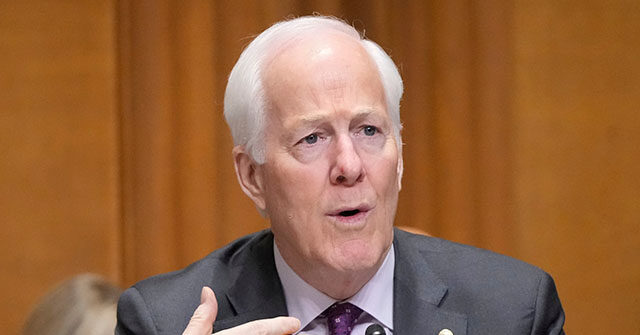
Sen. John Cornyn (R-TX) was once under investigation for perjury for signing conflicting statements about his residence in an attempt to remain the highest-paid judge in Texas and was later accused of “double dipping” by supplementing his Senate salary with public pensions that he failed to disclose for years.
Cornyn, who is trailing several points behind Texas Attorney General Ken Paxton in the upcoming GOP primary runoff race for the seat that he currently holds, was sued by Webb County in September 1991 over a conflict of interest for sitting on the Texas Supreme Court while still presiding over the Fourth Administrative Judicial Region.
A June 13, 1992, report from the San Antonio Light explained that the then-judge was sued before he resigned from that second administrative judicial position:
The seemingly endless brouhaha began with Cornyn’s decision to retain his post as administrative judge for the region that includes San Antonio after he was elected to the Texas Supreme Court. The extra salary he made from the $18,000-per-year administrative post temporarily made him the highest paid judge in the state.
Webb County District Attorney Joe Rubio sued Cornyn to remove him from the administrative job, but that suit was settled shortly before Cornyn agreed [in January 1992] to resign the administrative judgeship at the end of March. Left unresolved in the courts was whether Cornyn was required legally to maintain a residence in the 22-county region.
During the brief period where Cornyn held both positions, he was earning an over $109,000 salary — which would be worth nearly triple that in 2026. It also appeared that he issued conflicting sworn statements about his residency in order to hold both positions, leading to a perjury investigation by the Travis County District Attorney.
Cornyn was alleged to have signed four sworn statements confirming that he lived in Travis County, but also signed a sworn statement claiming that he resided in Bexar County to keep presiding over the Fourth Administrative Judicial Region while he was being sued.
A June 12, 1992, Houston Post article detailed how Travis County District Attorney Ronald Earle reviewed the documents related to Cornyn’s “losing fight to keep a second judicial post”:
In an attempt to move the legal dispute from Laredo to Austin and in response to questions, Cornyn signed four sworn statements that claimed Austin as his legal residence.
In a fifth sworn statement, however, the former San Antonio district judge said he had not given up his legal residency in San Antonio.
Lawyers say Cornyn’s conflicting statements, among 120 pages of documents also obtained by The Houston Post, raise questions of perjury because they cannot both be legally true. The justice made the fifth statement to that he had effectively abandoned his second judicial post – presiding over courts in 22 South Texas counties — by moving out of the region. Cornyn further told the court that state law does not specifically require active judges to be residents of the regions they supervise, a point disputed by opposing attorneys who said lawmakers never intended that presiding judges live outside their regions.
Cornyn dismissed the complaints as “political harassment” at the time.
“[It’s] an attempt to embarrass me. He’ll dismiss it virtually out of hand,” the future senator told reporters.
After resigning from his second job at the Fourth Administrative Judicial Region in March 1992, the lawsuit was dropped and the Travis County district attorney declined to press criminal charges in November of that year due to lack of “sufficient evidence” to meet the high burden for a conviction.
According to a November 18, 1992, Houston Post report:
The Travis County district attorney’s office said Tuesday it will not seek criminal prosecution of Land Commissioner Garry Mauro and Texas Supreme Court Justice John Cornyn, whose activities have been under review by prosecutors for several months.
…
Cornyn was reviewed in connection with differing sworn statements he had made concerning his residency.
Claire Dawson-Brown, the then-chief of the district attorney’s public integrity unit, said the probe ended with no prosecution because of differing state laws regarding legal residency.
“We do not feel there is sufficient evidence for perjury charges,” Brown said at the time.
Cornyn effectively swept the issues under the rug and went on to become the Texas attorney general in 1999 before becoming a U.S. senator in 2002, a seat for which he is now battling current Texas Attorney General Ken Paxton.
Still, questions remain about the hefty government pensions Cornyn has collected from his time in Texas while being paid over $174,000 a year as senator, which only became publicly known after he amended disclosure reports from years 2006 to 2010 in 2012 to include the pension payments he previously omitted.
According to the National Journal, Cornyn “supplemented his Senate salary with a trio of public pensions last year from his days as a Texas judge and elected official — a practice some fiscal watchdog groups have attacked as ‘double dipping.’”
Cornyn, who was the second-ranked Senate Republican at the time, reported collecting $65,383 in public retirement benefits in 2012. The largest of his pensions, $48,807, was from the Judicial Retirement System of Texas, which he got for his time as a member of the state’s Supreme Court. Another $10,132 in 2012 retirement benefits was from the Employees Retirement System of Texas, for his short time as state attorney general.
As the National Journal reported:
In a series of financial-disclosure amendments that he began filing last July, Cornyn disclosed that he had actually been collecting that $10,132 annual pension as far back as 2006. He had not listed it on his original disclosure reports from 2006 to 2010.
Cornyn also reported a $6,444 retirement distribution from the Texas County and District Retirement System. He was a state district judge from 1985 to 1989, according to his official bio, when the governor appointed him presiding judge for the Fourth Administrative Judicial Region of Texas, where he oversaw judicial administration for a 22-county region.
Overall, Cornyn has collected over $1 million in Texas pension payments since becoming a U.S. senator, according to his filings.
Olivia Rondeau is a politics reporter for Breitbart News based in Washington, DC. Find her on X/Twitter and Instagram.