“Hell is not other people. Hell is yourself.” – Ludwig Wittgenstein
It begins with a group of children looking down a hole. A boy in a hood, the remains of a hangman’s noose around his neck, pilots a boat adrift at sea. I do not know where he has come from or where he is going or if he was one of the ones staring into that well’s abyss. I only know the way forward. Red lights peak through the dark and fog. They are my compass, and I follow them. Buoys. Where they guide me, I do not know, but there is no other path. The ocean is so vast, and my boat is so small. For a time, I am alone. At the fourth buoy, the boy stops the boat and pulls aboard a girl. When he reaches for the hare mask covering her face, she pins him to the small outboard’s wooden bottom, her hands ripping at his mask until he kicks her away. They stare at each other from opposite ends of the boat. It might as well be a chasm. “I thought you were dead,” the boy offers. “Where are the others?” the girl asks. The boy doesn’t know. She takes a lantern and stands at our boat’s bow. The buoys are still our guide, but the girl lights the way forward.
By the time I reach the end of Reanimal, the latest horror puzzle platformer from Little Nightmares developer Tarsier, I have forgotten all of this, and lost track of what parts of this opening are most important. I am too busy trying to make meaning from what I have seen, too focused on trying to connect the pieces of Reanimal’s puzzle, to understand how we got here. But stories, at least the good ones, the ones that know what they’re doing, tell you what they’re about from the beginning. And Reanimal is a very good story. Remember this, it tells you. Remember all of this.
Together – I play the boy, my co-op partner plays the girl. There is no way to select who plays who; it simply works out this way – we sail through jagged cliffs, past mines larger than our boat, bisect a forest of jagged, barren trees. Then the banks of the river we have followed fade, and a large industrial building looms out of the fog ahead of us. It is a remarkable image in a game of remarkable images. Reanimal certainly knows how to set a scene.
There is very little overt explanation.The boy and the girl are brother and sister, but this fact is never told to you. You learn it through the way they help each other up, comfort each other when things go wrong. Their relationship is something you experience, the questions largely left for you to answer. Why does she attack him after he fishes her out of the sea? What happened to them before they were in the boat? Reanimal unspools its story slowly, and asks you to fill in the gaps yourself. To remember what you’ve seen, to put together the imagery, the symbols, notice patterns in the shapes throughout its world. I’m unsure of what they’re after until we find another child separated from us by steel bars blocking a drain pipe. “You came back,” he whispers. “I knew you would. You should leave… while you still can.” But we don’t. The girl’s earlier question is the answer to mine. We are here to save the others. Our friends.
Reanimal can be played alone, but it’s more meaningful to take the journey with someone else.“
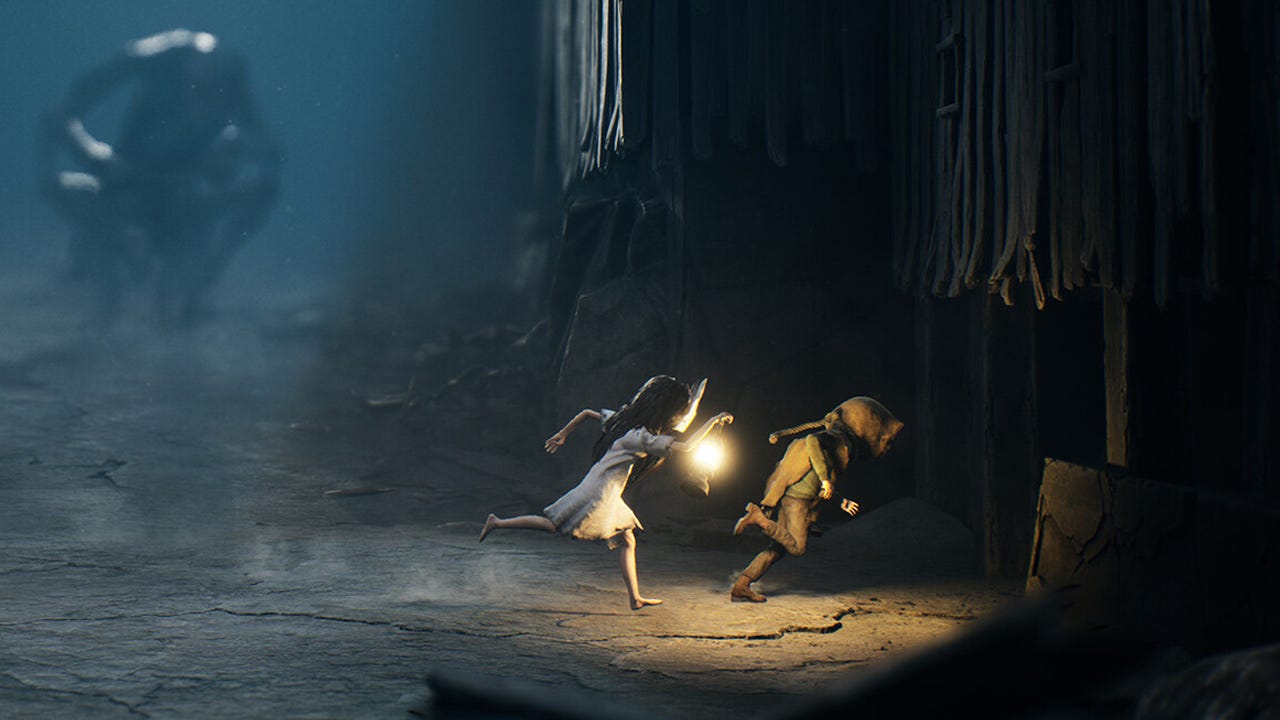
We navigate broken buildings, push through dark forests, leap across gaps, crouch into places only a child can fit. Often, we need to work together. The world is so big, and we are so small. It takes two of us to lift a metal trapdoor. I hold a lever to still a rotating metal shaft so my partner can pilot the girl across. On the other side, she knocks down a piece of wood so I can cross a gap. Reanimal is simple, elegant. You walk, run, jump, interact with and carry objects, boost one another to ledges neither of you can reach alone, and occasionally fight off foes in the clumsy way a child might. Little distinguishes the boy from the girl, save that she can attach her lantern to her hip while carrying something else. The boy’s lighter, on the other hand, is only usable if his hands are free. It’s a subtle distinction, but an important one, and my partner and I often made significant choices about who would do what based on how much light it would cost us, and whether we felt we could sacrifice it.
Reanimal can be played alone, but I found it more meaningful to take the journey with someone else, to coordinate and work together, to congratulate ourselves on our success and discuss our failures before trying again. Like the boy and the girl on screen, we are experiencing this together. Like them, we are not alone. That subtle distinction – of working with a living, breathing person – made it much better than it would have been had I spent the whole experience with a computer-controlled girl who always did exactly what she was supposed to. That’s not what this story is about, and I am deeply grateful that, in an era which has largely abandoned local co-op, Reanimal offers it.
Reanimal Switch 2 Screenshots
Both Reanimal’s gameplay and the choices it offers are satisfying, but simple. It is less a game you play and more a world you move through and experience without the obvious artifice of a video game. There is no HUD, no meters, no minimap. The camera is often fixed to show you exactly what Tasier wants you to see, and the sense of visual composition here is remarkable. Even horror can be beautiful when framed the right way. Often, the answers to the gameplay questions Reanimal presents are obvious – though not less satisfying for it – and the only way forward, though occasionally we get lost. What carries us ahead are not the puzzles themselves, but the desire to see what’s next. If you are expecting great leaps from the studio’s work on the first two Little Nightmares, you will not find it here, and I’m not bothered by that. You don’t return to your favorite restaurant angry the menu hasn’t changed, and here the chef is a master of his craft.
The environment is not our only obstacle. We start to notice the horrors as we search for the missing wheels to a handcar. A body leans against a wall, its belly a gaping hole left by something that forced its way out – or in. A plunger applied to a clogged toilet reveals a key and the deformed, deflated skin of what was once, perhaps, a man; his features are off, deformed, his face caught between that of a person and a pig.
What we’re up against isn’t obvious until we come across the second of the wheels we need for the handcart, and the man/animal skins around us come to life, slithering after us like snakes. We do the only thing we can do: we run. It gets worse from there; the first living human we encounter is impossibly tall, his face a Halloween mask of sagging skin, empty eye sockets, a maw that is always open. He skitters after us like a spider, biting our heads off if he catches us. He is not the worst of it; not even close. We spend most of Reanimal running from something. I don’t want to say more. These are terrors you really should see for yourself.
Will’s Favorite Puzzle Games
I just reviewed The Talos Principle 2. Here’s how it stacks up against my favorite puzzle games.
But I can say this: the place the boy and girl have returned to is wrong. There is a theory that hell is the worst moments of your life, replayed over and over again, without ceasing, simultaneously something you recognize and fresh at the same time. What does it say that the boy and girl have seemingly returned here by choice after having escaped? “I told you to leave,” the boy we encountered tells us later. Or are they all trapped here, together, in a hell we can’t leave? Only one thing is certain: we are off the edge of the map. Here be dragons.
As we continue, the world opens up to us. We navigate dark forests, the flooded ruins of cities, active warzones, and until the end, whatever shattered this place is only partially clear. Our journey is only partially linear. Returning to the boat allows us to explore, to explore this flooded place and find what lies off the beaten path. It is here that Reanimal is most obviously a video game, rewarding the curious with new masks, collectible concept art, and so on, but it never feels out of place or forced, and doesn’t detract from the atmosphere. Nor does the occasional replay of a chase sequence because you don’t initially know what to do or where to go, which is enough to spell your end. Reanimal’s atmosphere, its art, its sense of place and character and mystery carry the day at every turn, through the odd confusion, annoyance, or visual bug. It compelled us to see it through to the end, to understand the tale it was trying to tell in its roughly six-hour journey through hell. I think I understand. But I know there is much we missed, and I want to return to see it through, and see what, if anything, changes as a result.
Verdict
Remember this, Reanimal says as it shows you something. All the pieces matter. It is a horror story, a journey through hell made up of the simple, elegant gameplay that Tarsier has honed to a feather’s edge over the last decade. There are occasional frustrations: a chase where the way forward is not obvious, a path that is easy to miss. What will keep you going is the story, the world, the characters, the sense that beyond all of this lies answers, the act of working together in a world where the scariest things are often not monsters, but other people, and what we are capable of inflicting on one another. What kept me going was playing it with another person, sharing that experience, and working together to discover what was at the bottom of that hole, and how that boy ended up in a boat, and his sister nearly drowned at sea. Going through hell together, wondering if it was something that happened to them, or the world they – we – had made.