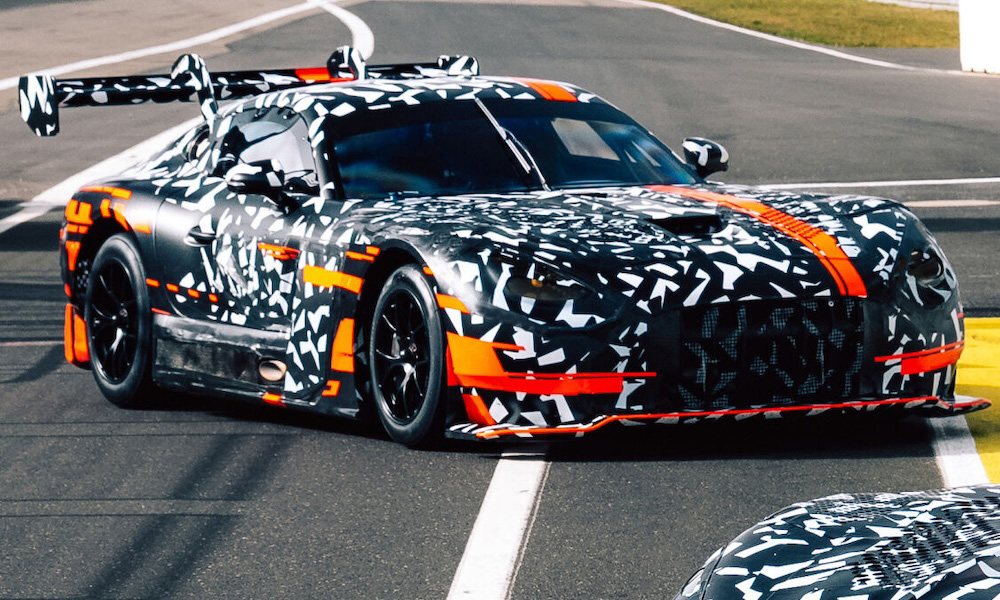
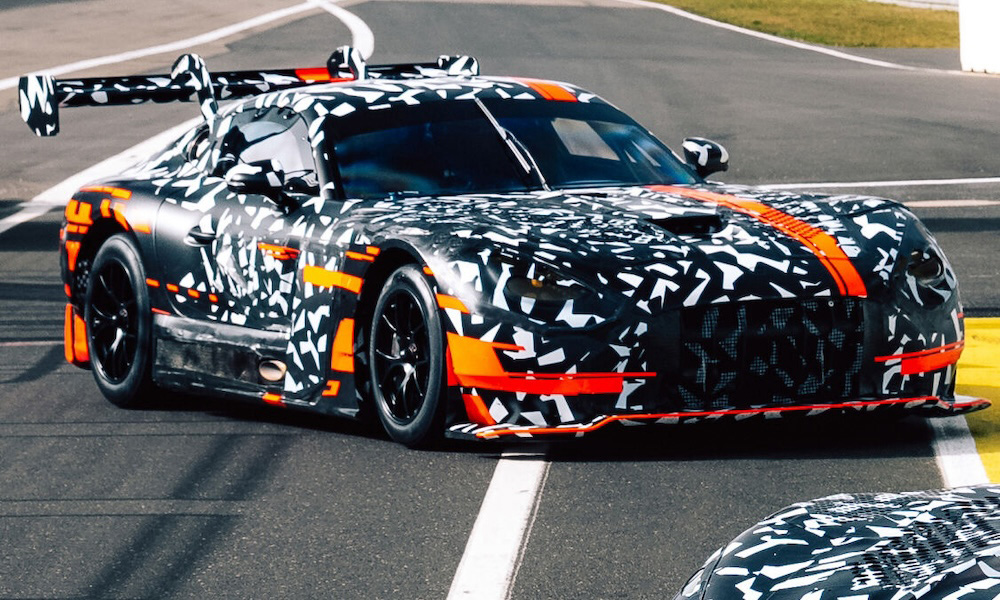
Photo: Mercedes-AMG
Stephane Ratel said he’s not concerned about the latest “evolution” of new-breed GT3 machinery, which have been designed for the race track before being developed as a production car.
Two soon-to-be-launched GT3 models, the all-new Mercedes-AMG GT3 (pictured above) and Toyota GR GT3, have taken reverse development strategies by each manufacturer, which has raised alarm bells of the cars having less road relevance and leading to potential costs escalation in the GT3 formula, which celebrates its 20th anniversary this year.
Speaking with Sportscar365 at the recent Nürburgring 24, Ratel dismissed any immediate worry that GT3 could turn into an arm’s race in the coming years, but cautioned that the price tag of both cars will ultimately play a factor.
“We know that GT3 is getting an evolution because the main factor of these cars is that they are cars that have been produced to be GT3 cars and then homologate it for the road, to produce the number of road cars that are necessary for the homologation,” said Ratel.
“It’s the same thing as the second-generation Ford GT, which is the same thing as the [Maserati] MC12 and the same thing as GT1. You can go back to that.
“But it’s not a bad comment against Mercedes and Toyota, which are both great supporters to GT racing.
“Toyota has done, in GT4, a fantastic job and they really embrace customer racing, which is the very nature of the sport.”
Ratel indicated the possible new trend for GT3 is instead being influenced by the road car market for GT-based production vehicles.
“As Claude [Surmont, SRO technical director] tells me regularly, the new production cars have the tendency to be bigger, to be heavier and to be less suitable for racing,” he said.
“That’s also a problem we’re having. It’s not entirely surprising that manufacturers have to go this way.
“Even if I look at the past and I say it’s a wrong example, but if I look at the way it’s going, maybe it’s unfortunately the way the market is going.”
Both manufacturers have yet to officially release pricing for the GT3 cars, which are expected to be rolled out to customers beginning next year.
“Now the question is: the price? That’s the key,” said Ratel. “If they can produce these cars at a reasonable price that maintains the customer racing element, we’re fine.
“But if it becomes too expensive and they only produce the minimum number of cars they need to produce… ”
When asked if he’s worried GT3 could evolve the way of GTE, which was ultimately killed off in 2023 after escalating costs and the end of full-factory programs, led to its demise, Ratel said GT3 holds fundamentally different values.
“The most important thing about GT3 is customer racing,” he said. “If it remains customer racing, we’re fine.
“GTE didn’t die on the car. It died when it became a manufacturer competition that required manufacturers’ marketing budgets.
“When it comes to marketing budgets, one day you get it and one day you don’t get it anymore. If you don’t get it anymore, it folds.”

John Dagys is the founder and Editor-in-Chief of Sportscar365. Dagys spent eight years as a motorsports correspondent for FOXSports.com and SPEED Channel and has contributed to numerous other motorsports publications worldwide. Contact John