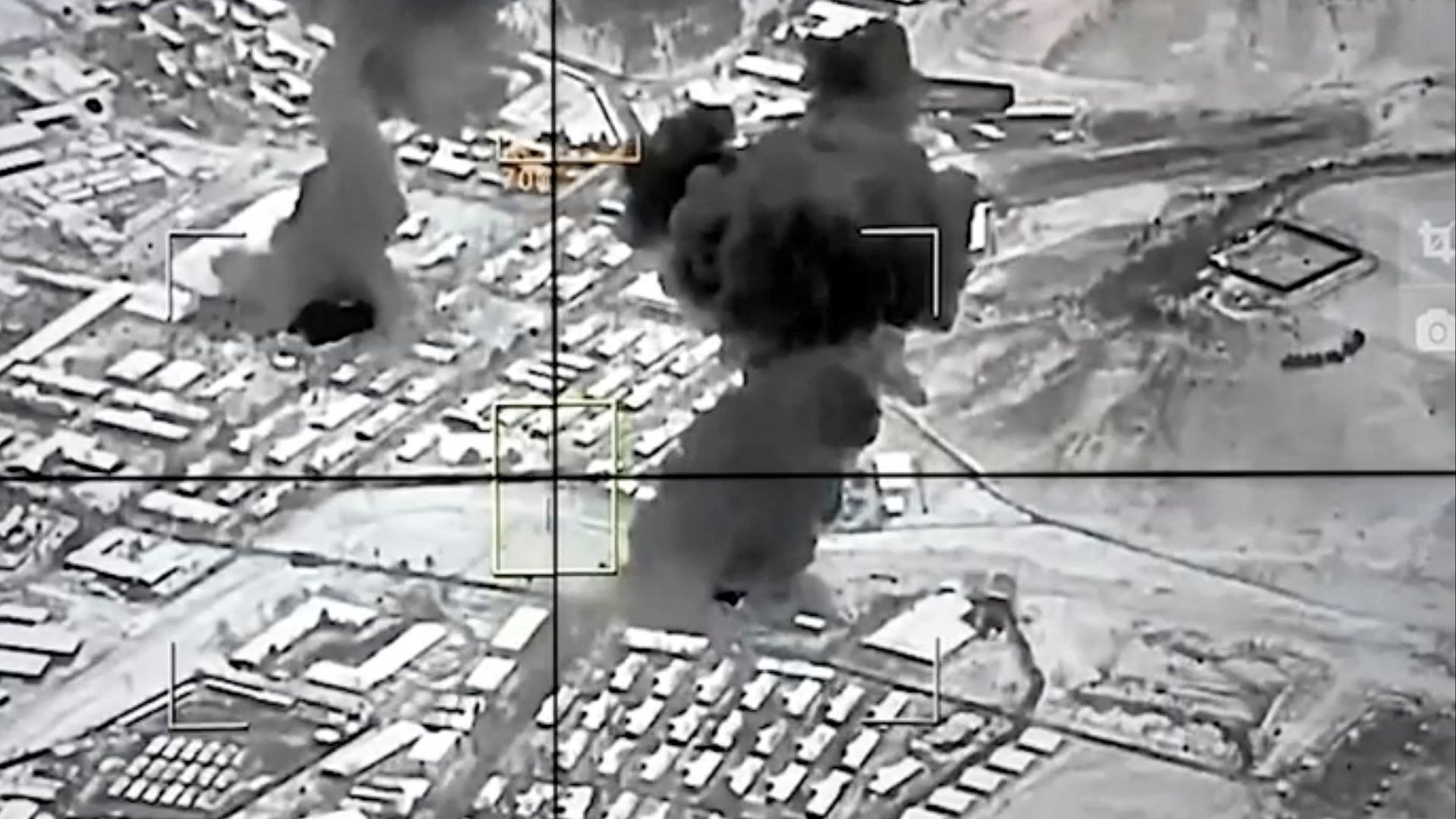
Pakistan’s defence minister has said the country is in an “open war” with neighbouring Afghanistan, after both nations launched strikes overnight.
Khawaja Muhammad Asif said Islamabad’s patience had run out as tensions escalated, with casualties reported on both sides.
“Our cup of patience has overflowed,” he said in a social media post. “Now it is open war between us and you [Afghanistan].”
He alleged the Taliban had turned Afghanistan “into a colony of India”, gathered militants from around the world and had started “exporting terrorism”.
There has been no reaction from Afghan government officials to Mr Asif’s comments.
Pakistan carried out strikes on the Afghan capital Kabul and two other provinces overnight, Afghanistan government spokesman Zabihullah Mujahid said, just hours after Afghanistan launched a cross-border attack on Pakistan.
A conflicted history
The two neighbours have had a complicated relationship since Pakistan’s founding in 1947.
Pakistan supported the Afghan mujahideen in the Soviet–Afghan War, even taking in Afghan refugees.
Pakistan later became one of the only states to recognise the Taliban-led government in Kabul in the late 1990s and even supported their second takeover in 2021.
But warm relations began to sour after the emergence of Tehrik-e-Taliban Pakistan – otherwise known as the Pakistani Taliban.
In Pakistan, they have become known for carrying out suicide bombings against political opponents.
Islamabad accuses Kabul of providing a safe haven for their top figures – leading to a rise in border skirmishes over recent years as Pakistani authorities try to take them out.
Security sources in Pakistan said the strikes involved air and ground strikes against Taliban posts, headquarters and ammunition depots along the border.
Datawrapper This content is provided by Datawrapper, which may be using cookies and other technologies. To show you this content, we need your permission to use cookies. You can use the buttons below to amend your preferences to enable Datawrapper cookies or to allow those cookies just once. You can change your settings at any time via the Privacy Options. Unfortunately we have been unable to verify if you have consented to Datawrapper cookies. To view this content you can use the button below to allow Datawrapper cookies for this session only.
A Reuters news agency witness in Kabul said many ambulance sirens could be heard following a series of loud blasts.
Both sides reported heavy losses, issuing sharply differing figures that have not been independently verified.
How did we get here?

Pakistan says it’s run out of patience and it’s now open war with Afghanistan after conflict between the two escalated overnight.
It’s a big moment after months of tension between the neighbours.
So what’s happened and why are we here?
Tensions between the two have been intensifying for months with deadly border clashes killing dozens of civilians, soldiers and militants.
And militant violence in Pakistan has surged – last year was the deadliest in a decade. The Pakistani government blame a lot of the attacks on the Pakistani Taliban.
They say that Kabul is enabling them – Kabul denies that .
There was a ceasefire mediated by Qatar back in October but that feels pretty shaky right now and several rounds of peace talks in November didn’t lead to any kind of formal agreement.
Here we are with both sides of the border on high alert – it certainly feels like a very sensitive, very fragile point.
Afghanistan’s defence ministry said overnight that 55 Pakistani soldiers had been killed, including some whose bodies were taken into Afghanistan, and that “several others were captured alive”.
It said eight Afghan soldiers were killed and 11 wounded. The ministry also said it destroyed 19 Pakistani army posts and two bases and that the fighting ended around midnight, about four hours after it began on Thursday.
Ahmed Sharif Chaudhry, a spokesperson for the Pakistan military, claimed its armed forces had killed 274 members of the Taliban forces and militants.
He also said 22 Afghan military targets were hit, adding that at least 12 Pakistani soldiers were killed in the fighting.
None of these figures has been independently verified.
He added that military operations were ongoing on the orders of Prime Minister Shehbaz Sharif.
Is Pakistan trying to split apart Afghanistan?

Military analyst
The increase in violence between Pakistan and Afghanistan has been some time in the making since the Taliban returned to power in 2021.
Islamabad accuses Kabul of harbouring ‘Pakistan Taliban’ terrorists who operate in the border areas between the two countries, who they say are trying to destabilise Pakistan.
In turn, Kabul accuses Pakistan of creating a pretext for intervention in Afghanistan as part of its long-running and deep-seated enmity with India.
Both India and Pakistan have long transferred their antagonisms into interventions in Afghanistan’s tangled politics.
But there is another dimension to this event – that the Pakistani Defence Minister already calls ‘war’. The Supreme Leader of the Afghan Taliban, Hibatullah Akhundzada, is probably fighting to keep control of his government at the moment.
The Afghan Taliban movement, long committed to total obedience, seems now to be deeply split between Akhundzada, who spends most of his time in Kandahar and a somewhat anonymous group based in the capital, Kabul.
In this respect, the split – if such it is – mirrors the long-standing geographical, ethnic, demographic and climatic difference between north Afghanistan and south-eastern Afghanistan. If the country were to split apart politically, that would be the major fault line.
And it’s possible that Pakistan’s over-strong response to the cross-border incidents it lays at the feet of the Afghan Taliban is actually intended to make the possibility of such a split within the government of Afghanistan all the worse.
It is possible that it is intended to heap more pressure on Akhundzada.
Read more from Sky News:
Zelenskyy tells Sky News the US has the power to end the war
UK’s delicate deal to get the Bayeux Tapestry loaned from France
Cross-border battles have intensified following months of tensions and skirmishes between the two nations.
The escalation threatens a fragile ceasefire along the 1,615-mile border and deepens a dispute over Islamabad’s claim that Kabul harbours Tehreek-e-Taliban Pakistan (TTP) militants – an accusation the Taliban deny.
British Foreign Secretary Yvette Cooper wrote on X: “The UK is deeply concerned by the significant escalation in tensions between Afghanistan and Pakistan.
“We urge both sides to take immediate steps toward de‑escalation, avoid further harm to civilians, and re‑engage in mediated dialogue.”