Order Jamie Glazov’s new book, ‘United in Hate: The Left’s Romance with Tyranny, Terror, and Hamas’: HERE.
The Strait of Hormuz is a vital waterway through which about twenty-seven percent of the world’s shipments of oil and petroleum products and twenty percent of global liquefied natural gas (LNG) traverse. The Iranian regime is playing its strongest card in its war with the United States and Israel by effectively closing the Strait of Hormuz to most shipping, including oil tankers.
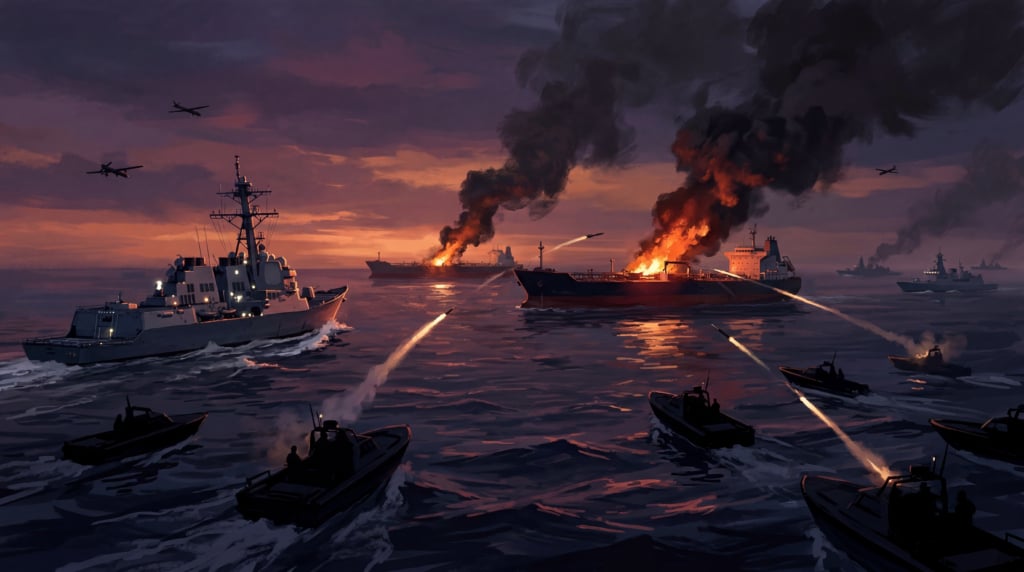
The Iranian regime’s military operations to close the Strait of Hormuz can utilize a combination of missiles, drones, mines, and speed boats. Just the threat of such catastrophic attacks has halted most shipping. This is causing energy prices to spike, which in turn threatens to severely disrupt the global economy. The United States is taking a hit, which will get worse the longer the Strait remains closed to most shipping. But Europe, which is more dependent on imported oil and LNG than the energy-independent United States, has considerably more to lose.
Nevertheless, when President Trump asked for other countries to share the military burdens and risks in providing naval support to secure safe passage of commercial shipping through the Strait of Hormuz, the Europeans first turned him down outright.
“The United States has been informed by most of our NATO ‘Allies’ that they don’t want to get involved with our Military Operation against the Terrorist Regime of Iran, in the Middle East, this, despite the fact that almost every Country strongly agreed with what we are doing, and that Iran cannot, in any way, shape, or form, be allowed to have a Nuclear Weapon,” President Trump said in a Truth Social post.
Instead of working with the United States to reopen the Strait of Hormuz to commercial traffic, several European nations, including Germany, France, and the United Kingdom, said that this was not their war. They have refused to accept that the U.S.-Israeli military operation to defang the Iranian regime’s military and destroy its nuclear weapons program is in Europe’s interest at least as much as it serves American and Israeli interests.
Such division between the United States on the one hand and its European allies on the other gives comfort to the Iranian regime.
After being on the receiving end of President Trump’s scolding, the Europeans are now playing Hamlet as they ponder whether, and to what extent, to deploy their own military resources to help reopen the Strait of Hormuz. In a joint statement, Britain, France, Germany, Italy, and the Netherlands, as well as Japan, said they were prepared to “contribute to appropriate efforts” to help ensure safe passage through the Strait. “We welcome the commitment of nations who are engaging in preparatory planning.” How they define “appropriate,” and how long “preparatory planning” will take until they come forward with significant military assistance, remain to be seen.
Al Carns, the British armed forces minister, said that “this must be a multinational solution. We’re not anywhere near that at the moment.”
Nevertheless, Britain has recently given permission for the United States to use British bases to attack Iranian targets that threaten ships in the Strait. Britain is also signaling its willingness to supply mine-hunting drones. Moreover, a small team of British military planners has been sent to U.S. Central Command at MacDill Air Force Base, in Tampa, Florida to discuss options to reopen the Strait. But these steps still fall short of what one of America’s closest allies should be doing, considering that it has much to lose itself if the Strait of Hormuz remains blocked.
Sending warships to the Strait to supplement U.S. naval assets has been out of the question. However, Britain may come to its senses after the Iranian regime fired two intermediate-range ballistic missiles at the joint U.K.-U.S. Diego Garcia military base in the Indian Ocean on March 21st – a distance of more than 2,000 miles from Tehran. That is bringing the Iranian regime awfully close to being able to reach London. The distance by air between Tehran and London is approximately 2,750 miles.
Additional European countries added their names to the joint statement, along with several non-European countries including the Republic of Korea, New Zealand, Australia, and Bahrain.
But we are getting some very mixed messages about what all these countries are willing to do.
France is willing to help reopen the Strait of Hormuz but only after the fighting has stopped. “We are convinced that once the situation has calmed down — and I deliberately use this term broadly — once the situation has calmed down, that is to say, once the main bombing has ceased, we are ready, along with other nations, to assume responsibility for the escort system,” President Emmanuel Macron said.
France signed the joint letter but wants to wait until the war ends before taking any action. How nice of Macron!
Even though the Netherlands signed the joint letter, Dutch Prime Minister Rob Jetten said, “We’re not part of this war. The Netherlands, together with France and other countries, is ready to protect our European partners, but we have had no clear request for a mission.”
The Netherlands has an Iranian regime-inspired problem at home to worry about – a new terrorist group known as Harakat Ashab al-Yamin al-Islamiyya (The Islamic Movement of the Companions of the Right). In one week, these terrorists launched an arson attack on a synagogue in Rotterdam and explosions at a Jewish school and the Bank of New York in Amsterdam. These are in addition to an explosive attack on a synagogue in Belgium, which shares a border with the Netherlands.
According to a report published by Israel’s Diaspora Affairs and Combating Antisemitism Ministry, cited in a Jewish News Syndicate (JNS) article, there was property damage but no casualties so far. The report concluded that these terrorists’ “main objective was psychological warfare, to sow fear in the Jewish communities.” But as the war with the Iranian regime continues, the terrorists can be expected to increase their level of violence with more destructive and deadly consequences.
Indeed, Harakat Ashab al-Yamin al-Islamiyya has distributed videos of its terrorist attacks against Jewish targets, hoping to cause a multiplier effect by inspiring other jihadists to conduct their own attacks. The videos “spread quickly on Telegram channels affiliated with Shi’ite militant networks and pro-Iranian circles, including channels linked to Hezollah and Iran’s Islamic Revolutionary Guard Corps (IRGC),” Israel’s Diaspora Affairs and Combating Antisemitism Ministry report said.
Europe has a large stake in a successful outcome to the war against the Islamist Iranian regime, which would mean dismantling the military-industrial capabilities of the world’s largest state sponsor of terrorism and ending its nuclear weaponization program. It is about time that European nations at least share fully in military operations to reopen the Strait of Hormuz to commercial shipping, which will benefit them more than it will benefit the United States. Their freeriding on U.S.-provided security is totally unacceptable.