Osmond ChiaBusiness reporter

 Reuters
Oil prices surged back above $100 a barrel on Monday after US President Donald Trump ordered the blockading of Iranian ports following the failure of peace talks.
Brent crude, the global benchmark for oil prices, jumped by 7% to $102.30 (£76.32), while West Texas Intermediate rose by 8.7% to $104.94.
The cost of a barrel of oil had plunged well below $100 last Wednesday after the US and Iran struck a conditional two-week ceasefire deal that included opening the Strait of Hormuz, a key shipping route for global oil and gas supplies.
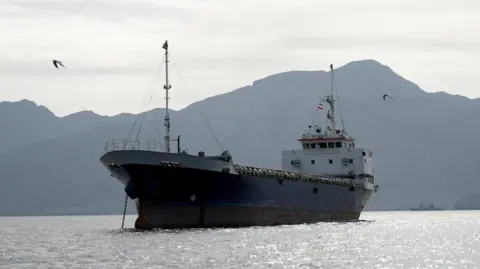
The strait, through which a fifth of the world’s energy shipments pass, has become a flashpoint of the conflict after Iran retaliated against US-Israeli strikes by threatening to attack vessels that try to use the waterway.
Shipments have largely been at a standstill since the US-Israel war with Iran started on 28 February, leading to energy prices surging around the world and pushing up costs for consumers, in particular making petrol and diesel more expensive.
However, Iran has continued to export oil.
Windward, the maritime intelligence firm, said that since 1 March more than 58 million barrels of oil have left Kharg Island, Iran’s main outlet for crude exports. It said more than 90% of these have been directed toward China.
On Sunday, Trump announced that “effective immediately”, the US Navy “will begin the process of BLOCKADING any and all Ships trying to enter, or leave, the Strait of Hormuz”.
US Central Command later said it would block all vessels entering and exiting Iranian ports and coastal areas in the Strait from 10:00 EST (15:00 BST) on Monday.
It said the blockade would not apply to ships transiting the Strait of Hormuz to and from non-Iranian ports.
Will the ceasefire hold?
Chua Yeow Hwee, an economist from Singapore’s Nanyang Technological University, said: “Oil prices are likely to remain elevated because expectations now depend on whether the blockade is fully implemented, whether shipping disruptions spread, and whether diplomacy resumes.”
Analyst Saul Kavonic from financial services firm MST Marquee told the BBC “oil prices are not as high as they normally would be” given the scale of disruption to supplies because traders still hope shipments will resume soon,”
“But if that doesn’t happen, oil prices will head higher,” Kavonic added.
There is also the question of whether the two-week ceasefire will hold, according to Marcus Baker, global head of marine and cargo at risk insurance firm Marsh.
Iranian parliamentary speaker Mohammad Bagher Ghalibaf, who led negotiations for Tehran in Pakistan at the weekend, says the country “will not submit to any threat,” in a statement carried by local media.
Iran’s Islamic Revolutionary Guard Corps (IRGC) Naval Forces said that any military vessels that approach the strait will be considered to be violating the ceasefire between Washington and Tehran and “dealt with severely”.
Baker said: “Will the Iranians decide that actually, despite what the US has said, they will continue to honour the ceasefire?
“Clearly, if that happens we will get much more confidence coming back into the market and I think the durability of that ceasefire is really critical to what happens next.”
Major stock indexes in Asia slipped on Monday, with the Nikkei 225 in Japan 0.7% lower and South Korea’s Kospi down by 1%.
Countries in Asia have been hit especially hard by the fallout of the Iran war as they are heavily reliant on oil from the Middle East.