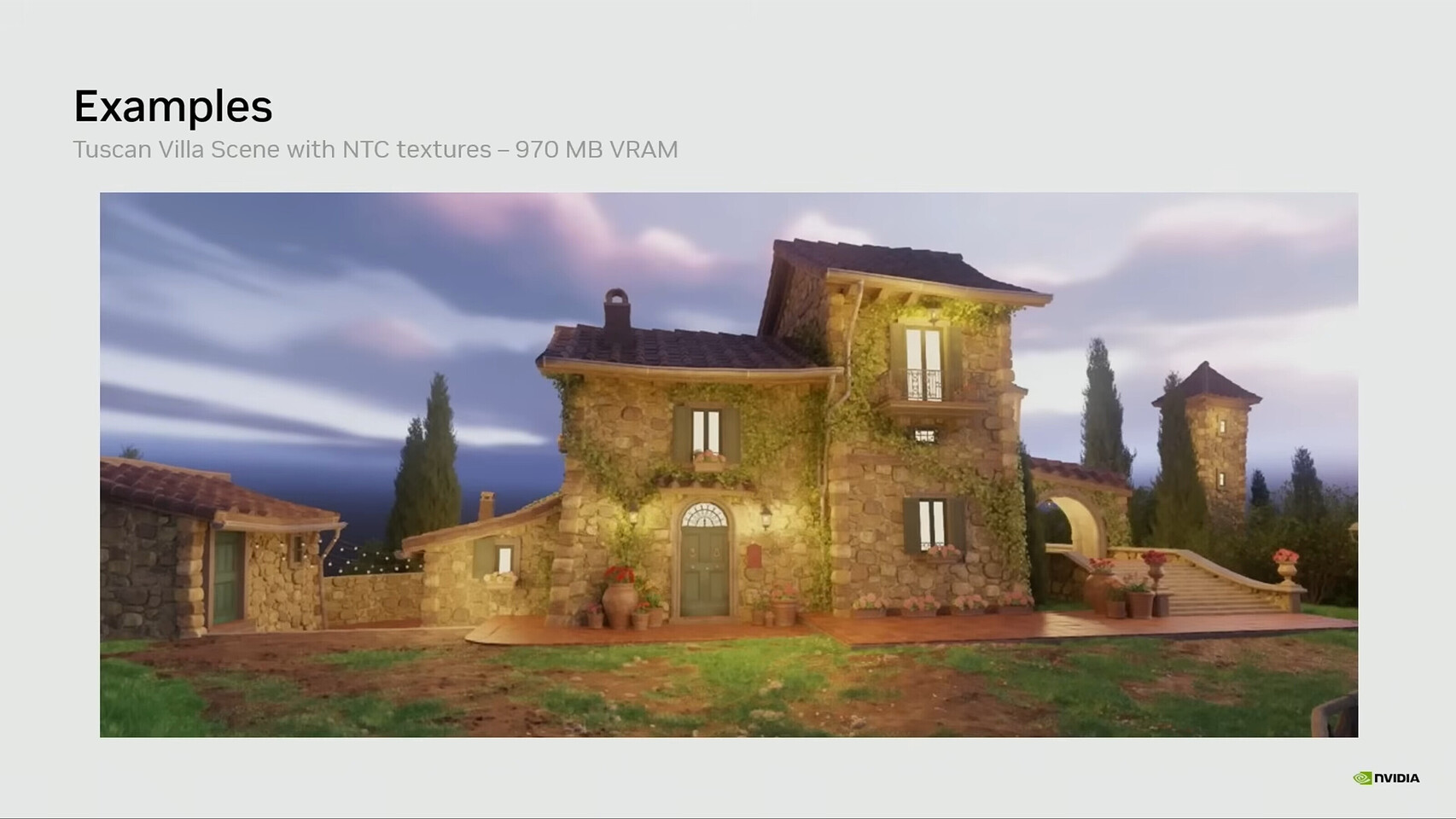
NVIDIA has released more details about its Neural Texture Compression (NTC) technology, which significantly reduces GPU VRAM usage by up to seven times. In a technology demo presented during one of the GTC 2026 sessions, NVIDIA revealed that its Neural Texture Compression can reduce VRAM usage from 6.5 GB to just 970 MB in certain scenes. This was demonstrated in a video comparing a Tuscan Villa and its interior. With virtually no difference in texture appearance, Neural Texture Compression represents a major advancement in maintaining graphics fidelity while freeing up GPU memory for more game content. For instance, in both the exterior of the Tuscan Villa and the interior demo showcasing detailed tableware, NTC technology provides users with high-quality textures while maintaining excellent material quality.
NTC technology is an AI-driven texture output that allows games to feature high-quality complex materials without a performance penalty. Games can benefit from the substantial VRAM reduction that NTC offers while maintaining the same texture quality. Traditionally, games use block-compressed formats like BCn, such as BC5, BC6, or BC7, which are commonly applied in 4×4 pixel formats and rendered by the GPU. However, NVIDIA has trained small neural networks that can produce the desired pixel format and texture appearance at a fraction of the size of traditional texture compression formats. Instead of using gigabytes of VRAM for textures, NTC drastically reduces VRAM usage by emulating textures, allowing for either much lower VRAM consumption or significantly enhanced material appearance, depending on the game developer’s goals. This enables games to incorporate much more complex scenery without any performance penalty, relying on NVIDIA’s AI technology to handle the workload. Below is the demonstration of Tuscan Villa, which shows just how the scene looks.


If we take a look at the interior showcasing the tableware, you can see how NVIDIA’s NTC actually pulls ahead of downscaled BCn textures to give a much better result, operating in the same 970 MB VRAM capacity.


Neural Texture Compression works by training a neural network to understand what a Texel, the base pixel of a texture map, looks like on a specific material. NVIDIA has trained these neural networks for nearly every game material, making them ready for real-world game deployment. This process is so refined that the output can either provide a more realistic version on top of the base texture layer that the game uses or maintain the same texture appearance for significant VRAM savings. For a full technical explanation and a look at what Neural Texture Compression does behind the scenes, you can watch the in-depth YouTube video about the technology.