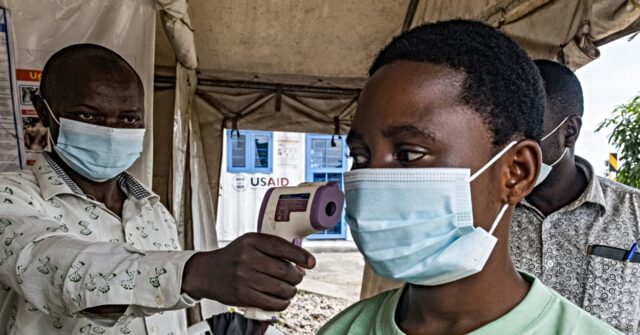
As the world watches the Ebola outbreak which has claimed 131 lives in the Democratic Republic of Congo, a World Health Organization (W.H.O). representative warned Tuesday the deadly malady may be disseminating faster than first thought.
W.H.O. representative Dr Anne Ancia told the BBC the more the agency investigates, the clearer it becomes that cases have spread to other areas at a scale and speed not previously predicted..
Officials said more than 513 cases were suspected in DR Congo as of Tuesday, while one person has died in neighbouring Uganda.
The emergence of cases in urban areas, the deaths of healthcare workers, significant population movement in the area and a lack of vaccines and therapeutics are the main cited reasons for growing fears, AP reports.
The warning comes after W.H.O. chief Tedros Adhanom Ghebreyesus declared the outbreak a global emergency last week and said he was “deeply concerned about the scale and speed of the epidemic,” as Breitbart News reported.
But modelling by the London-based MRC Centre for Global Infectious Disease Analysis as reported by the BBC suggested there had been “substantial” under-detection, and it could not rule out there had already been more than 1,000 cases.
There is no vaccine for the strain of Ebola virus fuelling the latest rise in cases, but the WHO is evaluating whether other drugs may provide protection.
Speaking to BBC World Service Newsday, Ancia said DR Congo’s Ituri province, the epicentre of the outbreak, is a “very unsecured area with lots of movement of population”, making it difficult for the agency to investigate and help control the disease.
She continued: “The more we are investigating this outbreak, the more we realise that it has already disseminated at least a little bit across border and also in other provinces.”
The outbreak has spread to the province of South Kivu, where the population has been affected by a humanitarian crisis for many years, she added in her BBC interview
Neighboring Uganda is also reporting cases.
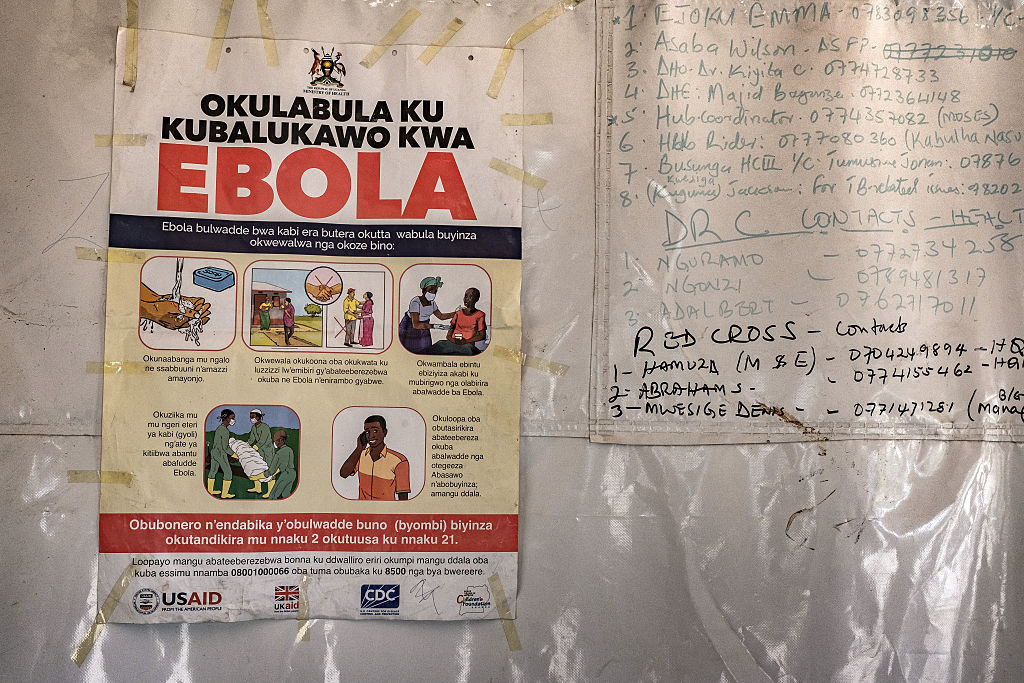
A poster displaying Ebola emergency contact numbers is pinned to a tent at the Busunga border crossing between Uganda and the Democratic Republic of Congo in Bundibugyo, on May 18, 2026. (Badru Katumba / AFP via Getty Images)
Ebola is highly contagious and can be contracted via bodily fluids such as vomit, blood or semen. The disease it causes is rare, but severe and often fatal.
Between 2014 and 2016, more than 28,600 people were infected by Ebola in West Africa, the largest outbreak of the virus since its discovery in 1976.
The W.H.O.’s recent emergency declaration is meant to spur donor agencies and countries into action while ensuring funding flows for the Geneva, Switzerland-based organization.