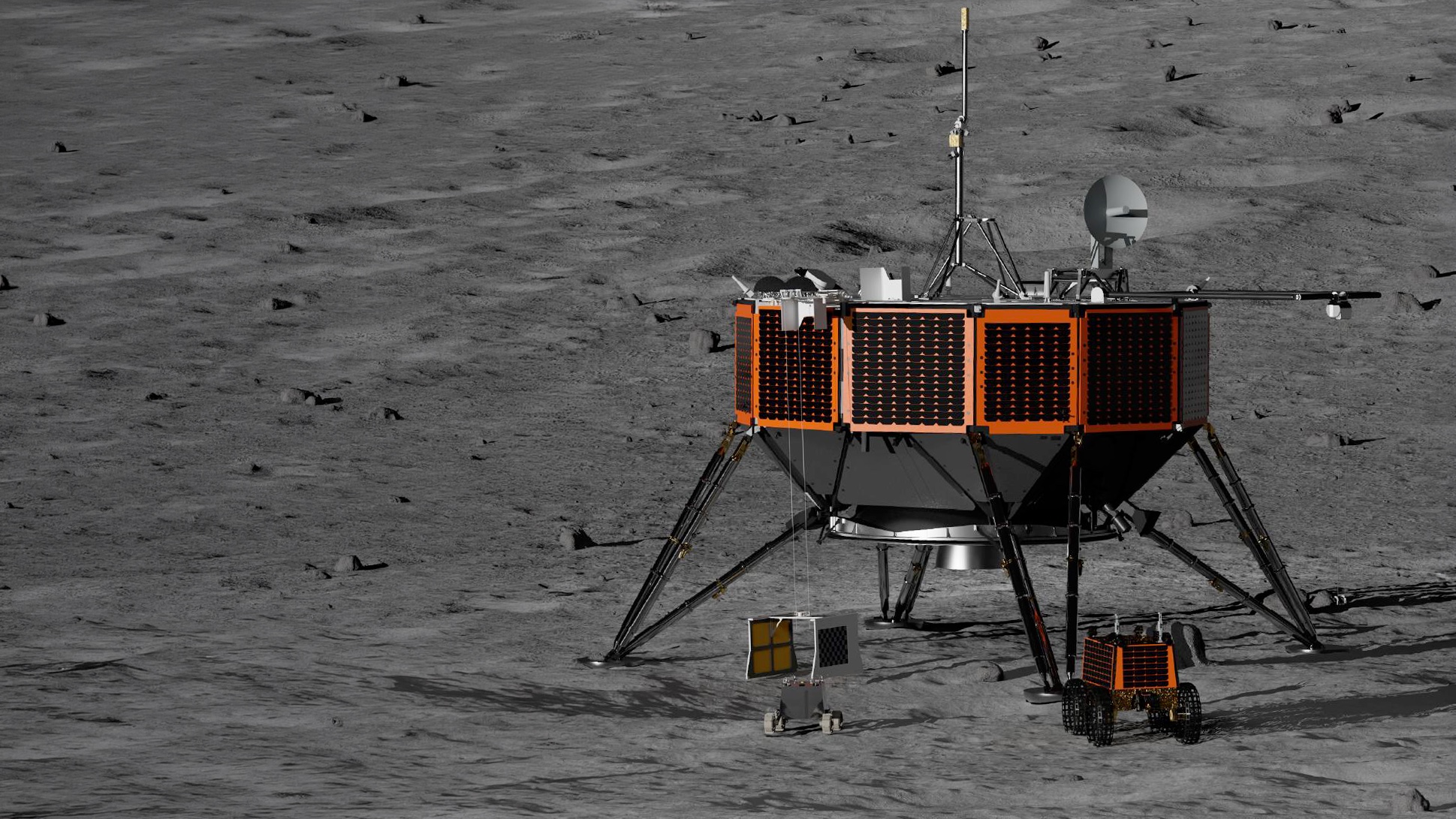
WASHINGTON — NASA is planning to increase the total value of a contract for robotic lunar lander missions to support a proposed surge in flights for the agency’s moon base plans.
In an April 27 procurement filing, NASA said it was planning to increase the maximum value of its Commercial Lunar Payload Services (CLPS) contract from $2.6 billion to $4.2 billion.
The CLPS contract includes 13 companies that are eligible to compete for task orders for specific missions. The current CLPS contract expires in 2028, with planning underway for a follow-on contract, called CLPS 2.0.
NASA has awarded task orders whose combined value is less than $2 billion to date, and with the recent pace of about two task orders a year, would have only come close to the contract ceiling in 2028. The large increase, though, suggests NASA is planning to award more missions or more valuable missions over the next two years.
Asked about the filing during an April 29 panel session at the Lunar Surface Innovation Consortium spring meeting, Joel Kearns, deputy associate administrator for exploration in NASA’s Science Mission Directorate, said he was not familiar with the document but that the agency expected to buy more CLPS missions.
“We’re looking into opportunities to buy into that ramp of demand for the very short term even as we work on issuing the CLPS 2.0 contract competition,” he said. “We have to start ramping now into this higher cadence, with a target of monthly landings, to bring some of the things to the surface very, very soon for Moon Base.”
At NASA’s “Ignition” event March 24, the agency outlined plans to develop a lunar base, simply called Moon Base, and with it a sharp increase in the number of robotic lunar landings. That included nine landings in 2027 and 10 in 2028.
That would be a sharp increase from current flight rates under the CLPS program. There were two lander missions in 2025, one by Firefly Aerospace and the other by Intuitive Machines. NASA is projecting up to four lander missions in 2026, by Astrobotic, Blue Origin, Firefly Aerospace and Intuitive Machines, although the charts shown at the Ignition event showed only two landings projected for the year.
That sharp increase has generated skepticism about NASA’s plans within industry, given recent flight rates and the time needed to develop a lander. NASA announced at Ignition a new CLPS award to Intuitive Machines, called IM-5, but that mission is not projected to launch until 2030.
Representatives of CLPS companies said on the panel that they can increase lander production but did not explicitly commit to the production rates needed to meet NASA’s projections.
“We’ve heard the call. We know this is NASA’s initiative, and we want to do more and more,” said Farah Zuberi, director of spacecraft mission management at Firefly. She noted her company now has three landers in production — Blue Ghosts 2, 3 and 4 — and has added new clean room space to support up to eight spacecraft at a time.
“There’s a lot of creative solutions that we can come up with,” she said. “Having that signal is really important. We know that this is coming. We can set ourselves up for success.”
Blue Origin is finishing testing of its first Blue Moon Mark 1 lander, called Endurance, at its Florida factory after performing thermal vacuum tests at Johnson Space Center, said Eddie Seyffert, director of civil space at the company. It is also manufacturing components for the second Mark 1 lander, which the company plans to use for NASA’s VIPER rover in 2027.
That work is done at Blue Origin’s Lunar Plant 1 factory, with 190,000 square feet of space “dedicated to making lunar landers to answer NASA’s call,” he said. “We’re excited about the challenge, and we want to show our stuff.”
Dan Hendrickson, vice president of business development at Astrobotic, said his company has already scaled up facilities to meet demand for its original CLPS mission. “We’ve got the basic DNA and roadmap” to meet higher demand, he said. “We’re starting from a place in which we have facilities that were intended to have multiple landers in development.”
One key issue is the supply chain for lander components, said Ben Bussey, chief scientist at Intuitive Machines. “The key, if you’re trying to ramp that up to multiple missions per year, is knowing you’ve got a supply chain that can do it in time, or bring things in-house,” he said.
He added that, on early CLPS missions, each lander was “slightly bespoke,” modified to meet the needs of its payloads. That’s less likely to be the case as flight rates increase. “I think you’ll see some form of standardization.”
“Going to build-to-print landers is maybe the response to the signal” from NASA’s Ignition plans, said Seyffert. “We’re going to build-to-print dozens of landers to help NASA achieve its goals.”